
Four Deputy Speakers elected, candidate of the Serb List rejected

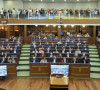
At the continuation of the constitutive session of the Kosovo Assembly, three deputy speakers proposed by the three largest parties have been elected so far: Albulena Haxhiu, nominated by Self-Determination, Vlora Çitaku, nominated by the PDK, and Kujtim Shala, nominated by the LDK. Of the two deputy speaker positions reserved for non-majority communities, one went to Emilija Redžepi, representing the Bosniak community. After Slavko Simic, nominated by the Serb List, failed three times to receive the necessary majority for the second deputy speaker post, a draw was held, which also failed to produce a result, leading to the suspension of the session.
During the voting for the three deputy speakers from the largest parties, Assembly Speaker Dimal Basha noted that 110 MPs were present in the chamber. The three were voted on “as a package” and received the support of 101 MPs, with none against, while the nine MPs from the Serb List abstained.
The Assembly then moved to the election of deputy speakers from non-majority communities.
MP Elbert Krasniqi proposed Emilija Redžepi as a candidate for deputy speaker from the non-Serb minority communities and requested that voting on her candidacy be conducted separately from the Serb candidate.
After him, Serb List MP Igor Simic, recalling that his party holds nine out of the 10 seats guaranteed for the Serb community, proposed Slavko Simic as deputy speaker.
Simic addressed the chamber in Serbian, which prompted protests from some MPs, though after a few minutes they put on headsets to listen to the translation.
Next, MP Nenad Rasic of the Party for Freedom, Justice and Survival nominated himself for the deputy speaker position from the Serb community.
“Never before have I nominated myself, but I am doing so now because in the past two mandates we have not been adequately represented in this highest chamber,” Rasic said, noting that this was in accordance with the Constitution.
Speaker Dimal Basha concluded that there was no consensus regarding the candidates from the Serb community and announced that separate votes would be held.
He then asked MPs to vote on Rexhepi’s candidacy, which received 73 votes in favor, one against, and 23 abstentions.
The Assembly then moved to vote on the deputy speaker from the Serb community. At that point, 108 MPs were present in the chamber.
However, Slavko Simic received only 10 votes in favor, 55 against, and 23 abstentions. Basha then invited the Serb List to nominate another candidate.
Igor Simic again nominated Slavko Simic on behalf of the Serb List.
In the second round, Simic again received 10 votes in favor, 56 against, and 21 abstentions.
For the third time, Basha invited the Serb List to propose a candidate, and once more Igor Simic put forward Slavko Simic.
He argued that the Rules of Procedure had already been violated when it was decided to vote separately on candidates from non-majority communities, reminding MPs of their declarations about respecting the rule of law, and urging them to support Slavko Simic’s election.
For the third time, however, Simic received only 10 votes, while 56 were against and 21 abstained.
Igor Simic once again took the floor, stating that in strict adherence to the Rules of Procedure he was nominating the same candidate for a fourth time.
Basha responded by claiming that, according to a Constitutional Court ruling, a candidate for deputy speaker can only be voted on three times.
Simic retorted that Basha had no authority to interpret Constitutional Court decisions, pointing out that the provision on a maximum of three rounds of voting applied only to the election of the Speaker, not deputy speakers. Basha, however, insisted that the rule applied to both the Speaker and deputy speakers.
Despite this, Igor Simic stood by his position, once again nominating Slavko Simic, calling it a compromise proposal.
Basha then called for consultations with the parliamentary group leaders, after which he announced that in his view Slavko Simic could no longer be voted on, and that the candidate from the Serb community would be chosen by lot.
Following a short break, Basha announced that the Assembly would continue with the fourth agenda item—the election of a deputy speaker from the Serb community—and invited the Serb List MPs to participate in the draw.
Basha noted that the Serb List refused to participate, but that the draw would proceed in the presence of the secretary and one MP. He then announced that according to the draw, the first candidate was Serb List MP Verica Ceranic.
He stated that 94 MPs were present, meaning quorum was met, and called for a vote. However, Verica Ceranic did not receive a single vote, so another draw was held.
Ceranic’s name was drawn again, but this time she received 50 votes against, 20 abstentions, and none in favor.
The next candidate drawn was Stefan Kovacevic, but he too failed, with 48 votes against, 19 abstentions, and none in favor.
The following candidate was Serb List MP Ljiljana Stefanovic, who declined to be considered, and her name was eliminated.
Verica Ceranic was then drawn a third time, after which she also declared that she did not wish to be a candidate.
Finally, the draw produced Nenad Rasic of the Party for Freedom, Justice and Survival. Basha noted that 95 MPs were present, after which Rasic received 55 votes in favor, one against, and seven abstentions. The Serb List did not participate in the vote.
Basha reminded the chamber that 61 votes are required to elect a deputy speaker, and as this threshold was not met, the session was adjourned.
The next session was scheduled for Thursday at 11 a.m.

0 comments