
Gerapetritis: Serbia’s accession to the EU is a geopolitical inevitability
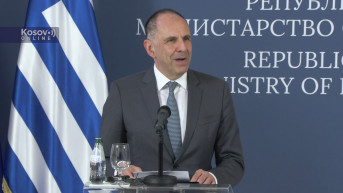
Greek Foreign Minister Giorgos Gerapetritis stated that Athens supports the Belgrade–Pristina dialogue conducted under the mediation of the European Union, emphasizing that Greece is one of the five EU countries that do not recognize Kosovo. According to him, the accession of Serbia, the largest country in the Western Balkans, to the European Union is a geopolitical inevitability.
In an interview with Politika, Gerapetritis said that, as foreign minister, ahead of Greece’s presidency of the Council of the European Union in the second half of 2027, his goal is to welcome one or more partners from the Western Balkans into the European family.
“I have already spoken with my colleagues and friends about ways in which Greece could substantially contribute to their European path, whether regarding fundamental issues of democracy and the rule of law, connectivity in all areas (transport, energy, data), or combating illegal migration. In this context, I would like to recall that Greece and Serbia signed an Agreement on Cooperation in September 2025 to accelerate Serbia’s accession path to the EU, providing for the sharing of our country’s expertise regarding the EU acquis,” said the head of Greek diplomacy, who yesterday met with Serbia’s president, prime minister, and foreign minister in Belgrade.
He stressed that the process based on the principle of individual merit will continue, but that, as he said, it must also be approached from a broader ideological and historical perspective in order to understand the value of the Western Balkans joining the EU.
“Greece’s position is completely clear. As I have stated before, the accession of Serbia, the largest country in the Western Balkans, to the European Union is a geopolitical inevitability. My visit to Belgrade, the first country I am visiting as part of my tour of the region, gives me the opportunity to once again express Greece’s full support for Serbia’s European path. We are obliged to recognize the efforts you have made and to contribute in practice to renewed momentum in your country’s accession process. At the same time, we call on the country to do even more to fully align itself with the European acquis, thereby sending a very strong and positive message to the Serbian people regarding their European vision,” Gerapetritis said.
He assessed that by accelerating reforms within the country, Serbia would also accelerate the processes bringing it closer to Europe, emphasizing that Greece stands by Serbia and supports its unwavering march toward the European Union.
According to him, Greece cooperates with Serbia guided by international law and the principles of the United Nations Charter.
“Greece is a member of the United Nations Security Council. Our commitment to international law and the fundamental principles of the UN Charter serves as our guiding compass. Guided by those principles, we cooperate with Serbia. It must be emphasized that Greece is one of the five European Union member states that do not recognize Kosovo’s unilateral declaration of independence. We support the dialogue between Belgrade and Pristina conducted under EU mediation, alongside Greece’s consistent policy of promoting the European integration of the Western Balkans,” the Greek foreign minister said.
He emphasized that Greece and Serbia maintain long-standing historical, cultural, and religious ties forged over time, and that the two peoples are connected by exceptional bonds of friendship and mutual support.
He added that their shared path acquired a strategic dimension through the Joint Declaration signed in Athens in December 2019 within the framework of the High Cooperation Council between Greece and Serbia.
“At the same time, we emphasize our determination to continuously nurture, expand, and deepen our cooperation. The Memorandum of Understanding on Cooperation between Greece and Serbia, which I signed with my colleague and dear friend Marko Djuric in Athens in December 2024, is precisely an indication of this mutual will across all fields,” Gerapetritis said.
He particularly highlighted economic and trade relations, on whose further development work is ongoing, and congratulated Serbia on hosting the highly significant Expo 2027 International Exhibition, which will be held in Southeast Europe for the first time.
“It is a candidacy that Athens wholeheartedly supported. We are ready to assist in any way requested, and we sincerely wish you great success,” the Greek minister said.
He noted that cooperation between Greece and Serbia is expanding into energy security and the diversification of energy sources, stressing that Greece serves as the main southern energy gateway and hub for supplying the Western Balkans and the wider Southeast European region, contributing to diversified energy sources for countries in the area, including Serbia, and reducing dependence on individual suppliers.
“Serbia’s role is equally crucial in connecting the energy systems of our region with Central and Northern Europe along the south–north corridor. Serbia’s energy diversification policies provide an opportunity to establish a solid foundation for stronger cooperation with Greece in the field of natural gas, particularly through gas interconnections with Bulgaria and North Macedonia,” Gerapetritis said.
According to him, cooperation could extend beyond natural gas to include renewable energy sources, electricity market integration, and future-oriented technologies such as hydrogen.
“Cooperation between our countries in the energy sector, both bilaterally and regionally, is at its highest point, as demonstrated by the four-party meeting of energy ministers, officials, and energy system operators from Serbia, Greece, North Macedonia, and Bulgaria, held in Athens on May 15,” Gerapetritis said.
He pointed out that Greece lies at the crossroads of three continents and has served since ancient times as a meeting point of cultures and civilizations. He added that Greece is fully committed to preserving the rules-based international order and has developed a consistent foreign policy strategy whose main diplomatic motto is building bridges.
According to him, Greece maintains a strategic relationship with Israel in the Middle East while also enjoying very close ties with the Arab world.
“Greece is not only their gateway to Europe but, more importantly, their most reliable ally in the wider region. On the other hand, we have not shied away from responsibility: we are leading the ‘Aspides’ operation to safeguard freedom of navigation in the Red Sea. We have undertaken a series of initiatives to highlight Greece’s importance as a highly sincere interlocutor and as a leading force in the region. For example, the recently adopted Delphi Declaration reflects our commitment to the European path and provides fresh momentum and vision for the peoples of the Western Balkans. We have elevated Greece into an energy hub in Southeast Europe and are currently working not only on energy interconnections but also on connecting trade, data, people, and communications,” Gerapetritis said.
He added that, as an elected member of the United Nations Security Council during these turbulent times, Greece has a tremendous opportunity to further expand its diplomatic footprint as a pillar of peace and stability in the region.
“The current geopolitical instability in our wider region is clearly a cause for additional concern regarding a possible increase in migration flows. Nevertheless, we must keep in mind that illegal migration is both a European and an international challenge and cannot be managed solely at the level of a single country. Greece addresses this issue by implementing a fair policy in strict compliance with domestic and EU law, but it should be clear that a fair policy does not mean open borders or the absence of borders. To that end, Greece is working to reduce migration flows from Libya by encouraging cooperation with both parts of the country,” Gerapetritis said.

0 comments