
Gërvalla: Local elections are an opportunity for Serbs to elect their representatives without fear or pressure
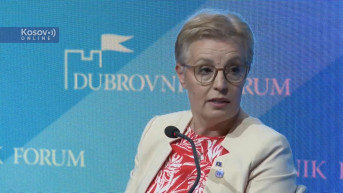
Kosovo’s caretaker Minister of Foreign Affairs, Donika Gërvalla, stated today at the Dubrovnik Forum that she hopes Serbs in Kosovo will use the upcoming local elections in October to elect people who, as she put it, are not oriented toward Belgrade but toward their own needs.
Speaking on the panel "The Western Balkans and the Euro-Atlantic Path," Gërvalla was asked about assessments that the Kosovo government has been criticized by friendly countries for uncoordinated actions toward the Serbian community. She responded that Serbs in Kosovo have never in the past 20 years been in a better position to make decisions about their own future, instead of having them made from the outside.
She stated that Kosovo's authorities have "defeated criminal structures" and that now is the time for "a broader dialogue with Kosovo Serb citizens."
"We are their government; we are not just the government of Albanians, Bosniaks, Turks, and others. The rule of law has no alternative," Gërvalla emphasized.
She noted that in the past three years, the number of citizens who trust the rule of law in Kosovo has significantly increased, and that perceptions in the north have changed as a result.
"We must prepare well for the local elections. They are an opportunity for Serbian citizens in the four northern municipalities to freely elect their representatives without fear or intimidation. I hope they will take this chance to be better represented—by people who will focus not on Belgrade but on their own needs," Gërvalla stressed.
She called on those interested in the region to talk not only to those "who are the loudest in the media," but also to ordinary people, to hear how reality in the north has changed.
"We have no tolerance for anyone—be they Albanian, Serb, or anyone else—who has committed a criminal offense or is involved in organized crime. Our institutions will arrest anyone who does not respect the laws of our country. I think that’s no different from other countries. We are deeply committed to the fight against organized crime. There can be no compromise with crime," the minister underlined.
She said this fight has brought significant change to the lives of citizens.
Gërvalla also acknowledged that she is not satisfied with all results, and more needs to be done in the areas of education and healthcare, but emphasized that the situation in the north has changed irreversibly.
"They are no longer victims of daily terror by organized crime and people who threatened and punished them for wanting to integrate into Kosovan society," she explained.
She noted that the global situation has changed significantly since her first participation in the Dubrovnik Forum in 2021.
"Back then we were talking about COVID and its consequences. Now we are in the third year of war in Ukraine, with a completely changed view of security on our continent. When we speak about Euro-Atlantic integration, it’s important to talk about trust and also the reasons behind the questions and challenges Kosovo faces on that path," she said.
Gërvalla said she had just come from Srebrenica, where she joined acting Prime Minister Albin Kurti to pay respects to the victims of events from 30 years ago—an example, she said, of something that the civilized world must not tolerate or allow to happen again.
She remarked that Ukraine demonstrates that lessons from the Balkan wars have not been learned.
She criticized the fact that, during the Srebrenica commemoration, hardly any of the dozens of speakers spoke about the perpetrators of the crimes.
"In contrast, I was also at Auschwitz for the 80th anniversary of its liberation, where the perpetrators were indeed mentioned. Germany holds a commemorative session every year in the Bundestag to remember those crimes and acknowledge its own responsibility. I wouldn’t bring this up if it didn’t define today’s reality in Kosovo and the Balkans," she said.
Gërvalla stated that the Western Balkans must continue reforms, but also that the EU must be ready to admit the region into membership.
"My sense—after talking to many colleagues—is that there is a desire and understanding that the Western Balkans should join the EU. But without EU reform, there’s no real prospect for regional countries to become members," she said, adding that Kosovo has no alternative to EU and NATO membership.
"It’s becoming increasingly clear that NATO membership will come sooner and will be more important than waiting for EU reforms and key steps the Union must take regarding enlargement," she explained.
Gërvalla said it is essential that more EU countries understand the importance of focusing on security, especially with a war raging on the continent.
"The war in Ukraine is a war against Europe, and Europe must be ready to defend itself," Gërvalla concluded.
Grlic Radman: For Croatia, the stability of the Western Balkans is a matter of national interest
Croatian Minister of Foreign and European Affairs Gordan Grlic Radman emphasized that for his country, as a member of the EU and NATO, the stability and functionality of the Western Balkans are of vital importance.
"This is in our national interest," Grlic Radman underlined.
He added that this responsibility does not lie solely with Croatia but also requires the active engagement of neighboring countries to promote regional stability and good neighborly relations—something that should be a priority for EU candidate countries.
He recalled that Croatia’s foreign policy priority after the war and international recognition of its independence was precisely NATO and EU membership. He added that during the accession process, Croatia worked hard not only to meet the established criteria but also to set new standards along the way.
"The process wasn’t easy, but at the end, we were very satisfied and carried out reforms in the interest of our citizens. Hard work pays off," Grlic Radman said, expressing support for the region's countries on their EU path.
He noted that Croatia has supported Montenegro’s EU path from the very beginning, as well as that of Albania and North Macedonia.
Regarding Serbia, the Croatian minister acknowledged the countries’ complicated history but expressed willingness to resolve outstanding issues, which he said are not only bilateral.
Speaking about Bosnia and Herzegovina, he stated that Croats are a constituent people in the country and emphasized that a functional Bosnia and Herzegovina is only possible if all three constituent peoples—and others—enjoy equal rights, in line with the Dayton Agreement.
"Kosovo, though I mention it last, is by no means the least important—it is very important to Croatia. Our position has been clear from the beginning—we were one of the first countries to recognize Kosovo, and we want to see it as a member of international organizations. Croatia is a vocal advocate for Kosovo’s European integration and its membership in the Council of Europe," Grlic Radman said.
Asked about the Declaration on Military Cooperation between Croatia, Albania, and Kosovo, Grlic Radman replied that he sees nothing controversial about it.
"Albania and Croatia are NATO members, they share the values of the Alliance, which we want to promote with Kosovo as well. This promotes cooperation, and I don’t see how it could be questionable. The declaration is open to others in the region," he added.
Tonino Picula: Montenegro remains ambitious, but Albania may surpass it
European Parliament rapporteur for Serbia, Tonino Picula—who previously dealt with Montenegro—stated that although Montenegro has long held a leading position in the accession process, Albania should not be underestimated in its potential to overtake it.
He emphasized that candidate countries do not compete with each other on the EU path, but rather with themselves, as they must overcome numerous obstacles and carry out difficult reforms.
Montenegro, he added, is highly ambitious in its goal to close seven chapters by the end of this year and complete accession negotiations by the end of next year.
Picula noted that since the 2020 elections, internal issues have slowed Montenegro’s progress toward EU membership.
He warned that Montenegro must be cautious of certain negative external influences that could jeopardize its path to the EU.
He also called on Brussels not to ignore developments in the Balkans or allow a vacuum to emerge that could be filled by others.
Amer Kapetanovic: Growth in the region is too slow to catch up with the EU
Amer Kapetanovic, Secretary General of the Regional Cooperation Council, pointed out that while the region has made progress in cooperation, it still faces many challenges.
He noted that ten years ago, the GDP of the Western Balkans was 25% of the EU average, while today it stands at 38%.
However, he warned that with annual growth of only 1–2%, the region will need 60 years to catch up with the EU. Therefore, he emphasized, the goal must be to achieve higher economic growth through stronger cooperation.
According to him, the main issues are slow implementation and still unresolved bilateral disputes.
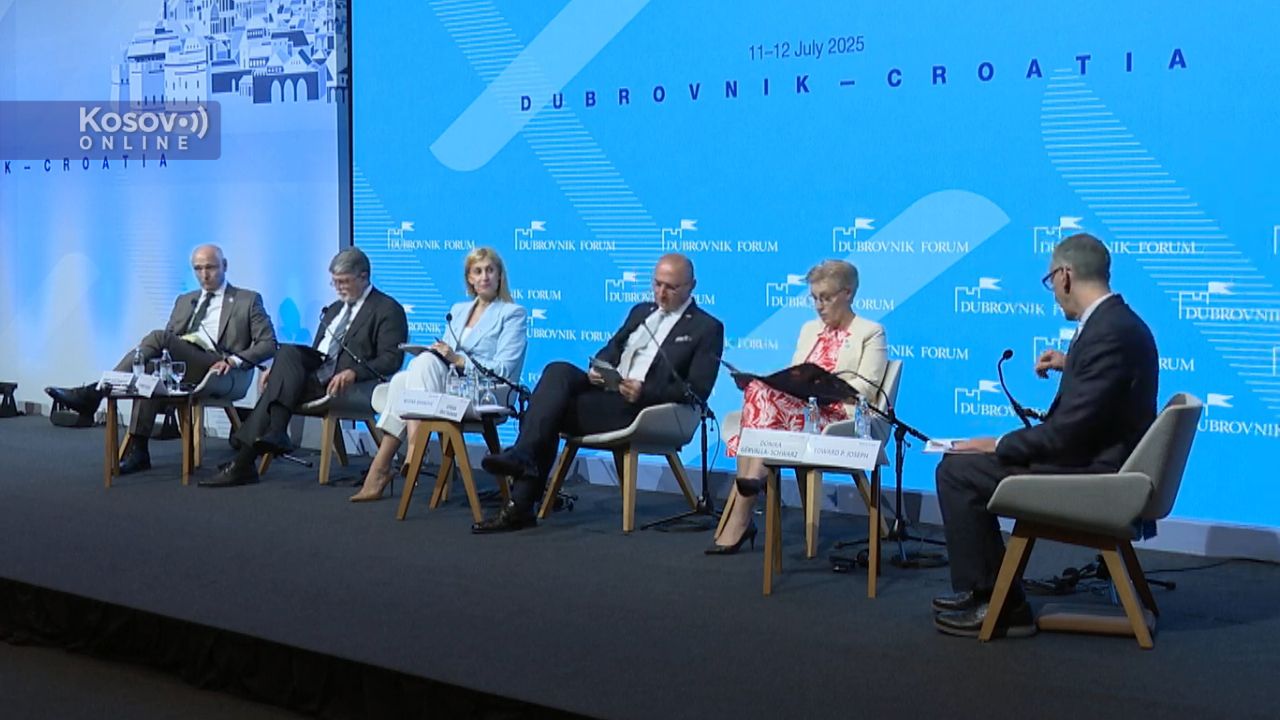
This year’s 18th edition of the Dubrovnik Forum is held under the slogan “Navigating the Future: Managing Change.”
It focuses on global shifts and challenges in an era of growing instability, with over 400 participants from around the world, including numerous foreign ministers and representatives of international organizations.


comments