
Gerxhaliu on Serbian goods import ban: Citizens suffer in political experiment over the economy
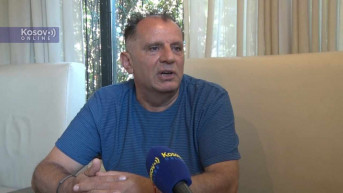
Former President of the Chamber of Commerce of Kosovo and economic expert, Safet Gerxhaliu, said for Kosovo Online that any barrier, tax, or blockade did not favor the development and promotion of Kosovo, which aimed for Europe, and that an urgent solution must be found for the current state and blockade of Serbian products, as the whole situation affected consumers the most.
Gerxhaliu emphasizes that the biggest problem in the Balkans is the inability to discuss pure economic processes without political implications, and he adds that this political aspect "slows down all the progress made in the past few years."
"Can you imagine that from 1999 to today, we've had over 72 or 73 various regional initiatives, and all of these initiatives have, in some way, either failed or not yielded the expected results. In that context, I believe the goal of all these agreements and initiatives was to eliminate barriers, to have free passage of goods, services, and capital," Gerxhaliu said.
In contrast to these initiatives, a blockade on importing products from Serbia has been in place in Kosovo for nearly two months. Serbian goods are scarce on the shelves, and some products have been replaced with others that are considerably more expensive.
"It's true that trade is like water and that products can be replaced, but we have to consider transportation costs. Transporting one truckload of goods from Serbia is only 500 euros; the same goods can be found anywhere, in Germany, Austria, the Netherlands, etc., but the transport costs around 4,000 euros, and who will cover that cost? Certainly, the citizens of Kosovo. Will 'Made in Kosovo' products be competitive in the global market? Certainly not. Therefore, I think rationality is needed here, analyzing this without emotions, and the sooner we work more for the economy, the better perspective we'll have, not only for us in Kosovo but also for the Western Balkans, which aspires to be a part of the European Union one day," Gerxhaliu believes.
He claims that those who suffer the most are the consumers in Kosovo.
"It's true that these goods can be replaced, and alternatives can be found, but the issue is that Kosovo consumers are most affected, and no one is paying attention to that. Therefore, dialogue has no alternative; we must find a solution as soon as possible because, in this way, it's always a citizen of Kosovo who is affected," Gerxhaliu emphasized.
He believes that a compromise solution needs to be found for the current state and that the entire situation needs to be analyzed from various dimensions - political, economic, social, cultural...
"While reasonable people build bridges, we're tearing down those bridges and building walls, and when we build walls, it's called isolation, which doesn't benefit anyone," Gerxhaliu said.
Gerxhaliu stresses that regional cooperation has no alternative and that the Berlin Process is the path to follow.
"You know that besides the pandemic in 2020, there was the Berlin Process, where three significant agreements were signed. The first was the so-called 'green agenda,' the second was the 'regional common market,' and the third is exactly what's happening today: the 'freedom of movement of goods, services, capital, and property.' Therefore, neither Kosovo, Serbia, nor the whole Balkans suffer from the absence of agreements, but there are problems with the fulfillment and implementation of these agreements. We need to direct more energy toward how to implement all this or turn it into reality, rather than just looking for reasons for failure," Gerxhaliu stated.
He points out that billions invested in infrastructure will lead nowhere if there's no freedom of movement.
"In this context, we must be smarter, and intensify dialogue, because if even major donors see unity and shared interests between us, they'll certainly support us in that. In this way, we're losing, we're losing donors, instead of building infrastructure that could serve as a model for Europe and beyond, we're somewhat regressing in that context," Gerxhaliu said.
When asked by Kosovo Online how similar the current situation is to that of 2018, when then-Kosovo Prime Minister Ramush Haradinaj imposed a 100% tax on goods from Serbia, Gerxhaliu emphasizes that there's a significant political difference, but the consequences from that period are still being felt today.
"Any barrier, any tax, or any blockade does not favor the development and promotion of Kosovo as a state aiming for Europe and with an economy that's a priority. Therefore, back then (during Haradinaj's rule), I was against it, logically. The consequences are still felt today. Politically, there's a big difference now that Kurti has the majority, and that majority is built on three so-called pillars: the first is the dilettantism within Kosovo, the second is exploiting emigration or the diaspora, mainly those living abroad, and third, I'm afraid he's exploiting Islamic fundamentalism. And in that context, from the temporal dimension, these are different positions. Regardless, I think anyone losing in all of this is Kosovo's image, the potential for major investors is lost, and the worst part is that Kosovo consumers are affected. In this whole political experiment on the economy, those who live on minimal earnings are the ones suffering," Gerxhaliu concluded.



0 comments