
Grubjesic: The most important condition for Kosovo's membership in the Council of Europe is the formation of the CSM
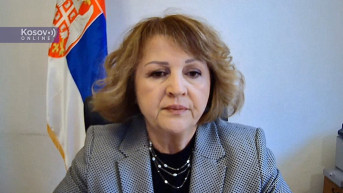
The enforcement of the court decision to return land to the Visoki Decani Monastery, which has been awaited for eight years, certainly cannot be the main or sole condition for Kosovo to become a member of the Council of Europe. The most important condition is the formation of the Community of Serb Municipalities, Suzana Grubjesic, Serbia's Ambassador to the Council of Europe, told Kosovo Online.
Kosovo Prime Minister Albin Kurti announced three days ago that the government had instructed the Kosovo Cadastral Agency to implement the Constitutional Court's decision from 2016 regarding the land of the Visoki Decani Monastery, and the next day an extraordinary meeting of the Political Committee of the Parliamentary Assembly of the Council of Europe was scheduled for March 27, where the rapporteur's opinion on Kosovo's accession to the Council of Europe by Dora Bakoyannis will be voted on.
Regarding this, Grubjesic says for our portal that there has been a lot of noise about the fact that after eight years, a court decision to return 24 hectares of land to the Visoki Decani Monastery has been enforced, but that this is only one of the three conditions that Bakoyannis included in her report.
"The most important condition is the formation of the Community of Serb Municipalities, not only for Kosovo's membership in the Council of Europe but also in general because it is an international obligation of Kosovo stemming from the First Brussels Agreement on the normalization of relations from April 2013. Gabriel Escobar also spoke about this during his visit to Kosovo. When asked whether the US, as clumsily stated, 'will lobby for Kosovo's admission to the Council of Europe,' he replied that it was about fulfilling the most important conditions, and that was the formation of the CSM," Grubjesic said.
As she explains, Bakoyannis' report states that Kosovo needs to fulfill three conditions – regarding the land of the Decani Monastery, the formation of the CSM, and expropriation in northern Kosovo, and she evaluates that it is "unbelievable that someone decided that returning land to the Decani Monastery would be sufficient for Kosovo's membership."
"There is only one item on the agenda of the extraordinary session of the Political Committee – a Statutory Opinion on the application for membership submitted on May 12, 2022, and the adoption of the preliminary draft opinion. It is expected that the Committee members will express their views on the report, and a two-thirds majority of the Committee members present is required to give a positive opinion. So, we are still talking only about an opinion. The opinion should also be given by the Assembly at its plenary session, but these are not bodies that decide in the Council of Europe, but it is the Committee of Ministers that will have its regular session in May," Grubjesic noted.
Officials in Pristina in the media specifically mention May as the month in which they expect Kosovo to become a member of the Council of Europe, and Grubjesic says that in the verbal note they submitted to the Secretariat of the Parliamentary Assembly of the Council of Europe, they wrote that the goal is to become a member in May.
"However, things are not so simple. There are no guarantees that it will be on the Committee of Ministers' agenda and that they will decide on it in May," Serbia's Ambassador to the Council of Europe said.
When asked if the expectation of officials in Pristina for Kosovo to become a member of the Council of Europe in May implies that they will form the CSM by then, since that is one of the three conditions, Grubjesic says that it is not realistic.
"After 11 years since the Brussels Agreement, expecting the CSM to be formed in a month is not realistic. It is more realistic to expect, and it is also talked about, that the Committee of Ministers' session could be held after May. There are no exact dates mentioned, but there are absolutely no guarantees that Kosovo's membership in the Council of Europe will be on the agenda of the next Committee of Ministers' session. As we can see, the official dialogue between Belgrade and Pristina under the auspices of the EU and with the support of the US does not give any reasons for the optimism of the Kosovo authorities to claim with certainty that they will easily become a member of the Council of Europe," Grubjesic says.
Although most Council of Europe member states have recognized Kosovo, the Ambassador notes that members of the Parliamentary Assembly of the Council of Europe are not obliged to follow the position of the country they come from, but she also points out that a two-thirds majority of present members can be easily achieved. When the Parliamentary Assembly of the Council of Europe expresses its opinion on Kosovo's request, that opinion will be forwarded to the Committee of Ministers.
Grubjesic reminds that Kosovo had the necessary two-thirds majority for starting the procedure in the Committee of Ministers on April 24 last year. At that time, 33 out of 46 Council of Europe member states voted "for," seven were against, and five abstained.
"We are not sure if the numbers will remain the same. We have no indications that any of the countries that did not vote then will change their stance, I mean the seven that were against, including Serbia, and the five that abstained. So, a two-thirds majority out of 46 is 31, and Kosovo had 33 votes last year. That's why their goal is membership in the Council of Europe, because here, consensus is not required for membership, although all previous members were admitted by consensus, there were no opponents or abstainers. If Kosovo were to be admitted by a two-thirds majority, it would be a political precedent. This means that the organization would be fundamentally divided," Grubjesic points out.

0 comments