
Hasani: Rasic cannot be proposed as Deputy Speaker on behalf of the Serbian community, it is unconstitutional
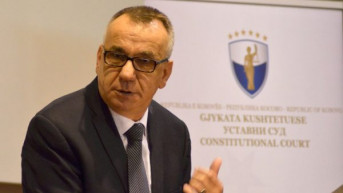
Former President of the Constitutional Court Enver Hasani stated that what happened today in the Assembly of Kosovo regarding the election of the Deputy Speaker from the non-majority community is completely contrary to the Constitution of Kosovo. Hasani stressed that the majority community cannot be asked about the constitutional rights of non-majority communities, Gazeta Blic reports.
In an interview with Nacionale, Hasani said that MP Nenad Rasic does not have the right and cannot be nominated as Deputy Speaker of the Kosovo Assembly on behalf of the Serbian community.
According to him, only the parliamentary group of Serbs in the Kosovo Assembly can make such a proposal, Gazeta Blic reports.
“What we saw today is completely contrary to the Constitution of Kosovo, both in letter and in spirit. The constitutional provisions are clear, as they were for the Speaker of the Kosovo Assembly, and give absolute priority to the proposal of the majority of MPs from the non-Albanian communities for the election of a candidate for Deputy Speaker of the Assembly. They do not represent political ideology there, but the rights and interests of their community, protected under Chapter III of the Constitution of Kosovo and its provisions on non-discrimination on any grounds,” Hasani said.
He explained that these provisions are divided into three parts: the first concerns the Speaker of the Assembly and his powers, clearly defined in the Constitution; the second concerns the Deputy Speakers from the Albanian community; and, finally, the third concerns the Deputy Speakers from the non-Albanian communities.
“It is precisely these latter provisions that clearly stipulate that the vote for Deputy Speakers from the non-Albanian communities must be conducted as a package, as has always been the case in parliamentary practice, without any exception. Drawing lots is applied only when the non-majority communities themselves fail to reach an agreement on their representative. This procedure applies only to non-Albanian and non-Serb communities. The Speaker of the Assembly cannot carry out the draw unilaterally and arbitrarily, as happened today,” Hasani emphasized.
According to him, Rasic has no right to be proposed, either under the Constitution of Kosovo or under the Assembly’s Rules of Procedure.
“The vote must be conducted by the majority of the Serbian community, as clearly defined by the Constitution and the Rules of Procedure of the Assembly. The Rules of Procedure are the only bylaw fully regulated by the Constitution of Kosovo and serve as the measuring parameter for assessing the constitutionality of Assembly acts if they end up before the Constitutional Court,” he added.
Hasani reminded that in terms of its spirit, the Constitution of Kosovo is based on a consociational democracy derived from the Ahtisaari Plan.
“On this basis, Kosovo’s independence was declared. This form of democracy means, in short, that the majority community cannot outvote or discriminate against the non-Albanian minority communities. This applies to all branches of government – legislative, executive, and judicial – including the Constitutional Court. In all these institutions, there must be adequate representation of non-majority communities. The majority community cannot be asked and cannot decide on the constitutional rights of non-majority communities,” he said.
According to him, the Speaker of the Kosovo Assembly, which is still unconvened, has no right to interpret Constitutional Court rulings for the purpose of their implementation.
He only has this right concerning the Rules of Procedure of the Assembly, Hasani added, clarifying that even this right exists only after the Assembly has been constituted.
“As is known, the Assembly is considered constituted only when the Deputy Speakers have been elected. Therefore, from a legal-constitutional perspective, the situation does not change at all compared to the situation before Mr. Dimal Basha was elected Speaker of the Assembly,” he said.
Regarding the election of the Speaker, Hasani said that the conduct of the PDK was correct and in line with its public promise to vote for a candidate who is not part of Kurti’s executive branch.
“For citizens, this is good news. However, from a political perspective, such a move by PDK, without a political agreement, is problematic, as there is no guarantee that the Assembly will be constituted and that the deadlock will be broken, which is evident from the behavior of the unconstituted Speaker today,” Hasani said.
He added that PDK’s and the citizens’ calculation that electing the Speaker would automatically lead to the continuation of forming the executive branch has proven wrong.
Hasani noted that Albin Kurti and his Self-Determination party are deliberately delaying the constitution of the Assembly because Kurti does not want the institutions to be constituted – or rather, he wants to do so by sharing the blame with the opposition, directly connected to the Brussels Agreement and the Ohrid Annex.
“Kurti accepted the creation of Serbian political-territorial autonomy, which in the legal-technical sense, in these 2023 agreements he approved, is called self-management. This is a technical term used in Western culture as a common denominator for all types of autonomy. Alongside these agreements, he also accepted the EU draft statute, which is expected to go before the Constitutional Court immediately after the formation of the new government,” he said.
Hasani added that the Brussels and Ohrid agreements, together with the EU draft statute, constitute the essence of the material constitution that Kurti himself built.
“And he knows it. At the time he accepted them, he was not aware of their dimensions, but later he understood. These obligations, to Kosovo’s detriment, will have to be implemented without exception by the next government, whoever is in power. Therefore, Mr. Kurti, by behavior that sabotages the formation of new central institutions, is trying to share responsibility with the opposition, so that the blame does not fall solely on him. But this resistance has limits and will one day be broken, because there is no other way. At that point, Kosovo will no longer be debating whether autonomy will be implemented, but only how quickly it will be implemented,” Hasani said.
As an example, he cited the case of the Council of Europe.
“We missed the opportunity, even though we implemented the decision on returning land to the Decani Monastery, but we did so too late. The same will happen with the Brussels agreements and the Ohrid Annex on Serbian autonomy in Kosovo. Every resistance, every exclusion of Serbs from institutions, and every discriminatory non-integration only accelerates and legitimizes the establishment of autonomy. The question of establishing Serbian autonomy, under the obligations Mr. Kurti undertook in Brussels and Ohrid in 2023, is the main reason why Western allies and friends of Kosovo are not intervening in the process of forming institutions, as they once did,” he said.
Hasani added that the allies are only interested in sending the European draft statute of the CSM to the Constitutional Court and then implementing Serbian autonomy.
“They do not care who is in power, because they know that whoever comes to power will be forced to implement this international obligation of Kosovo. That is where Albin Kurti is in trouble – nowhere else,” Hasani concluded.


0 comments