
Healthcare workers in front of the Post Office in Gracanica: Our existence is threatened; patients especially affected
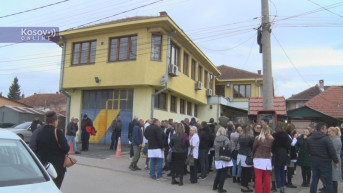
Healthcare workers from central Kosovo gathered today in front of the Post Office in Gracanica to express their discontent with the decision of the Central Bank of Kosovo to ban transactions in dinars and to convey their concerns for both their own and their patients' livelihoods, stating that they are in a much more difficult position.
Dr. Dalibor Stojanovic, a specialist in general medicine, stated that healthcare workers had gathered spontaneously today at the place where they used to receive their salaries in dinars until February 1st, in order to express a peaceful protest and dissatisfaction with the recent events in Kosovo.
"We used to receive our salaries in dinars here until February 1st, but with the decision of the Kosovo authorities, we are now forced to go, as most of you already know, to the nearest branch of Komercijalna Banka in Kursumlija to withdraw our salaries. For most of us, this is additional harassment, an additional expense. A colleague had to take a day off a few days ago to go and apply for a debit card. She had to endure hardship on both sides of the administrative border. She waited there for three hours just to complete a simple administrative procedure that we used to do here. Not to mention other administrative procedures and services we used to access, such as requests for overdraft authorization, for which we will now have to travel 80 km in one direction to withdraw the salaries that we earned by doing our job as healthcare workers," Stojanovic said.
He emphasized that healthcare workers were just doing their job, not engaging in any illegal activities, but providing medical assistance to all patients, whether they were Serbs, Albanians, Roma people, Gorani people...
He pointed out that patients were in a particularly difficult situation.
"You know yourself that certain patients have to pay a co-payment for some services. Now, with the ban on dinars, all of this jeopardizes the provision of healthcare and questions our livelihood, our stay, and our survival in these areas. Not to mention people who receive other benefits, such as minimum wage, will now not only have to travel an additional 160 km to withdraw their earnings, but they will also have to give a good portion of their earnings to organize and go to the first branches where they can withdraw their earnings," Stojanovic emphasized.
Pediatrician Zorica Jovanic emphasized that healthcare workers might somehow manage to cope, and questioned how people who did not have the means to do so would manage.
"We receive our salary from our country in dinars, but we will somehow manage to withdraw that money and convert it into euros. But what about those people who are here, who do not have the means like us to go, withdraw, and return? They are left in the lurch. Nobody listens to us, and in fact, it's all a perfidious game, a subtle game of the powerful, and we are small and we can't do anything, and that's the problem. Let's agree, let's sit down and agree on what we need to do for each other, to live in peace beside each other, if we can't do it together and forget all that is behind us and live in better conditions and better times," Jovanic said.
Specialist in intensive care, Vladimir Petkovic, stated that healthcare workers provided medical assistance to all people regardless of their national or religious affiliation and that every patient was treated equally.
Petkovic recalled that the functioning of healthcare institutions operating under the system of the Republic of Serbia was certainly made difficult due to inadequate and irregular supply of medicines and disposable medical supplies and equipment.
"And this move by the administration from Pristina makes our work, as healthcare workers, not only more difficult, but our concern is primarily greater because this move primarily jeopardizes our patients. Among them are many elderly people, sick, debilitated, semi-mobile or immobile individuals who have absolutely no possibility to collect their pensions or social benefits, so how will they manage to feed themselves, how will they go to buy medicines, which unfortunately are not sufficiently available in healthcare institutions," Petkovic said.
He appealed to international representatives to ensure basic rights to life and existence for healthcare workers, and above all, for patients.

0 comments