
Hill: The Community of Serb-majority Municipalities is a key element that must be implemented
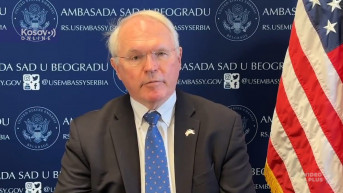
Ambassador Christopher Hill of the United States in Serbia stated tonight that the United States had clearly indicated for months that the Community of Serb-majority Municipalities was a key element that must be implemented.
Hill, in an interview with Kurir TV, responding to a question about what needed to be done for greater progress in relations between Pristina and Belgrade, said that the parties were deeply rooted in their positions but that the Brussels process was good, although many were dissatisfied with how long it had taken.
"I left the Balkans at one point and was in, among other places, Poland and South Korea. I did not expect to return to the Balkans and that the issue of Kosovo would still be relevant", the US Ambassador noted.
He pointed out that in diplomacy, the most important thing was to have a mechanism for resolving such issues, and that Miroslav Lajcak was the right man at the right time for that.
"Then we need to go through all the issues and see what can be done. I think the United States has clearly indicated for months that the Community of Serb-majority Municipalities is a key element that must be implemented", Hill said.
He noted that Kosovo was also dissatisfied that access to some international organizations was blocked.
"And we need to address that too. Lajcak did that. It's easy to look from the outside as someone tries to do something and give advice; now is the time to support what you want to achieve through dialogue under the auspices of the EU", Hill said.
In response to the question of what he expected from the new government of Serbia, Ambassador Hill stated that the government first needed to be formed.
"We look forward to that because we have a lot of work ahead of us with Serbia. We have many common goals, we want to improve economic relations, and that is extremely important. If we look at the economic situation today, it is not just about relations between individual countries; it is about regions and broader connectivity", the US Ambassador said.
He added that what drove US interests in relations with Serbia was the perspective for the entire Western Balkans region to be more peaceful and connected, with patterns of cooperation.
"If we go back to the past, immediately after the fall of the Berlin Wall, countries like Poland, Hungary, and then Czechoslovakia were trying to establish cooperation. At first, each was pushing its plan to be the first to join the European Union. In the end, they met in Visegrad, Hungary, and agreed to coordinate their entry into the EU. They agreed to avoid a situation where they were seen as countries that constantly had disagreements and spoke ill of each other, and thus did not want to be admitted to the EU. I believe a part of the solution for this region is the 'Open Balkan' Initiative", Hill emphasized.
He pointed out that countries must understand that they could not move away from this region and that they must cooperate. From the EU's point of view, it needed countries that coexisted peacefully and collaborated with each other, Hill added.
When asked about the main interest of the United States in investing in Serbia, Ambassador Hill responded that the US Government was very interested in assisting American companies that want to invest in Serbia, and there was significant interest from American companies in the Serbian IT sector and high-tech industries.
"There is a large number of serious companies interested in Serbia. Why? On the one hand, they anticipate – and I think they are right – that Serbia will enter the EU at some point. I cannot predict the exact date or circumstances, but American companies believe it will happen", Hill said.
He emphasized that the "common path" involved more than just the economy and that considerations should also include elements of security and defense.
"I think it's important for the US, Serbia, and other countries to cooperate. The US is very active in Europe through the NATO alliance", the ambassador added.
He recalled that not every country in Europe was a NATO member, and relationships were also being developed with those countries.
"We are doing that with Serbia; there are many joint military exercises. It is up to Serbia to decide on this, and I won't mention some difficult historical moments between our two countries now. It will ultimately be a mutual decision. We won't tell Serbia what to do, nor will Serbia tell us what to do. However, if we can agree on common interests, there is room for much greater cooperation", Hill stated.
On the question of whether the US and European countries were tired of investing in Ukraine and providing assistance, Ambassador Hill responded that there was a great interest in what would happen after the war. He noted that the EU had made some courageous decisions regarding Ukraine, a country aspiring to join the EU, which had had effects on the Western Balkans. He believes that, in light of the situation in Ukraine, it is necessary to consider what will happen with the countries in this region, as they are an integral part of Europe.
He emphasized that the process of rebuilding Ukraine would be extensive.
"I think a country like Serbia can participate in the future reconstruction of Ukraine. That's why I was pleased that the Chamber of Commerce and Industry of Serbia invited colleagues from Ukraine, and a memorandum of understanding was signed regarding potential cooperation. There will be more and more of this, and Ukraine and Serbia have a lot in common. I am pleased that last year the President of Serbia and the President of Ukraine met three times. Ukraine could prove to be very important for Serbia and its economy", Ambassador Hill said.

0 comments