
Institute for Serbian Culture Leposavic: Attempts to appropriate Serbian heritage part of systemic revisionism
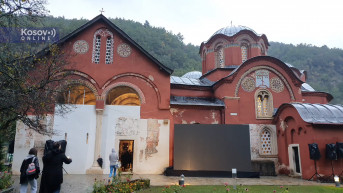
The Institute for Serbian Culture Pristina–Leposavic announced today, in connection with the case involving the Patriarchate of Pec, that this event is merely an example of how, through the cooperation of educational and cultural institutions, the identity of the “self-proclaimed state of Kosovo” and its Albanian citizens is being constructed. The Institute added that a lecture by an archaeologist on the Byzantine origin of the Patriarchate of Pec is not only meaningless, but also extremely dangerous.
“At a time when Serbian victims in Kosovo and Metohija are being trivialized and completely erased from collective memory, and when Serbs are portrayed as perpetrators through the controversial exhibition ‘Massacres in Kosovo 1998–1999’ in Pristina, organized on the anniversary of the start of the NATO bombing, the museum in Pec arranged a visit to the Patriarchate of Pec for students of the architectural department of the ‘Rifat Djota’ Secondary Technical School. Such a visit in itself would not be problematic, had it not been used as an opportunity for a museum archaeologist to deliver a lecture on the ‘Albanian’ Patriarchate of Pec. The students had the opportunity to hear how the ‘first Romanesque and Byzantine churches of Pec were systematically transformed into Raska-Serbian ones,’” the Institute stated.
The statement further condemns the event, emphasizing that it exemplifies how, through the cooperation of educational and cultural institutions, the identity of the “self-proclaimed state of Kosovo” and its Albanian citizens is being shaped, adding that the case of the Patriarchate of Pec is not an isolated one.
“The thesis presented within the walls of the monastery in Pec is based on pseudoscientific research from the past two decades, according to which the Serbs did not ‘transform’ only the Patriarchate of Pec, but also other ‘ancient Albanian shrines’ such as Bogorodica Ljeviska, Banjska, Decani, Gracanica, the Holy Archangels near Prizren, and even the church in the village of Ajnovce. Medieval Serbian art, for Kosovo Albanians, is portrayed as an embodiment of the Kosovo-Byzantine style, while the builder of Decani, fra Vita of Kotor, is presented as Albanian,” the Institute noted.
They also recall that tourist guides have long persistently repeated such narratives to visitors when guiding them through Serbian monasteries, presenting them as the cultural heritage of Kosovo.
In addition, they state that in the database on the website of the Kosovo Ministry of Culture, Youth and Sport, Bogorodica Ljeviska is attributed an Illyrian and Dardanian identity—two identities that are scientifically unfounded yet linked, and which, for contemporary Kosovo Albanians, represent the root of their identity.
The statement warns of a “decades-long, planned and systematic erasure of Serbian identity from the territory of Kosovo and Metohija.”
“From all mechanisms permitted and prohibited in wartime, to a somewhat quieter administrative war, all based on historical revisionism that has created a new Albanian ‘truth’—that everything Serbian (and not only Serbian) was once, and should once again become, Albanian. Initial physical destruction, followed by denial and appropriation of Serbian heritage, form the foundation of the intensive Albanization of Kosovo and Metohija,” the statement reads.
They further emphasize that, from a scientific standpoint, the lecture by the Pec archaeologist is meaningless, but—extremely dangerous.
“Albanian youth are being educated on such scientifically unfounded narratives, thereby creating generations for whom historical truth is entirely unknown, and fostering a strong and destructive urge to reclaim what is not theirs, but what they have been taught is,” the statement concludes, signed by Scientific Advisor Ivana Zenarju Rajovic.

0 comments