
Museum in Pec presented the Patriarchate of Pec to high school students as “Albanian and Byzantine”
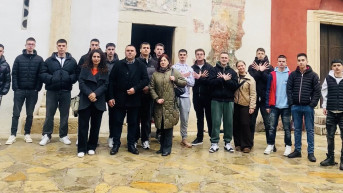
Students of the “Rifat Gjota” Technical High School yesterday visited the Patriarchate of Pec, organized by the Archaeological Museum in Pec, and in a statement noted that the Patriarchate of Pec “represents a complex of original pre-Romanesque and Byzantine churches that were systematically transformed into Raska-Serbian Orthodox churches.”
“Today, together with the ‘Rifat Gjota’ Technical High School in Pec, we visited the Albanian Patriarchate in Peja, presented as a church with older Romanesque and Byzantine layers, which was later systematically transformed and used as a Serbian Orthodox church,” the museum said in a Facebook post.
During the visit, it was highlighted that various restoration works (1931–32, 1938, as well as in the 1960s and 1970s) revealed parts of older Christian monuments dating from the 4th to the 6th century, which were scientifically documented, the museum stated.
“Plastering works carried out between 2006 and 2008 almost completely destroyed the older layers, making documentation of the cultural heritage more difficult,” the Facebook post added.
The students were guided through the Patriarchate by Dr Sefer Lajci from the Archaeological Museum in Pec.
“Thanks were also extended to professors Helena Berisha and Merita Arifaj (engineer), as well as to the students, with the message that this initiative should serve as an example and encouragement for other schools,” the museum said.
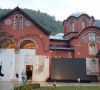
The Patriarchate of Pec has been on the UNESCO World Heritage List since 2006 as part of the entity “Medieval Monuments in Kosovo,” where it is clearly defined as a masterpiece of Serbian-Byzantine architecture and the spiritual center of the Serbian Orthodox Church.
From the mid 13th century, the Patriarchate of Pec became the seat of Serbian archbishops and later patriarchs. The complex consists of four churches built between the 13th and 14th centuries (Holy Apostles, St Demetrius, the Church of the Virgin Hodegetria, and St Nicholas).
It was constructed from the third decade of the 13th century to the mid 14th century, and consists of the main Church of the Holy Apostles, with the Church of St Demetrius built on the northern side, and the Church of the Virgin with the Church of St Nicholas on the southern side, as well as a shared outer narthex on the western side. Over the course of a century (1230-1330), the Patriarchate was expanded, new temples were added, and older ones were rebuilt. Until the mid 18th century, it remained the center of the Serbian Church, and during that period, care and maintenance of the ecclesiastical center continued uninterrupted.
Recently, four and a half decades since the burning of the Patriarchate of Pec were also marked – March 16, 1981 – when the old residence of the Patriarchate burned down in an arson attack during days of large demonstrations by Kosovo Albanians.
For more than two decades, there have been examples of renaming Serbian cultural heritage as Albanian, so encountering the Patriarchate of Pec labeled as an Albanian monastery on Google Maps in Albanian is not surprising, but it is shameful and absurd.
Kosovo Online also wrote about this last year, when interlocutors pointed out that this is not about facts, but about subtlety and a kind of special warfare, involving manipulation and the rewriting of history.
0 comments