
Jovanovic: The term Kosovo and Metohija is fully in line with international law
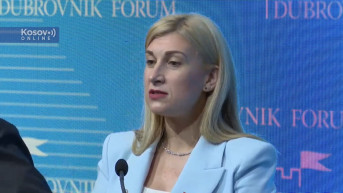
Serbian State Secretary at the Ministry of Foreign Affairs, Nevena Jovanovic, emphasized today at the Dubrovnik Forum that despite numerous ethnically motivated attacks on Serbs in Kosovo and unilateral moves by Pristina, Serbia strives to be a constructive partner in the dialogue to reach a sustainable solution. Responding to the objections of Kosovo’s caretaker Foreign Minister Donika Gërvalla regarding her use of the term “Kosovo and Metohija,” Jovanovic countered that the term is entirely in line with international law and UN Security Council Resolution 1244.
“Every dialogue requires two sides. This year alone, we’ve seen more than 80 ethnically motivated attacks on Serbs; in 2022 there were 150. For most, those are just numbers, but for Serbs in Kosovo and Metohija, that is their reality. And despite that, we are trying to be the constructive side,” Jovanovic stressed during the panel “The Western Balkans and the Euro-Atlantic Path.”
She emphasized that regional stability is Serbia’s highest priority.
“This is our main priority, along with maintaining open communication with all neighbors and especially strengthening economic ties, as improving economic relations can help ease the political context as well,” said Jovanovic.
Asked about criticism directed at Serbia regarding the Banjska incident, she responded that a broader context must be taken into account, as that tragic event was a reaction by the Serbian people to years of repression and violence they had endured.
She reminded that Serbian officials condemned what happened in Banjska, where, she noted, one Kosovo police officer and three young Serbs lost their lives, and pointed out that some are using the incident for political purposes and to continue the de-escalation of the situation in northern Kosovo. She added that Serbia has been ready from the outset to cooperate with partners in resolving the case.
On Serbia’s path toward EU membership, Jovanovic underlined that EU accession is one of Serbia’s top foreign policy priorities and its strategic goal.
“Our position is that the EU is the rightful place for the entire Western Balkans region,” said Jovanovic, adding that Serbia is actively working on implementing the necessary reforms.
She also highlighted that, despite being a militarily neutral country, Serbia values its cooperation with NATO through the Partnership for Peace program and high-level dialogue—recalling several meetings between President Aleksandar Vučic and NATO Secretary General Mark Rutte.
She especially emphasized Serbia’s appreciation for KFOR’s work in Kosovo.
“We are a country surrounded by NATO members. Only Germany has more NATO neighbors than Serbia. It’s important for us to strengthen relations with each of them—in the spirit of good neighborly relations, open dialogue to resolve outstanding issues, with the aim of closing some dark chapters of our history and building a shared future in the EU,” Jovanovic stated.
As for the speed of Serbia’s EU accession process, which began two decades ago, she said that both the region and Brussels should reflect on why it has taken so long and what both sides can do to accelerate the process.
She also noted the difficulty of maintaining enthusiasm for EU membership when there are no tangible benefits to offer citizens as a reward for their commitment.
She acknowledged that the most frequent criticism from the EU concerns Serbia’s alignment with EU foreign and security policy, but added that Serbia’s position is well-known.
“We are deeply committed to keeping the process alive and implementing key reforms. We have adopted a set of media laws and are striving for progress. But please don’t forget that, in parallel with these reforms, Serbia is also defending its national and state interests—preserving sovereignty and territorial integrity, a challenging process closely tied to European integration,” said Jovanovic.
Gërvalla: “Kosovo and Metohija” is an expression of Serbian hegemony — Jovanovic: The term is fully aligned with international law
Responding to the statement by Serbia’s State Secretary Nevena Jovanovic, Gërvalla claimed that the use of the term Kosovo and Metohija is an expression of Serbian hegemony—not only toward Kosovo.
“We are faced with young representatives using Milosevic’s rhetoric. There is no Kosovo and Metohija. Whether you mention it with a smile or a weapon, it is an expression of Serbian hegemony—not only toward Kosovo. We cannot continue the discussion as if everything is normal,” said Gërvalla.
She argued that Banjska cannot be justified, as it was, in her words, “an act of aggression against a neighboring country by 100 paramilitary forces equipped with anti-tank and modern weapons,” allegedly organized and financed by the Serbian state.
This, she said, is also reflected in the “stubborn refusal to extradite Milan Radoičic,” despite requests from the international community.
“Be skeptical of anyone who uses the term Kosovo and Metohija,” Gërvalla emphasized, and responded to the mention of 80 ethnic incidents by Jovanovic, claiming that neither the EU, the U.S., KFOR, nor anyone else refers to them as ethnic incidents.
“Serbia’s constant strategy is to portray itself as a victim. I call on Serbian society to wake up and free the region from the captivity of old politics,” Gërvalla said.
In response, Jovanovic reiterated that the term Kosovo and Metohija is aligned with international law and the legally binding UN Security Council Resolution 1244.
She added that Gërvalla’s rhetoric only underscores who the constructive side in the dialogue truly is.
“The term Kosovo and Metohija is in accordance with international law. We have already emphasized the need to respect international law. Serbia is a country that supports the territorial integrity and sovereignty of all UN member states. The term Kosovo and Metohija is fully in line with UNSC Resolution 1244, which remains in force. I can say it with or without a smile—but that is the truth,” Jovanovic concluded.


comments