
Konjufca: UNMIK report is one-sided; time for UN member states to recognize Kosovo
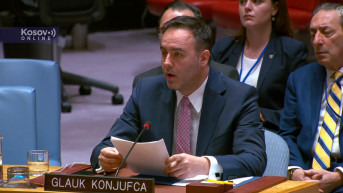
Kosovo’s Minister of Foreign Affairs and Diaspora, Glauk Konjufca, stated at a session of the United Nations Security Council that United Nations Interim Administration Mission in Kosovo had submitted a report containing controversial and one-sided elements that do not reflect the situation on the ground, and called on UN member states to recognize Kosovo and for the UN mission to be transformed into an office that would work on Pristina’s accession to the United Nations.
Konjufca emphasized that he had taken note of the UNMIK report but underlined that it does not reflect the actual situation on the ground.
“I will be brief, as I believe the UN Security Council has more important issues to discuss. Kosovo continues to develop as a democracy, with high standards of rights, particularly minority rights, demonstrating resilience to external challenges and crises. Since the last debate, we have held elections at both the national and local levels, which have shown that Kosovo has established institutions capable of maintaining stability,” he said.
Konjufca accused Belgrade of continuing a “destructive role by attempting to interfere in elections in Kosovo and impose the Serbian List, which it controls, with the aim of replicating Serbian authoritarian governance within the Serbian community.”
“Thanks to our partners, we prevented foreign interference in the elections and preserved the integrity of democratic institutions. We are a nation that loves peace and have never interfered in the internal affairs of other states,” he added.
Konjufca stated that Kosovo, despite what he described as Serbia’s aggression and hybrid threats, remains ready to establish good neighborly relations.
“The obstacle to peace and normalization remains Serbia, which is neither interested in EU membership nor in normal relations with its neighbors. We call on Serbia to face reality and recognize Kosovo as an independent state, and not to hold the entire region hostage,” he stressed.
Konjufca pointed out that UNMIK, in its report, avoids presenting the efforts of the authorities in Pristina to integrate the north.
“The effective functioning of society is based on cohesion. Our efforts in the north to ensure security and address threats are not mentioned, including the establishment of a safe environment for all citizens so they can live in peace and without pressure from illegal Serbian structures. In that spirit, we have implemented measures to integrate healthcare and education in Serbian communities,” he explained.
He stated that Kosovo has one of the most advanced frameworks for the protection of minority rights, but expressed concern that Belgrade uses minority rights and Kosovo’s multiethnic character to promote divisions and undermine institutions, as well as peaceful coexistence.
He criticized the report for failing to include references to the discovery of illegal weapons and to the measures taken by the authorities in that part of Kosovo to preserve peace and normality.
“The report presents isolated incidents, but does not address the hybrid threat from Belgrade toward the Serbian community. It also insufficiently addresses Banjska, which remains a major concern for us. Kosovo, the UN, and NATO have called for those responsible for this attack to be brought to justice, but Belgrade is protecting the main perpetrators,” Konjufca said.
He stated that Kosovo cannot trust Serbia or expect normalization without guarantees that there will be no aggression.
“If the report were not one-sided, it would also report on Serbia’s armament, as well as administrative ethnic cleansing in Presevo, Bujanovac, and Medvedja,” he added.
Konjufca recalled that last year Kosovo was recognized by four UN member states—Kenya, Sudan, Syria, and the Bahamas.
“I thank the 121 UN member states that have formally recognized Kosovo’s independence. I call on the remaining member states to recognize Kosovo as a sovereign and independent state. The key to peace and stability in the Balkans remains recognition of Kosovo by all EU and NATO members,” he stressed.
Speaking about UNMIK, Konjufca said that its mandate has been fulfilled and that UN resources and staff assigned to the mission could be better used elsewhere in the world in addressing crises and conflicts.
“Kosovo is a democratic state that has achieved normalcy, which is a condition for the termination of UNMIK. Participation in peacekeeping frameworks has demonstrated that Kosovo is ready to contribute to peace in other parts of the world, including through peacekeeping missions for Gaza. The UN’s focus should not be on maintaining UNMIK, but on admitting Kosovo as a full member of the United Nations,” he said.
Konjufca added that UNMIK should be transformed into a UN office that would contribute to Kosovo’s integration into the UN system and all its bodies.
“That would be a more sustainable approach than maintaining a role that no longer exists,” he stated.
At the end of the Security Council session, Konjufca emphasized that the Law on Foreigners is in line with European standards and that its implementation is an obligation assumed by Pristina under the Stabilisation and Association Agreement.
“We cannot have double standards. As an independent state, we have obligations toward the EU and others. No UN member state allows individuals without documents to remain on its territory,” he explained.
He added that the law aims at standardization, and that Serbs working in healthcare and education who hold Serbian documents should apply for residence permits within 12 months.
Konjufca stated that the integration of education and healthcare does not mean closing institutions of the Serbian community, but only ensuring that they operate within Kosovo’s legal framework in order to avoid parallel structures.
He added that the existence of “illegal Serbian institutions” was not beneficial to citizens, but aimed at keeping Kosovo divided.
He also pointed out that UNMIK exaggerates in its reporting of incidents that do not have an ethnic background, and that it is the responsibility of the Kosovo Police to address such matters.
At the same time, he stressed that there are hundreds of unresolved war crimes cases that have not been addressed by the courts, and that Kosovo has an obligation to deliver justice to the victims, and will not stop until all such cases are resolved.

0 comments