
Kostic: EU support for new enlargement models linked to geopolitical circumstances
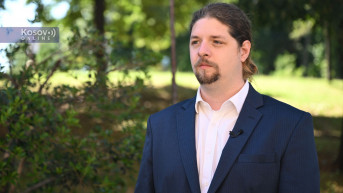
Mijat Kostic of the New Third Way organization told Kosovo Online that the current geopolitical situation has created a favorable moment for the enlargement of the European Union, which, in his assessment, currently enjoys greater unity than in previous years when it comes to preventing the spread of Russian influence. He added that this objective, together with economic interests, has encouraged discussions within the EU about new enlargement models and stronger support for the process.
"On the one hand, there are security reasons, primarily due to the war in Ukraine, to provide that country with a certain type of security guarantees and to geopolitically consolidate that area. This also includes integrating Moldova, which could become the next target of Russian hybrid activities and potentially direct pressure, into the European Union's common foreign and security policy," he said.
Kostic noted that, on the other hand, the reasons for discussing a different model of accession to the European Union are primarily economic.
"It is not easy to integrate countries such as Ukraine and Moldova into the Union, given that they are largely economically strained, have high levels of corruption, and insufficiently developed rule of law systems. That is why the possibility is being considered that new members would receive full rights, including veto power and decision-making authority on certain issues, only after a certain period of time. These are two different approaches - one driven by economic reasons and the other by geopolitical considerations," he said.
Kostic believes that candidate countries could receive a certain type of support already during the accession process, while the opening and closing of negotiating chapters for individual states could be accelerated.
He added that there is also the possibility of applying a specific accession model for each country in order to address particular issues more effectively on the path toward EU membership.
"One of the ideas being discussed is that candidate countries, although not yet members, would be included in the work of certain institutions, such as the Council of Ministers or other European Union bodies, so they can become familiar with the decision-making process, but without the right to participate in that process. Perhaps the most radical proposal would allow countries, even after accession, to exercise veto rights only after a certain number of years, or after they have resolved key domestic issues," Kostic said.
He explained that this would preserve the possibility of unanimous decision-making and prevent potential blockages by member states, such as those that, according to him, came from Hungary while Viktor Orban was in power.
"The greatest incentive would be that countries, depending on the reforms they implement and the way they address domestic issues, would gradually receive additional rights and greater powers," he said.
Kostic expects that some EU member states will advocate for new enlargement models, noting that the goal of Berlin and Paris is to prevent the expansion of the Russian sphere of influence, particularly in Ukraine and Moldova.
"Even Hungary, which previously blocked certain sanctions packages against Russia and additional aid to Ukraine, changed its position after the change of government in Budapest. We can see that the European Union is more united today than it was a year ago, and that represents a positive development in terms of enlargement policy. In that case, new members would also have a similar degree of caution toward Russia as Germany and France. During this process of consolidation, it is very possible that all member states, or at least the majority of them, will adopt a common position that Ukraine and Moldova should be part of the European security space and, consequently, the economic space as well. I believe the current momentum for enlargement is ideal because Europe currently has both internal unity and a strong incentive to consolidate its security and economic space," Kostic concluded.

0 comments