
Kurti: CSM sought by Belgrade would be a mechanism for challenging Kosovo’s functionality from within
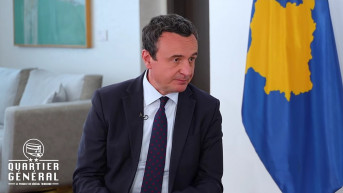
Kosovo’s caretaker Prime Minister Albin Kurti said on the “General Trinquant’s Headquarters” podcast that Pristina remained committed to normalizing relations with Serbia, but only on the basis of mutual recognition, while rejecting the establishment of the Community of Serb-majority Municipalities (CSM) according to the model he claimed Belgrade was seeking. He assessed that such an Community would have powers resembling those of the Republic of Srpska and would constitute a mechanism for challenging Kosovo’s functionality from within.
Speaking about the CSM on the podcast hosted by retired French general and military analyst Dominique Trinquand, Kurti said that more than a decade ago the Constitutional Court of Kosovo had found that “the model of a monoethnic Community of municipalities was not in accordance with the spirit of the Constitution.”
“In February 2023, we reached the Basic Agreement with Serbia, followed a month later by the Implementation Annex in Ohrid. Kosovo respects that agreement and requested that it be formally signed. Serbia refused to sign it. The agreement also includes previous arrangements reached by earlier Kosovo governments, including the issue of the Community of Municipalities. Kosovo already has an Community encompassing all 38 of its municipalities. However, more than a decade ago, the Constitutional Court found that the model of a monoethnic Community of municipalities was not in accordance with the spirit of the Constitution,” Kurti said.
He added that he supported cooperation among municipalities to improve the provision of public services, but exclusively within the “constitutional order of the Republic of Kosovo.”
“The problem arises because Belgrade wants a structure that would have political powers resembling those of the Republic of Srpska in Bosnia and Herzegovina. That would constitute a mechanism for challenging Kosovo’s functionality and statehood from within. This is precisely where the greatest difference between our positions lies,” he stressed.
“Constitution provides a high level of protection for minority rights”
Asked how he viewed the future of minorities, Kurti said that he cooperated with all minority communities and wanted “their voices to be represented.”
“Our Constitution provides a very high level of protection for minority rights. It was drafted under the strong influence of Martti Ahtisaari, the United Nations Special Envoy, and provides for 20 guaranteed seats for minority communities in parliament—ten for the Serbian community and ten for other minorities, including Bosniaks, Turks, Roma, Ashkali, Egyptians, and Gorani. I cooperate with all minority communities and want their voices to be represented and their rights protected. We have ministers and deputy ministers from different communities in the Government. Serbian is an official language in Kosovo at all levels of administration,” he said.
He added that he believed ideas about ethnically pure territories belonged to the past.
“In the 21st century, there are no perfect ethnic borders. What we need are democratic states in which all citizens are equal before the law and have equal opportunities. Our goal is the full normalization of relations with Serbia, based on mutual recognition. An overwhelming majority of Kosovo’s citizens support European integration and see no alternative to membership in the European Union,” the caretaker Prime Minister said.
“Relations with Belgrade also burdened by geopolitical differences”
Commenting on relations with Belgrade, Kurti said that they were burdened not only by the issue of independence but also by different geopolitical orientations.
“Kosovo is clearly oriented toward the European Union and NATO, while Serbia formally speaks of its European path but maintains close ties with Moscow on many issues. I believe that Serbia has still not genuinely accepted responsibility for the crimes committed during the wars of the 1990s. This further complicates the process of normalizing relations,” Kurti said.
“The problem is not the citizens, but certain political elites”
He also stressed that he did not believe there was currently mass nationalism among the peoples of the Western Balkans that could lead to new wars.
“The problem is not the citizens, but certain political elites that still live in the past and use nationalism to remain in power. Thirty years ago, people readily took up arms. Today, citizens would report such attempts to the police. Society has changed. The danger does not come from ordinary people or from different nationalities or religions, but from policies that are still attempting to pursue hegemonic objectives,” he said.
He added that the geopolitical situation had become even more complicated following the war in Ukraine and that the European Union should therefore recognize and reward those who consistently implemented reforms, strengthened the rule of law, and respected European values.
“According to numerous international indices, Kosovo is among the most successful countries in the Western Balkans in the areas of combating corruption, security, the rule of law, and the protection of civil liberties. I do not mind when our European partners criticize us, but I believe that the progress we are making should be recognized more objectively,” he stressed.
“I would like elections to be held less frequently”
Kurti also spoke about the political situation in Kosovo, stressing that he would “like elections to be held less frequently.”
“In the most recent elections, we won around 47 percent of the vote, whereas previously we had more than 50 percent. We are forming the Government together with partners from minority communities. However, electing the president requires a two-thirds majority in the first two rounds of voting. A 2011 Constitutional Court ruling allows the president to be elected by a simple majority only in the third round, provided that a quorum of at least 80 MPs is present in the first two rounds. The opposition is using this procedure to block the election of the president. Nevertheless, I will continue talking to them and seeking a common solution. So far, it has mainly been us who have put forward proposals, while the opposition has rejected them. Forming the institutions is not solely the responsibility of the governing parties; it also requires the opposition’s cooperation,” Kurti said.
Political and economic importance of the diaspora
Kurti also commented on the political and economic importance of the diaspora, saying that remittances from abroad accounted for around 20 percent of gross domestic product.
“According to the 2024 census, Kosovo has a population of around 1.6 million, but more than one million of our citizens live abroad. Most people did not leave Kosovo because they wanted a better life, but because the 1990s, under Slobodan Milosevic’s regime, made life here almost impossible. Today, the diaspora’s connection with the homeland is exceptionally strong. Many buy apartments in Kosovo, visit frequently, invest in businesses, send their children to study here, and plan to return after retirement. An increasing number of our citizens from the diaspora also participate in elections. Their political participation can influence the allocation of several parliamentary seats,” Kurti said.


0 comments