
Latinovic: Increased security risk in the Balkans is not in America's interest
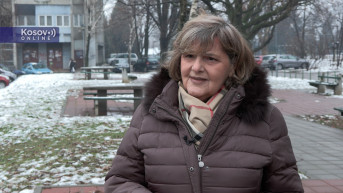
The statement by US President Joseph Biden, who linked the security situation in Ukraine to possible instabilities in the Western Balkans, is very serious and must be thoroughly analyzed, according to Branka Latinovic, the vice president of the Forum for International Relations.
Biden recently stated in the White House that cutting financial aid to Kyiv could lead to a crisis in the Balkan countries, suggesting that a Russian victory in Ukraine could "change the dynamics" in Europe.
"One should consider the conditions and context in which the statement was made and the fact that it was made by the US president, who wouldn't say it just like that. Probably, it is the result not only of assessments of the situation on the ground but also of their vision, both American and Western circles, of how things could develop on the European continent if Russia were to win the war in Ukraine," Latinovic says to Kosovo Online.
She emphasizes that the European landscape has changed and is no longer the same as in 2022 or 2023. Not only are things changing in Europe, but also in its surroundings. Latinovic refers particularly to the conflict in the Middle East between Israel and Hamas and the potential risks and wars associated with it. She notes that the risk persists, although not at the same level as before, but that future development remains uncertain.
"All of this shows that the Balkans retain their geostrategic importance as they always have. You can have a left, right, pro-Western, or Eastern government, but the Balkans, as a geostrategic area, always maintains its place because it leads to Greece, Turkey, and the Middle East. Probably, it was considered that the Western Balkans is not consolidated, not just in terms of not all countries in the region being NATO and EU members but also having two sensitive points - Kosovo and Bosnia and Herzegovina. This is primarily related to the political actions of Milorad Dodik, his performances, and the statements he makes. Most analysts today consider Bosnia and Herzegovina a greater risk than Kosovo, considering that Kosovo is under international security forces, primarily NATO forces, under control, and attention toward Kosovo has increased after everything that happened last year. I'm referring to the increase in the number of KFOR members, among other activities," Latinovic states.
She does not believe that the West, especially the United States, wants the security and political risk to increase in the Balkans because that would mean a failure of their post-conflict conflict resolution model, into which they invested a lot, including financial resources and human lives, as a significant number of their citizens were engaged in peace missions in the former Yugoslavia.
Latinovic disagrees with assessments, such as those of the President of Republika Srpska, Milorad Dodik, who claims that Biden is invoking war in the Balkans. She reminds that the Dayton Agreement was an American project, and the United States invested authority and other capacities to end that war with a peace agreement and to maintain that peace. She also highlights that Russia used its status as a witness in the Dayton Agreement to increase its political and geostrategic influence in Bosnia and Herzegovina, primarily through Republika Srpska and Dodik.
When asked if the intention of the United States to arm Kosovo with Javelin missiles can be related to Biden's statements linking Ukraine and the situation in the Western Balkans, Latinovic responds, "To some extent, yes."
She recalls events on the ground in Kosovo during the past year, conflicts with KFOR members during protests in the north, events in Banjska, and the stationing of a larger number of Serbian Army members and weapons in the Ground Safety Zone area, which, according to Latinovic, obviously was not synchronized with the main international actors and led to certain suspicions.
"That decision is, in fact, a kind of warning. It is an announcement; we do not know if it will actually happen and to what extent, but in any case, it has been announced, and one should carefully consider all its consequences. The methods of the international community are not the same as they were in the 90s or, if you will, a few years ago. There are not as many warnings or strong statements; they gradually unfold, but then you have surprises. Like the F-16 flights over Banja Luka during the celebration of RS Day, then the announcement of the sale of Javelins to KSF, the opening of a NATO base in Bulgaria near our border, and what is happening in Beli Manastir. A completely new approach is being created, a new method adapted to today's European military, security, and political landscape," Latinovic concludes.



0 comments