
Milutinovic: The EU has stronger mechanisms to pressure Kurti, but the normalization process is politicized
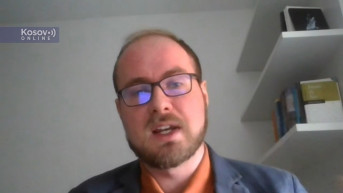
Petar Milutinovic from the Institute for European Studies told Kosovo Online that the EU is trying to compel the government in Pristina to implement what was agreed in the Ohrid Agreement as much as possible, but he emphasizes that the whole normalization process is politicized by decisions such as granting visa liberalization to Kosovo, although it has not fulfilled any of the agreed terms.
When asked whether the Quint has mechanisms to force Kurti to fulfill what he promised, Milutinovic says that it is currently "in the process of implementation."
"Since June last year, for the first time, the EU has introduced restrictive measures towards Pristina in a somewhat ambiguous manner during the negotiation process. These are often violated by member states," emphasizes our interlocutor.
As he mentions, these restrictive measures mainly pertain to high-level visits, some events, bilateral meetings, maintaining contacts, as well as funding the government in Pristina and certain projects that the government in Pristina implements, for example, concerning environmental protection.
"A certain amount of financial resources has been frozen, although it's a very small number compared to what is envisioned through the IPA 3 program for financing Western Balkan states. Specifically, about 24 million euros have been frozen, which is really a small amount compared to, for example, the 600 million euros that Kosovo received through the IPA program from 2014 to 2020. Thus, this could really be characterized as a precedent," assesses Milutinovic, but repeats that these measures have been violated multiple times.
He adds that the EU is trying as much as possible to finally compel the government in Pristina to implement what was agreed in the Ohrid Agreement.
"The Ohrid Agreement itself is not questioned, but now its implementation is being questioned. What is happening now with the Council of Europe is just one aspect of the implementation of this Ohrid Agreement," says Milutinovic. He adds that the EU has stronger mechanisms than restrictive measures to pressure Kurti.
"One of the strong, firm mechanisms is not to grant visa liberalization to the so-called Kosovo at all. However, this has not happened; they have received it and we can absolutely say that it is a political decision that will harm this entire dialogue and the normalization of relations between Belgrade and Pristina. Visa liberalization is something that can be characterized as a carrot in negotiations, you do something and then you get visa liberalization. However, they have done nothing, have not implemented what was agreed in the Ohrid Agreement, and yet they received visa liberalization, which is a political decision and that is very paradoxical," thinks Milutinovic.
He says that this example shows that the "normalization process of relations is politicized, that it really all comes down to cheap political points" and reminds us that Kosovo has significant problems with the rule of law, the functioning of judicial institutions, and democracy.
"Although the rights of minorities in the territory of Kosovo are not respected, now you have this situation where tomorrow Kosovo will be a full member of the CoE like other states, and that is a classic political decision, which will really set a precedent and open Pandora's box," he states.
According to him, there are certain differences among the Quint countries themselves in their approach to the Kosovo prime minister.
"There is a rivalry that has always existed in the process of normalizing relations between Belgrade and Pristina - that America has one approach, and the EU has another. However, in this case, it is the EU whose approach is definitely the most important. Here, negotiations are constantly mediated by EU institutions and the most powerful member states. The Ohrid Agreement itself was drafted by French and German representatives, who are well-versed in events in the Western Balkans, so America is no longer interested in this region nor does it have any real interests here different from those of the EU," emphasizes Milutinovic.
He adds that America now has other foreign policy priorities, in the realm of Eurasia, in conflict with the Russian Federation on the territory of Ukraine.
"This is now an additional complicating factor for the entire process of normalizing relations between Belgrade and Pristina. Because it is in everyone's interest in this election year to end and finish this on the most favorable terms possible for all sides, to finally close this 'front,' so that later on other fronts can be tackled," concludes Milutinovic.


0 comments