
Muhaxhiri: The Kosovo government turned the license plate agreement into a bizarre spectacle

Political analyst Artan Muhaxhiri said that the license plate agreement, instead of being used for the qualitative improvement of Kosovo's agenda in the dialogue, had turned into a "bizarre spectacle", Telegrafi reports.
He pointed out that the agreement had unnecessarily become potentially dangerous, populist, and with negative consequences for the image of the Kosovo leadership.
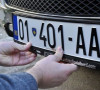
Muhaxhiri emphasized that the issue of license plates had created a dramatic scenario of a thriller, where, as he said, for several hours the citizens of Kosovo had been deeply concerned about the multidimensional consequences of a possible escalation of violence in the north.
"After the very successful diplomatic method that Albin Kurti's government applied in the period of August-September for the issuance of identity cards when the goal was elegantly achieved after harmonizing with the Quinte countries and the Americans in particular, it was logical to expect the same fruitful approach for license plates. However, this time it was decided to ignore visionary pragmatism and coordination with the allies, and a dramatic scenario of a thriller was chosen, which until the last hours left citizens deeply worried about the multidimensional consequences of a possible escalation of violence in the north," Muhaxhiri said.
He said that "the non-issuance of new license plates of that specific category is neutralized by the fact that there are no penalties for their continued retention, and there is also an obligation to start discussions on the Franco-German, i.e. Euro-American plan".
"After several months of continuous American-European insistence on this plan, the government's attempt to package this evident fact as an essentially catalytic initiative on its part is incomprehensible. Any wishful and unrealistic interpretation of the supposed imposition of essential orientational changes in the dialogue through this political style is destined to fail", he said.
In such situations, Muhaxhiri assessed, every decision had systemic consequences with a "domino effect".
"It makes unacceptable the tyranny of any party that wants to overcome several steps at once to reach the goal. Without a valid analysis of the breadth of life, political and identity influences on the state, citizens, allies, and the region", he pointed out.
Regarding the statements of the Serbian and Kosovo sides on the agreement, Muhaxhiri said that "the fog surrounding the short-term agreement means that the parties will necessarily return to the dialogue table to negotiate a long-term agreement."
The director of the Kosovo Institute of Justice, Ehat Miftaraj, stated that among the main shortcomings of the agreements that had been reached in Brussels was the fact that these agreements were not published in their entirety.
According to him, only the main points of what the parties had agreed on were published for citizens, allowing them to interpret them as they saw fit.
"Undoubtedly, the best thing that happened recently in Brussels is the agreement on license plates and overcoming any escalation of the situation in the north of Kosovo. On the other hand, one of the main disadvantages of the agreements reached in Brussels remains the fact that these agreements are not published in their entirety, but only the main points of what the parties have agreed are published, giving the possibility to both parties to interpret those agreements and only those parts that they consider to be in their favor," Miftaraj said.
He added that without complete information it was impossible to evaluate the reached agreement in detail.
"In this regard, without having all the information, it is almost impossible to evaluate the reached agreement in detail. However, experience has taught us that the public in Kosovo should never take the statements of the Serbian side for granted because they treat the dialogue with Kosovo as propaganda and serve their public information that most often does not match reality," Miftaraj said.


comments