
Petkovic: EU’s deceitful and hypocritical role in undermining the reintegration of judges and prosecutors
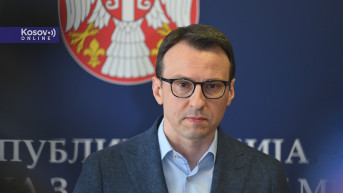
Director of the Office for Kosovo and Metohija Petar Petkovic said that the Kosovo Judicial Council, by rejecting requests from Serbian judges and administrative staff to return to the institutions, had unlawfully derailed the reintegration process, describing the EU’s role in undermining that process as hypocritical and deceitful.
Petkovic told a press conference that the same thing had happened on July 20, when the Kosovo Prosecutorial Council rejected the return of Serbian prosecutors.
He said this clearly demonstrated that Pristina did not want reintegration, that Albin Kurti was striking at the very foundations of the Dialogue, and that there was no rule of law in Kosovo.
“The moment Serbian judges and prosecutors, as well as administrative staff, submitted their requests electronically on July 15 to return to the institutions, the most brutal campaign was launched by Kurti, Albulena Haxhiu, and other representatives of the Pristina authorities. They said that it would amount to an act of treason if the so-called Kosovo Judicial and Prosecutorial Councils ruled in favor of the Serbian judges and prosecutors. Enormous political and media pressure was exerted, while the European Union did not say a single word about it. And we are talking about agreements reached in 2013 through the Brussels Agreement, the Agreement on the Validity of Appeals, also from 2013, the 2015 Agreement on the Judiciary, and the 2016 conclusions relating to that agreement. We are talking about key agreements within the Dialogue that are intended, above all, to ensure that Serbs also have access to justice, given that we can see that Kurti’s judiciary serves exclusively as a cudgel against Serbs and as an instrument whenever Serbs need to be persecuted, holiday homes demolished, or Serbs arrested simply because they are wearing T-shirts bearing Serbian emblems,” Petkovic said.
He added that it was the European Union that had demanded the reintegration process.
“When we look at everything that has happened in Pristina, it is clear that we cannot expect Albin Kurti, or anyone else in Pristina, to guarantee the implementation of any agreement because, if it were up to Kurti, there would be no Serbs in Kosovo and Metohija at all. We understand that very well. But that is precisely why the European Union is there. It undertook to conduct the Dialogue, it is the facilitator of the Dialogue, and it bears responsibility for the implementation of all agreements, given that it also signed the 2013 Brussels Agreement, Article 10 of which, among other things, clearly sets out Pristina’s obligations concerning the agreement on the judiciary,” Petkovic said.
He stated that Serbian judges and prosecutors had decided to leave the institutions because the Brussels Agreement and the agreement on the judiciary had never been fully respected.
“When Serbs left the Pristina institutions in November 2022, Serbian judges, prosecutors, and administrative staff also left those institutions. In addition to the terror and intolerable living conditions created by Kurti, which were the reason Serbs left those institutions in 2022, the judges and prosecutors decided to leave, among other reasons, because neither the Brussels Agreement nor the agreement on the judiciary had ever been fully respected—whether regarding the jurisdiction of courts, filling the required number of judicial and prosecutorial posts, or many other issues such as the validity of appeals, meaning the recognition of court decisions from the Serbian system, and many other matters. Not to mention that, in practice, judicial panels often consisted of two Albanians and one Serbian judge, even though the agreements clearly stipulated that in cases concerning Serbian matters and Serbian municipalities, the majority should consist of two Serbs—that is, two judges of Serbian ethnicity—and one Albanian. In practice, everything was different,” the Director of the Office for Kosovo and Metohija added.
He said these had been justified reasons for leaving the institutions.
According to Petkovic, following the illegal elections in the north and the takeover of municipalities by Albanian mayors, the EU began insisting that Serbs had to return to the institutions, while the first thing it demanded within the Dialogue was the collection of signatures for the removal of the Albanian mayors in the northern municipalities.
“In January 2024, the Serbs collected those signatures. However, the European Union once again failed to honor the process because it did not allow it to be completed. Pristina then came up with some kind of administrative instruction on a referendum and so forth. We then had to wait for the local elections in October 2025, in which the Serb List, of course, won convincingly, enabling Serbian mayors who had secured overwhelming victories in Serbian communities, particularly in the four municipalities in northern Kosovo and Metohija, to take over the local administrations.
“And, believe it or not, Kurti was rewarded for that. Something that should be entirely normal—democratically elected representatives taking over local governments—was described as a peaceful transition, allowing Kurti to regain access to European funds and enabling the measures previously imposed by the European Union on Kosovo to be lifted,” Petkovic said.
He stressed that once that process had been completed, the European Union began insisting that the reintegration of judges, prosecutors, and police officers was necessary.
“There is also a letter dated March 22, 2024, which Kurti sent to international representatives and signed together with Vjosa Osmani and Konjufca, in which, among other things, he undertook to carry out the full reintegration of judges, prosecutors, and police officers in northern Kosovo and Metohija. That is the letter he sent to international representatives.
“What happened next? The European Union continued to insist that it was important for judges and prosecutors to return to the institutions, although we kept saying throughout that all the outstanding issues dating from 2023 also had to be resolved,” he said.
Petkovic added that the EU then requested discussions on the reintegration of Serbian judges and prosecutors, to which Belgrade agreed.
“At one point, the European Union said: Kurti does not want the reintegration of the police, so let us begin with the reintegration of judges and prosecutors. To prevent Belgrade from once again being attacked, to prevent the Serbian people from once again being accused of refusing to participate in the reintegration process—because that is how they always portray it: Belgrade is always to blame, the Serbian people are always to blame, never Kurti—we spoke with our people on the ground, with the judges and prosecutors, and said: All right, let us discuss the reintegration of judges and prosecutors and resolve all the outstanding issues concerning the Appeals Division in North Mitrovica, the composition of judicial panels, the recognition of court decisions from the Serbian system, and everything else,” Petkovic said.
According to him, an agreement was reached with EU Special Representative for the Dialogue Peter Sorensen in September last year that the issue of judges and prosecutors would be discussed in Brussels.
“During 2015, I spoke with Sorensen on several occasions. Let me remind you that since February 2015 there has been a complete political crisis in Pristina, where they have been unable to form institutions, Kurti governs in a caretaker capacity, they cannot form a government, and there have been three electoral processes. The entire situation has carried over into 2026, and even today they do not have a legitimately elected government. In fact, the only legitimate authority in Kosovo, when we speak of the Provisional Institutions of Self-Government, is the local government and nothing more. Not even the MPs, given that some say the deadline for constituting the Pristina Assembly has expired. In those talks with Mr. Sorensen, I agreed that September 2026 would be the period when we would discuss the reintegration of judges and prosecutors in Brussels. Naturally, the Pristina negotiator did not attend. They were campaigning for elections and did not want to participate in the Dialogue, following Albin Kurti’s policy. As you know, he has clearly stated that the Dialogue is not an important issue for him and ranks last on his list of priorities,” Petkovic said.
He added that although Belgrade had agreed to discuss the issue, Sorensen’s team arrived in Serbia on July 6 with a request that the judges and prosecutors submit applications to return to the institutions, given that Haxhiu had already called on the Kosovo Judicial and Prosecutorial Councils to accept the resignations of Serbian judges and prosecutors.
“To prevent us from being accused of being responsible for the reintegration process or of obstructing anything, while Serbia was simultaneously fighting to open Cluster 3 on its European path, implementing reforms and everything else, we demonstrated full constructiveness in terms of the Dialogue and a willingness to compromise,” Petkovic said.
Belgrade’s position, he added, was that it was better for Serbian judges and prosecutors to work in the north.
“It is better for Serbs to be tried by Serbs than by Albanians, because we can see how they are being tried. Since Kurti came to power, more than 257 people have been arrested, and 62 remain in Pristina’s prisons. Many of them are political prisoners. On July 15, as I said, 143 Serbian representatives—judges, prosecutors, and representatives of the judiciary—submitted requests by email to return to work. First, the so-called Kosovo Prosecutorial Council rejected their request, and yesterday the so-called Kosovo Judicial Council acted in the same manner and rejected the request of the Serbian judges,” Petkovic said.
He then pointed to what he described as the EU’s deceitful and hypocritical policy on the issue.
“This merely demonstrates that the entire process was, in fact, initiated by the European Union. And it was the European Union that guaranteed—although it is now evading responsibility and avoiding any mention of guarantees—that the entire process would be carried through to completion. I am holding this press conference to draw attention to the highly hypocritical and deceitful role of the European Union on this issue as well, when we speak about the reintegration of judges and prosecutors. I have here a letter from Mr. Sorensen dated July 10, in which he responds to my letter of July 9, in which I said that the judges and prosecutors were ready to participate in the reintegration process, but that we had to resolve the numerous outstanding issues I have already mentioned several times here today. Mr. Sorensen thanks me for the letter and says that it is important for the judges and prosecutors to return and that, as soon as they return—which clearly demonstrates their guarantee regarding this process—we can address the remaining outstanding issues,” he added.
Instead of that happening, he said, there was now a decision by the Pristina authorities, issued on Albin Kurti’s orders, preventing Serbian judges and prosecutors from returning to the institutions, which, according to Petkovic, had effectively brought the Agreement on the Judiciary to an end.
“This strikes directly at the very foundations of the Dialogue itself. I do not know in what manner or how, but we will continue talking, bearing in mind that such an important agreement—which, together with the Brussels Agreement and the Association of Serb-majority Municipalities, represents the very heart of the Dialogue—is now being brutally trampled upon in this way. Just imagine if Belgrade had done anything like this. They would have imposed a hundred sanctions on it,” the Director of the Office for Kosovo and Metohija said.
However, when it comes to Kurti, Petkovic said, no one responds.
“No one in the European Union. I have sent more than 20 letters. Letters were sent to the Quint in Pristina, the Quint in Belgrade, and EU member states—to everyone. I received one response, in the form of a WhatsApp message, from just one European Union official. That shows you the true state of affairs, and we have to speak openly about this because Belgrade is not to blame. Belgrade is not the party obstructing anything. The address of the obstruction is in Pristina, but also in Brussels, which is clearly supporting Kurti and doing everything in Albin Kurti’s favor,” he added.
Petkovic said that all developments in the recent period demonstrated that there was no rule of law in Kosovo and that the EU was paying no attention to that fact.
He added that this was a serious issue and that he would request talks in Brussels because responsibility lay primarily with the EU, which, he assessed, had been unwilling or had failed to see the process through to completion.
“The result of this process is that the Agreement on the Judiciary has collapsed, thanks in part to the European Union, which failed to carry out everything that needed to be done through to the very end. The positive thing is that the prosecutors, judges, and administrative staff have initiated certain legal proceedings, so we will see how those ultimately conclude. In any event, we will continue fighting for our people in Kosovo and Metohija, insisting on compromise and the preservation of peace, and considering what more we can do. But we cannot simply overlook this, because this is the responsibility of the European Union, which must fully understand the consequences of such decisions by the so-called Kosovo Prosecutorial and Judicial Councils. Because if we do not have our people—judges, prosecutors, and administrative staff, and we are talking about 143 Serbian representatives of the judiciary in the Pristina institutions—the question arises as to how the Brussels Agreement can be implemented if Point 10 of that Agreement and all the other agreements from 2013, 2015, and 2016 have been completely trampled upon,” Petkovic said.
The Kosovo Judicial Council (KJC) yesterday rejected the request by Serbian judges and court staff to withdraw their resignations and return to the judicial system.
The request for the return of Serbian judges and court staff was rejected by nine votes in favor, one against, and one abstention.


0 comments