
Petritsch: An urgent step – forming the CSM; the international community must be more active
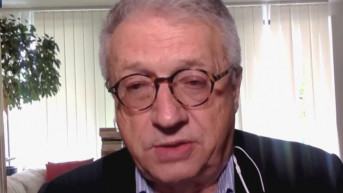
The decision to leave Kosovan institutions made by Serbs from Kosovo leads to "dangerous escalation"; however, the first, urgent step that needs to be taken is forming the Community of Serb Municipalities (CSM) despite Pristina's resistance, the former EU's Special Envoy for Kosovo Wolfgang Petritsch says, the Serbian RTV channel reports.
The Serbs' decision, he finds, does not lead closer to resolving the problem, because it's questionable if Pristina – out of pure resistance or stubbornness – will be ready to compromise, and it also opens up the question of what else can Kosovo Serbs do now, after all this.
Commenting on the tense situation in Kosovo, Petritsch indicates that now, in a certain way, everything depends on the flexibility of Pristina, which he, however, does not expect.
"This is a situation in which the international community must be active, much more active than it has been lately", Petritsch points out, noting that it has been clear that the license plate issue would become a symbolic one – and those are, he adds, always the most difficult ones to resolve.
That is why he thinks the European Union and the USA must come forward together and call on both sides to work on a compromise.
Regarding the statement made by Serbian President Vucic on how the development of the situation had been predictable for a long time and how it resembled that of the 1990s when there had been no contact between Serbs and Albanians after the Albanians left the Serbian institutions, as well as how that situation would reflect upon the conditions in Kosovo, Petritsch claims that, if it came to that, it would mean the failure of the process to normalize relations, Serbian Tanjug news agency reports.
Therefore, he hopes it does not come to that and thinks it should be prevented at all costs because, as he puts it, it's necessary to preserve the co-existence between Serbs and Albanians. On the contrary, Petritsch believes there will never be peace in the region.
"The case of Ukraine shows how tense the situation in the world is and how difficult it is in Europe now to be fully devoted to matters in the Western Balkans. The greatest issues and challenges are Kosovo and Bosnia and Herzegovina.”
Petritsch, who used to be the international community’s High Representative for Bosnia and Herzegovina, further explains that the current crisis needs to be overcome as soon as possible in order to avoid a situation that would lead to complete social discord. “Someone needs to try and do something, and that someone should primarily be the EU," he underlines.
Commenting on the proposal that KFOR and EULEX take over the tasks of Serb police officers and lawmakers who resigned from their posts, Petritsch said that it was certainly a proposal worth considering, while also remaining aware that OSCE had an important mission in Kosovo as well.
"I don't think it is in the interest of Pristina to have the situation deteriorate back to how it was before. But, if need be, then certain measures will have to be taken, such as international institutions taking on a more active role,” he stated.
Asked whether it could be expected of Kurti to use force since he had been provoking Serbia and Serbs in Kosovo through his recent actions, Petritsch answered that the line between verbal provocation and real incidents is always very thin.
"That's why we can only warn all those who think that returning to the 1990s can bring about a solution. It's impossible. I think both Pristina and Belgrade are aware of this fact. It's important that Serbs from Kosovo and Metohija don't become a ball in a game; the burden of their already difficult life in Kosovo and Metohija should not be any heavier,” Petritsch warned.
He said that Kurti was known for his hard politics and attempts at torpedoing everything that was accomplished while trying to restore trust between Pristina and Belgrade, and such behavior, as Petritsch added, was surely not being appreciated by the international community.
"I'm aware there's a critical attitude towards this in the USA. For example, there's the United States Ambassador in Belgrade Christopher Hill who says that things just can't go that way. There has to be a basic willingness on both sides to reach a compromise. "However, Kurti has lately been developing in a direction that doesn't contribute to a solution", Petritsch said.
When asked whether the EU still had influence in Kosovo, he said the EU had an influence when the situation approached normalization, but that the influence was smaller at the moment.
Hence the concern shared by Paris and Berlin, resulting in their appointing the special envoys for Kosovo who were the ones to come forth with a proposal, he explained.
"It seems problematic, taking into account that EU mediation and appointing Lajcak and Borrell limits the scope of action. It's clear that Berlin is the deciding factor. And, Kurti listens to opinions from Berlin. Nevertheless, one should take heed to re-establish a shared strategy within the EU regarding this matter", Petritsch pointed out.
He further underlines that Kosovo's sovereignty is the ultimate question, but that a decision regarding it can only be reached at the end of the process.
"The road to UN membership has to be well prepared. If agreements made ten years ago don't get carried out first or the agreed legal entities – such as a Serb self-governing to a certain extent – aren't established, then it will be difficult. That's why the next urgent institutional step is to establish the Community of Serb Municipalities", the former Austrian Ambassador in Belgrade explained.
He says it's understandable that Pristina resists the Community of Serb Municipalities because they don't want another Republic of Srpska; on the other hand, it is also necessary to accommodate Serbs as much as possible.
"That doesn't only include nurturing their culture, but also infrastructure, supply flow, everything the people living there are facing. Improving the everyday life of Serbs in Kosovo and Metohija is a priority. This is why forming the Community of Serb Municipalities is urgently needed. This won't be possible without the support of the USA and the EU. That's why the matter should be approached with earnest seriousness" Petritsch affirmed. To that end, he underlined, Berlin and Paris were needed.
"German-French proposal for a solution is just that – a proposal, and it needs to be discussed and analized.” Petritsch was also clear in claiming that the only way to get out of the current impasse was to focus on establishing the Community of Serb Municipalities.
Responding affirmatively to the question on the possibility of Pristina forming the Community of Serb Municipalities after a ten-year-long refusal to do so, he further noted that it had to be possible, mainly because that was what they accepted in 2013.
"There's a decision made by the Constitutional Court in Pristina that needs to be taken into account. Adjusting the law shall create possibilities for implementing what was agreed upon ten years ago," he added.
When asked to comment on the statement saying it seemed that the problems in the Balkans had been left in Germany's hands and about how he saw a more active role of Germany in the region, he said that, in regard to Berlin's engagement, one had to take into account the war in Ukraine and Chinese initiatives in the Western Balkans, but also the role of Russia in the region.
"Germany wants to try and use the EU ticket more clearly. It has to be about integrating the Western Balkans into the EU, and that will be a long road. I have always advocated taking pragmatic steps that would bring the entire region closer to the Union. I believe Germany has exactly the same intention," Petritsch concluded.

comments