
In Pristina, on June 16, the largest trial of Serbs in absentia begins: Legal or political “trial of the century”?
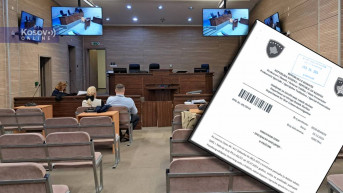
Even before it begins – the “trial of the century.” The indictment lists 53 names, including numerous former generals of the Yugoslav Army, officers, and members of the Serbian Ministry of the Interior. On June 16, the first major war crimes trial in absentia will begin in Pristina. Legal experts already see numerous dilemmas: from the content of the indictment to the potential convictions for events that took place in April 1999.
Written by: Djordje Barovic
Heading the group of the accused is former head of the Military Security Agency (VBA), General Momir Stojanovic, who in 1999 was chief of the security command in the Pristina Corps.
Among the high-ranking military officers of the former Yugoslav Army are Generals Veroljub Zivkovic, Chief of Staff of the Pristina Corps, Ilija Todorov, former commander of the 63rd Parachute Brigade, Dragan Zivanovic, commander of the 125th Motorized Brigade, and Milos Djosan, commander of the 52nd Artillery Brigade.
Also on the list are former Deputy Chief of State Security Franko Simatovic, a number of SDB and MUP members, as well as politicians.
Three Albanians who were serving in the Serbian Ministry of the Interior at that time are also charged.
They are all indicted for a “joint criminal enterprise” described in the indictment as the military-police operation “Losa Reka,” on two counts.
The first count is the murder of 370 civilians in several villages around DJakovica between April 27 and 29, 1999, most of them – 270 – in the village of Meja.
The second count is “deportation, destruction, and looting of property,” under which over 20,000 Albanians were deported through two border crossings into Albania during that period, and their property was looted and set on fire.
In this case, 217 victims and 43 witnesses are scheduled to testify, three of whom remain under protective measures introduced during the period of the Hague Tribunal.
For the crimes around DJakovica, the ICTY Appeals Chamber in 2014 delivered final verdicts in the case “Sainovic et al.,” sentencing former Yugoslav Deputy Prime Minister Nikola Sainovic, generals Nebojsa Pavkovic and Vladimir Lazarevic, and police general Sreten Lukic to prison terms ranging from 14 to 20 years.
However, in determining Lukic’s sentence, the Appeals Chamber accepted the defense’s argument regarding the events in Meja and surrounding villages in 1999.
“The Appeals Chamber notes that the Trial Chamber did not determine whether each of the victims was a civilian not participating in hostilities or hors de combat at the time of death. In the absence of sufficient evidence regarding the circumstances and status of each victim, the Trial Chamber erred in concluding that all 287 killings during the Reka Valley operation constituted murder as a crime against humanity and violations of the laws or customs of war,” the judgment stated.
The indictment filed by the Kosovo Special Prosecutor’s Office notes that the investigation into these same events began in 2013 and was halted several times.
This confirmed indictment results from an investigation launched on April 27, 2022, with an international arrest warrant for 35 defendants issued on October 6 of the same year.
Trials in absentia are a novelty in Kosovo’s judiciary.
The first such trial began in mid-November 2023.
It concluded in December last year with a 15-year sentence for Cedomir Aksic for alleged war crimes committed between January and May 1999 in villages in the municipality of Stimlje.
The possibility of trials in absentia was first legally defined in Kosovo in July 2019, for crimes “against international humanitarian and criminal law committed from January 1990 to June 1999.”
Two years later, this law was partially amended by the Law on Trials in Absentia, especially regarding investigative procedures against war crimes suspects.
The new law abolished the deadline for investigations into crimes against international humanitarian and criminal law for the 1990–1999 period.
Simultaneously, the provision requiring that the country where the suspect is believed to be located must be sent at least five requests was removed. The new formulation states that “international police cooperation was attempted but was unsuccessful.”
In August 2023, a new Criminal Procedure Code was adopted, with Article 303 providing for trials in absentia.
Former President of the Kosovo Supreme Court Fejzulah Hasani, commenting last month on the rejection of the Special Prosecutor’s request for a trial in absentia in the “Banjaska” case, stated that this form of trial is clearly defined by law.
“According to the Criminal Code, trials in absentia can be held only for crimes that do not expire, namely: war crimes, genocide, crimes against humanity, and aggravated murder,” Hasani emphasized.
Legal Effect
Former military prosecutor and lawyer Dragan Pasic told Kosovo Online that the outcome of a war crimes trial in absentia cannot produce legal effect according to international law standards, as also indicated by the European Convention on Human Rights.
“If we look at the standards and principles of international law, such a verdict cannot have legal effect. I remind you that in war crimes cases, the presence of the accused is required. For example, the accused must have the right to cross-examine witnesses. In this case, 260 witnesses are expected, and if they are tried in absentia, that right will be violated,” Pasic said.
He explained that the rights of the accused in such proceedings are defined by numerous international instruments.
“Their rights are guaranteed by the European Convention on Human Rights and Fundamental Freedoms, especially Articles 3, 6, and 8. In theory, given that the indictment has entered into legal force, they can be convicted in absentia, but the question remains whether such a verdict would hold,” Pasic noted.
He sees the trial of 53 accused as a form of balance against the proceedings before the Kosovo Specialist Chambers, but also as a consequence of the current political situation in Kosovo.
“Simultaneously, proceedings are underway in The Hague against the leadership of the so-called KLA. It is an active moment. There are also final convictions by the ICTY of military and police generals. We cannot ignore that the political situation in Kosovo and Metohija is unfavorable and that relations with Serbia are poor. So there are many contributing factors,” Pasic added.
He maintains that it is difficult to speak of an objective trial in this case.
“It is hard to talk about an objective trial, especially considering that all 53 accused are outside the territory of Kosovo and Metohija. These are military and police generals, but also a significant number of police officers,” Pasic emphasized.
Challenges of Trials in Absentia
Lawyer and Humanitarian Law Center associate from Pristina, Amer Aliu, says that the trial in absentia for the war crimes in Meja will be the largest in terms of the number of accused, but that legal experts’ main criticism is the inability to ensure an effective defense.
“Lawyers have objections to trials in absentia because they are challenging. It is difficult to ensure an effective defense for the accused, but such trials are not forbidden. They are used in Serbia and Croatia, where many such cases exist. For Kosovo, this is new legal practice,” Aliu told Kosovo Online.
He adds that every trial must guarantee “equality of arms” between the parties, which he sees as a major issue in this process.
“There must be equality of parties in the proceedings. Also, effective defense must be ensured, which is hard to achieve in such cases,” Aliu emphasized.
He explained that judges and prosecutors are required to act in accordance with the law.
“They conduct investigations, send a request for the suspect to be summoned to the prosecution to give a statement. If the suspect is not found, a warrant is issued. Eventually, an indictment is filed, and a summons for a hearing is sent. All this takes several months and must be made public so anyone with information can share it with the police or prosecution,” Aliu described.
He stresses that if a final verdict is rendered, it will be legally valid.
“Under the law, such verdicts are valid. The court panel must base it on strong and clear evidence and ensure that the accused receive professional legal assistance,” Aliu said.
He added that the law provides that if a person convicted in absentia is later arrested, they have the right to a retrial.
“They automatically have the right to request a trial in their presence. That is guaranteed by law,” Aliu stated.
He explained that this legal solution—trials in absentia—was introduced due to the lack of cooperation between Kosovo and Serbian judicial institutions.
“Kosovo institutions were forced to allow trials in absentia because it is difficult to secure the presence of someone suspected of war crimes, especially if they are in Serbia. Serbia and Kosovo do not cooperate, do not exchange information. That is why these proceedings were launched quickly, and there are now over 70 people indicted in absentia,” Aliu said.
He reminded that the possibility of trials in absentia was introduced through legal amendments in 2019.
“Two more amendments to the Criminal Procedure Code followed, and since 2023, the Kosovo Prosecution has started filing indictments in absentia. So far, 17 indictments have been filed against over 70 accused for war crimes committed during the war in Kosovo. Among them is the indictment for Meja. It is one of the largest indictments filed in absentia, even compared to others since the end of the war in Kosovo. This indictment includes 53 people suspected of participating in and committing the crimes they are charged with,” Aliu recalled.
"Defending Sovereignty"
Former President of the Military Court in Belgrade, lawyer DJordje Trifunovic, believes this process is an attempt by Kosovo to “defend its sovereignty,” and that the indictment is “vague.”
“The indictment is quite vaguely formulated. It lists the number of killings, states that there are lists of those allegedly killed, originating from mass graves in Batajnica. I see some connection between what was brought there and what happened in the field, but there are no specific descriptions of the acts, no individual breakdown of what each accused did, when, how... So it’s all quite vague,” Trifunovic told Kosovo Online.
He noted that Pristina announced the trial would follow the highest international standards and legal practices, which means that the international community will likely be involved in monitoring.
“This obligates our judiciary, our military security and police institutions, to assist these people and ensure that court-appointed defense lawyers receive all necessary information. There is no other way,” Trifunovic clarified.
He explained that this mass trial in absentia represents a form of “proving Kosovo’s sovereignty,” but that the accused will face real consequences.
“They continue trying to defend their sovereignty through serious indictments, which they’ve previously announced. But these are our citizens. They are not obliged to appear there for trial or to voluntarily submit themselves. However, this creates problems for their ability to travel and for their peace of mind. Still, it is what it is. We cannot simply proclaim that we do not recognize those war crimes or that court—we’ve already said that. But the international community also has a say,” Trifunovic said.
He added that if convictions are delivered, each convicted person will have the right to request a retrial, and that Serbia could also prosecute if there is sufficient evidence of criminal responsibility.
“In trials in absentia, there is a mechanism for retrial in presence. Now, if a final agreement is reached, and it is established that there is credible evidence that some of these crimes were indeed committed, the state could try its own citizens—because war crimes do not expire. But for now, there are no objective criteria to say how this will end,” Trifunovic emphasized.
Asked why it took so many years to prepare a case with so many defendants, Trifunovic said that collecting evidence in such proceedings takes time.
“The investigation started in 2013 or 2014, and I assume they needed that long to gather relevant evidence—if they even did. There is no statute of limitations here, so the passage of time has no bearing on whether an indictment can be filed or not,” he stressed.
He also questioned how it was decided to prosecute such a large number of former military and police officers in absentia.
“Trial in absentia is a known procedural instrument when attendance is unfeasible. The indictment states that they did everything possible to ensure the presence of the accused, but I’m not sure what that means, since it claims they have no addresses or unknown whereabouts,” Trifunovic concluded.

0 comments