
Radic: Serbs are a nation that constantly resurrects, March 17 was a rewarded crime
After March 17, 2004, the hardest thing for the Serbs from Kosovo was seeing that it was a 'rewarded crime,' Olivera Radic, a Serbian language professor at the High School in Orahovac and author of the book 'The Voices of Kosovo and Metohija' assessed.
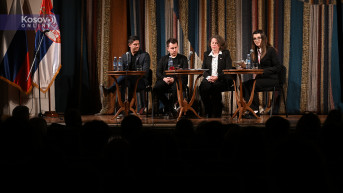
"The hardest thing for the Serbs was that there was no punishment for those responsible after that March 17. It was a rewarded crime. At that moment, I became convinced that the 'civilized Europe' pays more attention to those who commit evil than to those who defend against it. But we must continue; our holy places live on. We are Christ's people who will continue to resurrect," Radic said at the panel discussion 'Kosovo and Metohija – a lasting pogrom' held at the Russian House in Belgrade.
According to her, "that March 17 was the peak of the desolation of Kosovo and Metohija."
"It bothered them that Serbs gradually began to return to their homes, to rebuild their demolished houses. They wanted to prevent that and to drive us out, and they succeeded. After that March 17, none of us living in Kosovo can feel free anymore, aware that the same disaster could strike us the next day," Radic stated.
Describing the events from 20 years ago, she said that the Serbs in Orahovac and its surroundings had first heard about what was happening in other parts of Kosovo on television, and then they had heard the roar of the crowd from the lower part of the town.
"They shouted 'KLA, KLA' and started marching up the Soric Street. It was a Serbian street. Everyone who managed to escape that crowd fled towards the center, towards the church. The Grkic married couple didn't succeed. They broke into their house and literally trampled them. I rushed outside with the children and realized I had nowhere to escape. Albanians were all around us. We hid in the house, and there we heard a shout, order in Albanian, and they withdrew. I don't know why they did that. The whole of Soric Street was on fire, and there were no more Serbs there. Later, we had to move out of other streets closer to the Albanian part," Radic stated.
Satirist, a sociology student at the University of Pristina Jovan Zafirovic was seven years old on March 17, 2004, and lived with his parents near Kosovska Kamenica.
"Our villages were purely Serbian, and we weren't targeted. But everyone watched TV in disbelief and wondered what would happen next. I remember many people from the cities, especially Gnjilane and Kosovska Kamenica, moved to relatives, to us, in the villages. As a child, I couldn't understand why someone would leave the city to live in a village. Today, after 20 years, I think - where would I go if they try to drive me out of my village? I have nowhere to go," Zafirovic said.
As the most memorable image, he remembers a scene from the television where a mother held a child in her arms, and another child ran after her, carrying a toy.
"At that moment, I thought, if they come for us, which toy will I take with me..." Zafirovic said.
He said that he was not optimistic about the survival, especially of young Serbs in Kosovo.
"It must be said, that young people only think about finishing their studies and getting a passport and leaving. They don't want to leave, but for existential reasons, they think they have no other solution," Zafirovic stated.
The President of the Humanitarian Organization "Kosovo-Pomoravlje," Nikola Vasic, says that what happened to Serbs on March 17, 2004, continues to this day.
"It's a crime that actually never stopped since then. And today, people are arrested just because they are Serbs," Vasic said.
He added that on March 17, the international community had shown all its impotence.
"KFOR, the army that came to ensure peace for all citizens that day, showed that it was not capable of doing so. They were not able to protect the Serbs," he said.
Vasic emphasized that the image that was imprinted on him was when the Serbs from Klokot started to move out.
"Before them stood a monk from the Draganac Monastery who sent them back home. This is proof that the church is with its people," Vasic said.
He concluded that the current biggest problem was how to retain the young because they were leaving not only out of fear but also due to economic factors and living conditions.
At the panel organized by the Serbian Political Forum from the Faculty of Political Sciences in Belgrade and the Serbian Youth for Kosovo and Metohija, it was stated that the events of March 17 and 18, 2004, had been the largest ethnic cleansing in Europe in the 21st century.
It was noted that more than 4,000 Serbs had been expelled from their burned and destroyed homes, and six cities and nine villages had been ethnically cleansed.
Nineteen people lost their lives, while more than 900 were beaten and severely injured.
Thirty-nine Orthodox churches and cultural monuments were destroyed, which, as mentioned, these same vandals today seek to claim as a part of their cultural heritage.
The panel discussion had a humanitarian purpose, and all the funds collected were intended for the maternity ward in Pasjane, for the purchase of a delivery table.


0 comments