
Ruzin: Macron and the EU have marginalized the Western Balkans and the Belgrade–Pristina dialogue
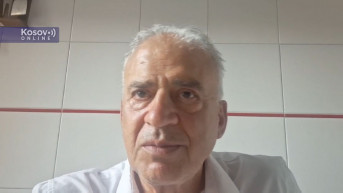
Former Ambassador of North Macedonia to NATO and professor of political science and geopolitics, Nano Ruzin, assessed that turbulence within France is diminishing the influence of Emmanuel Macron in the European Union, while also marginalizing the Western Balkans and the issue of the Belgrade–Pristina dialogue.
Ruzin emphasized that the crisis in France could be mirrored in the EU, with the Balkan region bearing the consequences.
“On the external front, too much attention is being devoted to Ukraine and Moldova, in other words, to EU enlargement in that direction. One gets the impression that the Western Balkan countries, with all their challenges—from EU enlargement to the problems between Belgrade and Pristina—are somehow falling into the background. In other words, both Pristina and Belgrade, as well as the other countries of the Western Balkans, will increasingly rely on EU leadership rather than on the significance Macron once had. Thus, the Western Balkans have been marginalized both in Macron’s eyes and in the eyes of the EU,” Ruzin told Kosovo Online.
He argued that the unfavorable situation in France has also weakened the country’s influence, pointing out that Macron currently has the lowest approval rating of any French president, standing between 12 and 15 percent.
“He is trying to use foreign policy as a kind of trump card to improve his ratings—in other words, to focus less on domestic affairs and concentrate solely on foreign policy in the hope of boosting his political standing,” Ruzin explained.
As a result, he believes there has been a “decline in France’s traditional monopoly.”
“France has long been one of the engines of the European Union and a country that drove the Union forward during Merkel’s era. Macron and Merkel were the twin engines. But today, France enters both the EU and the broader international community weakened. Just recall what Trump says and what his positions are toward Macron—France has lost the credibility it once had,” Ruzin stressed.
According to this analyst, a keen observer of French affairs, the country is currently experiencing its “greatest economic, political, and social crisis” since 1958, despite the fact that under the Constitution, most executive power lies in the hands of the president.
He added that many analysts explain the overall crisis in France through a combination of factors: the impact of the COVID-19 pandemic, the war in Ukraine, rising prices, and the poor economic, social, and budgetary policies of Macron’s government.
Ruzin argued that Macron has made several political mistakes in recent years, the most critical being the dissolution of parliament following poor results in the European Parliament elections.
“That is considered one of his biggest blunders. He then called new elections, in which he was defeated even more drastically by Le Pen’s party and the Socialists,” the analyst noted.
He interprets the frequent changes of prime minister as a result of France’s “huge public debt,” amounting to €3.4 trillion, or 113 percent of gross national product.
This was also the reason for the dismissal of François Bayrou and the appointment of the new Prime Minister, Sébastien Lecornu.
“The French must tighten their belts and show discipline. Working hours need to be increased and two days off removed… Bayrou’s policy failed,” Ruzin explained.
Another challenge, he said, lies in the disunity of the EU.
“Just look at the handling of COVID-19 up to the present, especially the Ukraine crisis, and now the issue of Gaza—you see a fragmented European Union. The EU has weakened in terms of a unified approach to global problems. In a way, it has timidly left that role to the United States,” the analyst observed.
Ukraine, he underlined, is currently the greatest security challenge for the EU, but the Union has shown it lacks the military capacity to resolve the crisis.
“The announcements that the United Kingdom, which is not an EU member, and France are ready to send troops to Ukraine remain tentative, as no other EU country is prepared to do so. I am thinking of Poland, Germany, Spain, Italy…” Ruzin said.
He noted that an additional problem for France does not lie so much in the announced protests and blockades, but rather in the fact that no one can predict the outcome of the war in Ukraine.
“Macron’s opponents argue that perhaps the best solution is for Putin and Zelensky, with Trump’s mediation, to be compelled to sign a peace agreement. If Russia retains the territories it has conquered, this would amount to a victory over both the EU and France. And that is not a good sign, because Putin could be emboldened to continue territorial expansion. But the question is whether there is any other option. Would the alternative be to fight for another decade while European powers strengthen and increase their support for Ukraine? I don’t think the world is ready for such a scenario. Peace negotiations may take place. The EU must play a significant role in those talks between Russia and Ukraine,” Ruzin concluded.


0 comments