
Sabovic: The draft of the CSM based on the Brussels Agreement will be a legal entity without executive powers
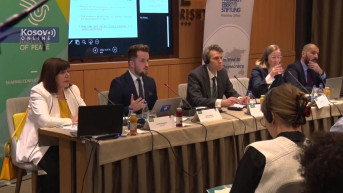
A member of the European Institute for Peace, Senad Sabovic, after the presentation of the statute of the CSM by the German "Friedrich Ebert" foundation, said today that the draft was based on the Brussels Agreement from 2013 and 2015 and added that the CSM was a legal entity, but that it would not have executive powers.
As he stated, the goals were to initiate a public debate based on a specific proposal.
"We had a lot of public debates, but as far as I know, there was no opportunity to hold a public debate based on a specific proposal. The goal is to see how it would look concretely and what it would represent for the included municipalities and the population," he said for Kosovo Online.
According to his words, the CSM would have a large number of functions and all the bodies foreseen by the Brussels Agreement, as well as the budget.
"The Community of Serb-majority Municipalities is a legal entity within the public system of Kosovo and represents a significant resource for the residents of the Community. It has a large number of functions; all bodies that are provided for in the Brussels Agreement; has an integrated budget and economy of functioning and use of funds," Sabovic added.
However, as he pointed out, it would not have executive powers.
"It has no executive powers, in the sense that it is not the third level of government, it cannot take over the executive powers of the member municipalities, because it is contrary to the judgment of the Constitutional Court of Kosovo. I do not know whether this statute differs from the Brussels Agreement in this respect because on this issue there are different opinions," Sabovic said.
He stressed that the CSM would not be a mono-ethnic creation, but a multi-ethnic one.
"The CSM will not be mono-ethnic, it must be multi-ethnic. The Constitutional Court ruled that it could not be like an entity within the local government; it could not be mono-ethnic. If the municipalities are multi-ethnic, the Community cannot be mono-ethnic. This does not mean that it must fight equally for all communities. This is a comprehensive resource for the given ten municipalities and it is known which population is the majority in them," Sabovic said.
He added that the President was elected by the Community Assembly, which was also the highest authority.
Professor of the University of Pristina, Gjyleta Mushkolaj, pointed out that they had worked for a long time on the statute of the CSM in order to initiate the process and make it easier for everyone.
"The association, like any other, is very important for the prosperity and life of citizens, especially the population that is not the majority in a country. According to our laws, municipalities, where Serbs are the majority, have greater responsibilities than other municipalities. In order to really prosper in this country - this is very important for these municipalities so that they can better initiate the interests of the Serbs living in Kosovo," Mushkolaj said.
She added that it was important for the Serbs in Kosovo to coordinate with Serbia.
"Through the Community of Municipalities, greater cooperation is possible to ensure prosperity for the Serbs living in those municipalities. Likewise, minorities living in these municipalities will have their own channels so that they are not discriminated against by the majority population. Kosovo is a multi-ethnic society. Roma, Ashkali, and Egyptians should also have their own channels so that they are not discriminated against," Mushkolaj said.
She concluded that the CSM would enable everyone to have a better and more prosperous life in Kosovo.

0 comments