
Simic: It is a disgrace for the CEC and representatives of the international community that the law is being violated for the third time
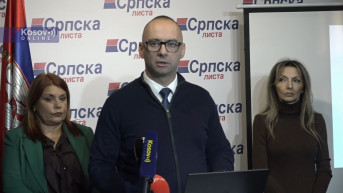
Igor Simic, a member of the Presidency of the Serb List, stated today that the Central Election Commission (CEC) has adopted a decision on the composition of polling station committees for the upcoming extraordinary parliamentary elections, in which it has violated both the law and its own Rules of Procedure to the detriment of the Serb List. For this reason, he said, they have once again submitted an appeal. He emphasized that it is shameful for the CEC and for international representatives that laws are being violated for the third time this year to the detriment of the Serbian community.
“I must ironically note that these kinds of press conferences have become traditional. These are the third elections this year, and the third time that Albanian parties in the CEC wish for the Serbian people to become accustomed to illegality and the violation of their rights. We will not accept such a thing,” Simic stressed.
He said that the manner in which the CEC treats the Serb List is disgraceful, pointing out that the party holds all 10 mayoral posts in the 10 Serb-majority municipalities and won all 10 mandates in the previous parliamentary elections—one of which, he said, was later taken away through electoral engineering.
“The CEC held a session yesterday and adopted a decision on the composition of polling station committees. Once again, the decision was taken contrary to the law and to the CEC’s own Rules of Procedure, which stipulate that the CEC shall invite confirmed political entities to nominate one member each to the polling committees, and that it must ensure fair representation based on population and representation at the municipal level,” Simic explained.
He added that, although it is a legal obligation, the CEC did not deliver its decision to the Serb List, which only learned of it late last night through its representative.
“We immediately began preparing the appeal, which we submitted this morning at 10 o’clock,” Simic stated.
He noted that the decision regarding the vote-counting centers was delivered to the Serb List only this morning at 9:28 a.m., meaning they had only a few hours to file an appeal instead of the required 24 hours.
“This is a disgrace for everyone in the CEC, and for international representatives, because this is the third time in the same year we are talking about a violation of the rights of Serbs, and nothing changes. It is also a shame for those who consider themselves neutral observers, because three times in a year we face the same problem—the non-certification of the Serb List—while some other parties face no such obstacles,” Simic underlined.
He presented specific data regarding the number of chairpersons of polling committees in Serb-majority municipalities.
Thus, in Novo Brdo, the Serb List—despite winning 61.39% of the vote—will receive only three out of 23 committee chair positions, while Self-Determination, with seven times fewer votes, will receive twice as many chairs, as will PDK and LDK, and the party of Nenad Rasic, which received zero votes, will nonetheless receive two chair positions.
In Leposavic, despite winning 75% of the vote, the Serb List will receive seven out of 25 chair positions—the same as Self-Determination, which won only 1.56% of the vote.
“Rasic, Kurti’s favorite politician, will have four out of 25 chair positions,” Simic said.
In Strpce, the Serb List will receive only two out of 17 chair positions despite winning 62.02% of the vote. The Alliance for the Future of Kosovo, which received zero votes, will also receive two chairs. The party For Freedom, Justice and Survival, with 7.44% support, will likewise receive two.
Meanwhile, Albanian parties with significantly fewer votes will receive more chairs: Self-Determination and PDK will receive four each, and LDK three.
Simic added that in Zubin Potok, where the Serb List won 75.12% of the vote, it will receive only three of 15 chairs—the same as Self-Determination and PDK, which won 14 or 15 times fewer votes, or LDK, which won 75 times fewer votes.
The situation is similar in Zvecan, where the Serb List, with 86.77% of the vote, will receive only two chairs, the same as LDK, which won no measurable support. Self-Determination and PDK will each receive three.
He also cited Partes as a particular paradox: the Serb List will have only three out of seven chairs, while Rasic’s party—despite receiving zero votes—will have the remaining four.
A similar situation exists in Ranilug, while in North Mitrovica the Serb List, which won 65.36% of the vote, will have the smallest number of committee chair positions.
Simic noted that at five polling stations in North Mitrovica, the Serb List will have no committee members at all, meaning it cannot monitor the process.
“Once again someone is using tricks and unlawful administrative decisions to influence the electoral process and create conditions that favor those close to the regime in Pristina,” Simic stated.
In Gracanica, the Serb List—despite winning 63.92% of the vote—will have only six out of 34 chairs, while Albanian parties will receive 22, and Rasic’s party, with ten times fewer votes, will also receive six.
He added that in Klokot, under the current CEC decision, the Serb List and For Freedom, Justice and Survival will each receive one chair, while all other parties will receive more.
“In the 28 Albanian-majority municipalities, the Serb List will receive zero chair positions. In the 10 Serb-majority municipalities, Albanian parties—Self-Determination, PDK, and LDK—will receive 107 chair positions. That is what democracy and respect for the ethnic composition and population of municipalities in Kosovo apparently look like,” Simic said.
He reiterated that the Serb List has filed an appeal, but noted the paradox that the Election Complaints and Appeals Panel previously upheld the same appeal before parliamentary elections—yet the CEC did not implement it or allow sufficient time—while before local elections the same Panel rejected their complaint.
“It is obvious that we Serbs in these areas must take the harder path. We do not mind that, but we do mind when those who speak loudly about democracy and the rule of law write reports on the democratic process, yet fail to mention the composition of polling station committees,” Simic remarked.
He warned that if Serbs are marginalized in polling committees—and since these committees vote in cases of legal violations—the representatives of the Serb List will always be outvoted.
“That is why we are fighting for this. We seek genuine democracy, in which, when we run in elections, we have equal participation,” he said.
He added that despite everything, they have no right to withdraw and will not do so.
“With unity and solidarity, such decisions will not prevent Serbs from choosing their own representatives,” Simic stressed.
Asked what the Serb List will do to prevent a repeat of what happened in the previous parliamentary elections, when one of its mandates was effectively taken away, Simic said they will use all available mechanisms to prevent falsification of the results.
“We will engage the maximum possible number of observers, but there are several thousand polling stations in Kosovo, and we cannot monitor all of them. We have encountered attempts to prevent our observers from monitoring voting, under the pretext that there is no space or that secrecy is compromised. We will not allow this. We call on NGOs and the media to participate. This is a fight for all of us—for rights and justice,” Simic said.
He added that the Serb List has proven that it enjoys the strongest support among the Serbian community and believes it will maintain that support.
“We cannot influence Djakovica, Skenderaj, Podujevo or Prizren so that someone wins more than 150 votes. I would like if so many Serbs lived there, but they do not. Those are not Serbian votes—others decide who obtains that mandate,” Simic said.
Asked about meetings with international representatives, he replied that the Serb List has an obligation to meet them in order to convey the situation faced by the Serbian people.
“Unfortunately, apart from some level of understanding, we do not see concrete actions that would bring change on the ground. I sometimes personally wonder what the purpose of those meetings is,” he remarked.
He emphasized that the Serbian people can rely only on their own state and on President Aleksandar Vucic.
“We know what happened over the past three years when Albin Kurti violated all the rights of the Serbian people, and what the Serb List has endured—proceedings have been launched against all its leaders and prominent Serbs on charges of attacking the constitutional order. Institutional pressure is being exerted on every Serb who refuses to be obedient to Pristina. This cannot and must not intimidate us,” Simic said.
He added that, on the one hand, it is both a blessing and a great honor to live in Kosovo when more than 40,000 Serbs believe you will fight for them and work to ensure normal living conditions in the 21st century.
However, he expressed doubt that the Complaints and Appeals Panel will overturn the CEC’s decision, stressing that the Serb List faces systematic institutional pressure.
“We took part in the previous elections under similar conditions and won a convincing victory. That is why I call on citizens to show responsibility, unity and solidarity,” Simic said.
Asked what conditions the newly elected mayors found upon assuming office, Simic said he personally visited Zvecan and found that the municipal building resembles anything but an institution.
“When you see it, you ask yourself who was in that building and what its purpose was. How could any human being have worked there? Everything was destroyed, all computer equipment removed, dampness appeared from the first to the third floor. Someone deliberately sought to destroy everything,” Simic said.
He emphasized that in North Mitrovica and Zvecan, more than 90% of employees in the municipal administration were Albanians, fewer than 3% of whom speak Serbian—raising the question of how they could provide services to Serbs.
He reported that in Zvecan, walls were dug into, while in Zubin Potok, Kosovo Police lit fires on parquet flooring, removed electrical outlets, and burned air conditioning units. In Zubin Potok, he added, a children’s playground was turned into a parking lot to demonstrate force.
Simic called on citizens for patience, noting that major changes require time, and added that the new mayors have requested reports on the financial situation and on the status of municipal property, which has often been unlawfully occupied.


0 comments