
Starovic: With Kurti, it's hard to be optimistic about Dialogue progress
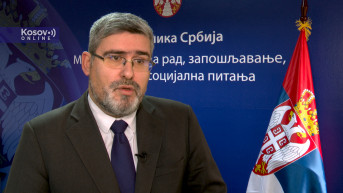
Serbian Minister for European Integration, Nemanja Starovic, emphasized that it is difficult to be optimistic about progress in the dialogue while Albin Kurti remains at the helm of institutions in Pristina, as he continuously ignores the dialogue and implements unilateral measures that are typically directed against the Serbian population in Kosovo.
“It’s hard to be optimistic given our bitter experience, especially over the past four years, during which Kurti has led the institutions in Pristina. It’s true that our EU accession is conditioned by progress in the normalization process with Pristina, which is part of Chapter 35, and this chapter is evaluated during the opening or closing of every other chapter. Since Kurti has been ignoring the dialogue and implementing unilateral measures targeting Serbs in Kosovo and Metohija, it would hardly make sense for the EU to blame Serbia for the current standstill in the dialogue,” he said in an interview with Kurir.
Starovic noted that he had the opportunity early in his mandate to meet with the EU’s envoy for the Belgrade–Pristina dialogue, Peter Sørensen, and expressed hope that he would succeed in revitalizing the dialogue and making it relevant again.
“However, I believe that the EU is not the only actor that can contribute to the dialogue and normalization between Belgrade and Pristina, or between Serbs and Albanians more broadly. The active involvement of the top level of the Trump administration could help stop the deterioration of the situation on the ground and pave the way toward a sustainable compromise,” Starovic added.
He stated that Serbia had met all technical conditions for opening the third cluster of negotiating chapters as early as the end of 2021 and had already received a recommendation from the European Commission for its opening.
“In fact, we've been receiving that positive recommendation for four consecutive years. However, the final decision of the European Council, composed of the heads of state and government of EU member states, has been absent for evidently political reasons. In recent years, we’ve been facing political expectations from certain member states that go beyond what is defined in our negotiation framework. So, beyond what has been codified and accepted as obligations in the accession process, some expect Serbia to change its political stance on issues of great importance to us—without any guarantee that such a shift would lead to the opening of membership doors. We aim to overcome such obstacles through a consistent policy and by fully implementing all aspects of our Reform Agenda,” Starovic stated.
Asked how much Serbia is held back by political conditions and how this can be circumvented, he responded that much more openness and sincerity is needed from those dealing with EU enlargement.
“It’s up to us to decisively and efficiently implement the reforms we've committed to, and it’s up to Brussels and the capitals of key EU member states to finally open the door to enlargement, instead of hiding behind bureaucratic procedures or bilateral blockades. Political conditionality is a reality and cannot always be avoided, but it is important that such demands remain within the realm of the possible and that their fulfillment is clearly evaluated—which unfortunately has not always been the case, especially with regard to some of our neighbors,” he said.
Regarding the current political crisis in Serbia and the blockades that have become a new normal, Starovic said the only solution is dialogue and political compromise.
“The formation of this Government of Serbia, with Professor Dr. Macut at its head, already represents an outstretched hand toward citizens involved in the protests. I believe this will significantly help ease social tensions. While respecting the right to political assembly, I believe unlawful traffic blockades are completely unacceptable, as they amount to violence against the normal life of all citizens. From the perspective of my ministry, I can responsibly say that there is no EU member state where such prolonged public disorder would be tolerated, which again speaks to the strength and depth of Serbia’s democratic foundations, where the state apparatus exercises maximum restraint before using legitimate force,” he added.
He noted that this week, European Commissioner for Enlargement Marta Kos visited Belgrade, and that visits from European Council President António Costa and EU High Representative for Foreign Affairs and Security Policy Kaja Kallas are expected by the end of May.
“I believe this unusually high intensity of visits speaks volumes about the importance the EU places on Serbia, as reflected across various institutions. High-level meetings serve to reaffirm mutual commitment to Serbia’s EU accession. For us, EU membership is a national interest, but the EU also has a clear political, geopolitical, economic, and security interest in expanding to the Western Balkans—because that’s not expansion, it’s completion,” he explained.
Commenting on the fact that EU enlargement to the Western Balkans is declared a priority of the new European administration, but without concrete steps, he said a certain degree of optimism is necessary to do the job enthusiastically—but it's not always wise to express that optimism publicly.
“Especially because when it comes to results that Serbian citizens rightfully expect from the accession process, not everything is in our hands. That’s why I won’t speculate about the steps the EU or its member states should take, nor will I hazard a guess on the date of our EU accession. Making such projections over the past 25 years—often with good intentions—has proved harmful, leading to disappointment among parts of the population whose active participation is now crucial for Serbia’s EU path,” Starovic noted.
Regarding the Serbian president’s upcoming visit to Moscow for Victory Day and the anticipated negative reactions—particularly from Brussels—he pointed out the evident political gulf between Brussels and Moscow, which has become vast since the war in Ukraine began.
“In such circumstances, any communication—let alone cooperation—with Russia draws criticism and becomes a trigger for threats. For us, marking the 80th anniversary of victory over fascism is purely a commemoration of historically significant events. We believe that Moscow is the right place to mark this milestone, acknowledging the Red Army’s role in liberating Europe and the immense sacrifices of the Russian and other Soviet peoples. We’re too small a country to bridge the deep rift between Brussels and Moscow, but we can explain to all our interlocutors that Serbia lives in the year 2025 and strives for a future defined by peace, stability, and development—not Orwell’s 1984, where a ‘Ministry of Truth’ rewrites history to suit current political needs,” Starovic stated.
Asked about potential consequences for Serbia if EU criticism turns into concrete steps or measures, he refrained from predictions but noted that at least one EU leader—Slovak Prime Minister Robert Fico, who is also a member of the European Council—will attend the May 9 celebration in Moscow.
“There is no doubt that this will affect how Serbia is perceived by some EU member states, but some of them already hold negative preconceptions about us. Our main complaint against the EU is precisely the shift from a merit-based accession process to one governed by political perceptions and expectations of member states, rather than written commitments. This diverges from the model that applied to all previous candidate countries,” he said.
Starovic concluded by stressing that a de-escalation of the war in Ukraine—even a ceasefire—would greatly benefit Serbia, both economically and politically.
“With that in mind, we truly welcome President Trump’s initiative to end that terrible war. You rightly point out the differing perspectives of Brussels and Washington on the desired outcome of the war in Ukraine—as well as on many other key issues. There used to be a saying in Central and Eastern Europe that the fastest route to Brussels was via Washington. That may no longer fully apply today, but it is certainly unimaginable for any EU candidate to progress while antagonizing or clashing with the United States. That is definitely not Serbia’s path. We will invest significant political will and effort to improve relations with the U.S. during President Trump’s second term, and ultimately that could strengthen our overall capacity to join the EU,” he concluded.

0 comments