
Vucevic: I fear a new provocation in Kosovo on Monday, during the time of the Berlin Process Summit
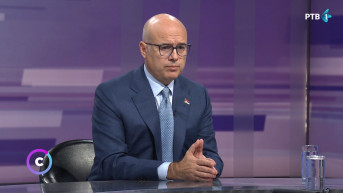
Serbian Prime Minister Milos Vucevic stated this evening that he fears a new provocation in Kosovo aimed against Serbs on Monday, while the Berlin Process Summit is being held in Germany.
"I fear that on Monday you will see a new provocation in Pristina, because people who are veterans of such formats and events have shown me that every time there was a plenary-level meeting, something bad happened to us in Kosovo and Metohija from Pristina. I hope it won’t happen, but I have a suspicion that Albin Kurti will do something that morning," Vucevic told RTV.
He fears that Serbia’s provisional institutions might be attacked.
"Or that they might shut down two or three municipalities under the Serbian system, disperse people, close offices, just to send a message," Vucevic added.
He pointed out that the Berlin Process is important for regional stability, as it has brought results which should not be underestimated, even with varying degrees of intensity.
"I'm proceeding with caution because there's always a chance that someone will use this gathering to accuse Serbia of being a disruptive factor," the Prime Minister added.
He said that it is "far better" news that Pristina has decided to partially lift, as he emphasized, the unilateral and unjustified ban on the entry of Serbian goods into Kosovo.
"For now, it's only through Merdare, and they justify it by saying they can't use Jarinje and Brnjak until they receive equipment, scanners from Germany... Kurti will spin the narrative that when this equipment arrives, it will confirm that Western partners understand and recognize Pristina's concerns about what might be supplied to Serbs in Kosovo and Metohija," Vucevic believes.
He emphasized that the most important thing is for the Serbian community to receive food, medicine, and essential supplies on time.
Regarding CEFTA, Vucevic explained that UNMIK remains a part of CEFTA, and Belgrade has agreed that Pristina can technically participate in meetings, with a footnote next to its name.
"UNMIK is the signatory to CEFTA, and that doesn't change, but Pristina will be able to attend technical meetings with a footnote," Vucevic added.
Regarding Kurti's statement that he is going to Berlin as a "victor," the Serbian Prime Minister said he is not surprised, given that elections in Kosovo are on February 9.
"What else is there for him to talk about? There’s no Expo, Bio4 campus, high-speed railway; he can't talk about highways, railway reconstruction, or new terminals... We must understand that he has nothing else to talk about except that he is a victor and that he is solving the Serbian issue and, as they say, finalizing their Kosovo independence agenda," Vucevic emphasized.
He stated that he is aware of forthcoming criticisms and stressed that it would be much worse if Serbia were absent from the Berlin Process Summit.
"It’s far worse for decisions to be made about us without us. What we think of each other, you can imagine. We don’t have any affection, we only look out for our interest — to maintain peace and political stability in the region, for Serbia to develop peacefully, and to realize projects. The most important thing is to protect the Serbs in Kosovo and Metohija," Vucevic said.
He noted that the Berlin Process is important for Serbia, as well as anything that contributes to regional stability, moves away from conflict, benefits citizens, and creates conditions for wage and pension growth.
He added that he expects significant pressure regarding Kosovo, as well as regarding sanctions against Russia and the Republic of Srpska.
Vucevic reiterated that Serbia's stance on not imposing sanctions on Russia remains unchanged.
"We don’t believe in the politics of sanctions, President Vucic and the Serbian government have emphasized this, and that position remains," the Prime Minister stated.
He added that he expects pressure concerning the Republic of Srpska and ongoing attempts, more or less successful, to revise the Dayton Agreement, citing the trial against RS President Milorad Dodik, which he said could have serious consequences for Bosnia and Herzegovina.
Yesterday marked the fifth anniversary of the establishment of the "Open Balkan" initiative, which has delivered concrete results. Vucevic said his impression is that Tirana and Skopje do not see this regional initiative as a priority now.
"Edi Rama has stated that the “Open Balkan” is a finished process for them. The “Open Balkan” needed to further develop and deserved the inclusion of Montenegro and Bosnia and Herzegovina. This would have given it more substance. It is undeniable that the “Open Balkan” has brought many positive outcomes for Serbia, North Macedonia, and Albania, improving historically complex relations between Serbia and Albania and putting relations with North Macedonia where they should be," Vucevic said.
He stated that there is nothing negative in the relationship between Serbia and North Macedonia, but there is disagreement on the issue of Kosovo, which is the most sensitive for Belgrade.
"We recognize their sovereignty, as well as their identity, national, linguistic, and cultural matters. The Serbian Orthodox Church granted autocephaly to the Ohrid Archbishopric—the Macedonian Orthodox Church. As far as we are concerned, those matters are entirely clear, and they do not have any disagreements with us on the issue of Kosovo and Metohija, which is the most sensitive issue for us," Vucevic said.
0 comments