
Vucic: Serbia wants to implement all agreements, but it does not accept Kosovo's independence
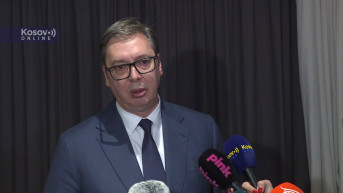
President of Serbia, Aleksandar Vucic, stated this evening, following talks with EU leaders, that Serbia had clearly, in line with its policy, stated its desire to implement all agreements, and had consistently emphasized that it could not accept Kosovo's UN membership, adding that it would be clear to everyone in Europe who was hindering progress.
In these discussions, he said that all key topics of the agreements signed in the past had been discussed.
"Serbia has clearly stated, in line with its policy, that it wants to implement all agreements signed from the Basic Agreement in 2013 to all others. We've always emphasized one thing that has been known from the beginning: Serbia cannot accept Kosovo's UN membership or Kosovo's independence. We are prepared to fulfill everything necessary within these positions," he explained.
He assessed that the paper he had received on October 21 from EU representatives was a good basis for future work.
"The only thing we have reiterated reservations about concerns Kosovo's UN membership. We have acted responsibly and seriously. We are fully prepared to form the CSM in accordance with the proposals we received," Vucic emphasized.
He denied claims that he refused to sign anything.
"It was not a matter of signing but rather implementing what was agreed. I want peace in the entire region, and we will continue to act responsibly. We need to make progress. It will be clear to everyone in Europe who is hindering progress," Vucic emphasized.
The paper relates to the formation of the CSM, a good basis for the continuation of the dialogue
Answering reporters' questions, Vucic stated that the paper from October 21 related to the formation of the CSM, and provided a good basis for continuing the dialogue. However, he couldn't discuss the details as it was agreed not to disclose them.
He says that Belgrade is a reliable, responsible, and serious partner that adheres to the agreement not to disclose details, which wasn't the case with some other parties in the past when there were agreements regarding other papers that were later published in the Albanian Post, making it clear who had released them.
"That paper is very solid and a very good basis for continuing the dialogue and implementing what has been agreed upon. There is an important condition I have been talking about all along and have informed the heads of states and governments of the three most powerful European countries and the most powerful people in the EU. That condition is always the same and relates to Kosovo's UN membership and Kosovo's independence," Vucic said.
He added that he knew very well what remained from the agreements, from the issue of stamps to license plates. He also said that they were close to an agreement on the energy sector, and representatives of Elektrosever and KEDS Energy would meet in Skopje tomorrow.
"I can't speak about the details. What's important for us are the principles from 2015; it's important that Serbia can finance healthcare and education. You know how much disruption there is, from preventing ambulances from entering to not delivering medicines to hospitals and health centers," Vucic said.
It's challenging to negotiate with those who have long recognized Kosovo
In response to a question from a German journalist about what he called ten years of marathon negotiations, Vucic pointed out that negotiations and discussions took time.
"I'm not one of those who think that the world begins with them. Negotiations have been ongoing before that. It's true that it's very difficult to conduct discussions on the same level with those who have long made the decision to recognize Kosovo's independence," Vucic said.
He noted that even today when it comes to Israel and Gaza, everyone refers to various UN resolutions, but whenever Serbia invokes international public law, which is at the core of UN resolutions, it is told they will find other principles.
"In that sense, the position is challenging, and I don't think it will be any easier in the future. We will continue to fight, and we can be proud that we uphold international public law," the President said in Brussels.
Regarding whether any European representatives mentioned sanctions against him or Serbia, Vucic said that no one had mentioned any sanctions against Serbia.
"I heard that others mentioned them, but when someone is responsible and serious, they know they cannot conduct EU's policy. I've never said here that sanctions should be imposed against someone in Kosovo, Sarajevo, firstly because I'm decent, I know whose job is what, and secondly because I know that imposing sanctions creates a bad atmosphere from which it's not easy to get out," he said.
He also emphasizes that today, as always, he insisted on Serbia's positions and interests.
There was no talk of signing anything
In response to a question from an Albanian journalist about whether they discussed signing something today, Vucic said there had been no discussion about signing anything, reminding that this had been done in Ohrid, as well as long before Ohrid, in Brussels.
He pointed out that it had been signed in 2013 and it should have been implemented, but it hadn’t been in the past 10 years.
"I said that we were ready to implement almost everything, but we would not accept Kosovo's independence and Kosovo's membership in the UN," Vucic said.
He emphasized that it was not about signing but about implementation, and asked why the Serbs were leaving Kosovo, wondering if it was because life was much better for them.
The President once again stressed the need to preserve peace and stability.
Support for the creation of the "Kosovo army" is a violation of UN Security Council Resolution 1244
Asked to comment on the statement of the US and German Ambassadors in Pristina that they would support the transformation of the KSF into an army and that Kosovo would one day be a part of the NATO family, Vucic said that he had not seen those statements in their entirety, only the headlines, so it would be unprofessional to comment on them.
"You must keep in mind a very important thing. When NATO and KFOR refer to the norms of the Kumanovo Agreement, UN Security Council Resolution 1244, and the entire KFOR mandate is based on that resolution, they are rightfully referring to it, and we support NATO and KFOR's actions in line with that. We expect them to expand their mandate and increase the number of personnel. The problem is when, beyond the mandate, you say you will support the creation of some Kosovo army because you have no right to do so if you operate in line with UN resolutions. When I pose that question, they respond, 'we recognized Kosovo and they have the right to it'. It's not a problem, but don't then refer to international law," Vucic said and added that nothing was in line with international legal norms.
Asked about the EU's proposal, he said he was ready to sign anything that Serbia is required to fulfill, except Kosovo's UN membership, Kosovo's independence, and territorial integrity.
"Not that, everything else, yes. And that's nothing new. I said it a year and a half ago, eight months ago, a few days ago," he added.
Vucic emphasized that Kosovo should have fulfilled its obligations first, but Serbia was ready to fulfill the obligations in parallel.
"But I know they won't fulfill their obligations. Sorry, you will have to fulfill them!" he underscored.
Asked if the EU proposal stated that Serbia should recognize Kosovo, he said not in that way, but indirectly.
"The topic is the CSM, and it is entirely clear who does not want to fulfill the Basic Agreement," he added.
All of this is someone's game; now everything is much clearer to everyone
When asked how the dialogue would proceed if Kurti's condition was imposing sanctions on Serbia, he said that all of this was someone's game to try to shift blame and responsibility to the other side.
"We had to go through all this all the time. But I think the leaders and advisers who came in the late afternoon hours have a much clearer situation than they had before," Vucic concluded.
0 comments