
Vucic: We demand and appeal to the UN to react, and to Turkey to respect international law
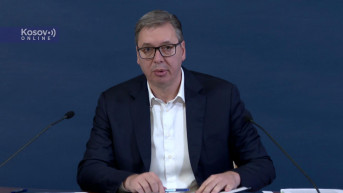
The President of the Republic of Serbia, Aleksandar Vucic, emphasized today that, in connection with the delivery of “kamikaze” drones to Kosovo, Serbia both demands and appeals to the United Nations to react and to ensure respect for the resolutions that have been adopted, as well as for the UN Charter, and that Turkey, as a partner and friend, respect the elementary norms of public international law.
Vucic stated that yesterday he reacted strongly—some might even say too strongly—to the additional arming of Albanians in Kosovo by Turkey, and added that this is not directed against anyone, but rather is aimed at protecting the international legal order, protecting the Serbian population in Kosovo—which, he underlined, is the principal goal—and preserving peace and stability.
“We demand and appeal to the UN to react and to ensure respect for the resolutions that have been adopted and for the UN Charter. At this moment we do not need any further escalation. We appeal once again to our Turkish partners to talk with us and take our interests into account. Turkey’s conduct is of the utmost importance for the stability of this region. Therefore I appeal to our Turkish partners and to President Recep Tayyip Erdoğan to consider not only their own interests, but those of the entire region, and of Serbia as a partner and friendly country. We call for respect for the norms of international law, the UN Charter, and UN resolutions. We desire the closest and best relations with Turkey, but we ask for respect for the elementary norms of public international law, as well as for the interests of Serbia and the Serbian people,” Vucic stressed.
He stated that he will always be a good host to President Erdoğan of Turkey, adding that Turkey is a great country and Erdoğan a great leader.
“The President of Turkey is always welcome in our country. My job is to build good relations, just as my job—when my people are endangered by the unlawful delivery of weapons—is to fight for their interests. I will certainly speak with President Erdoğan,” he emphasized.
Vucic recalled that more than a year ago, at Turkey’s Permanent Mission to the UN, he held a bilateral meeting with President Erdoğan, attended also by Foreign Minister Hakan Fidan, at which he requested that Turkey cease arming Pristina.
“I appealed and referred to Resolution 1244. I also referred to other instruments, from Resolution 1160 to the agreements of 2013. I asked that this not continue. We made the same request to the Americans, who explained that they had nonetheless made a decision regarding the Javelin,” he said.
“Is this a force that can frighten, defeat, or endanger Serbia—no; but the intention to continue down that path is worrisome,” Vucic stated.
He said that the provisional institutions in Pristina are attempting to implement a ten-year plan for the transition of the KSF into the Kosovo army.
“The equipping with complex combat systems is intensifying. Turkey leads the way in this, the British, Croats, Germans, Slovenians—everyone is contributing something. Some provide helmets, others weapons; the United Kingdom provides shooting-range equipment and facilities for physical training; Germany over 300 trucks and other transport vehicles; 375 crowd-control vehicles; a simulation center; medical equipment; a classroom for learning the German language,” Vucic said.
He recalled that the contract for the delivery of “kamikaze” drones was signed in December 2024, and that delivery was planned for January of the following year, but that they arrived yesterday.
On the criticisms of Vjosa Osmani: She is not from a neighboring country, she lives on our territory
Commenting on the statement by Kosovo President Vjosa Osmani that he had threatened Turkey, Vucic said he had stated that Serbia is too small, while Turkey is a great power—as he wrote in his response—and that he conveyed he had understood the message.
“It is not important how small we are. Our obligation is to protect the freedom and the right of our people to survive. You do not always ask how great the force is that attacks you, but how sacred is that which you defend,” the President of Serbia underlined, adding that in Kosovo there is a barracks named after Sultan Murad, and that he will see how many barracks in Serbia bear the name of Obilic.
Responding to Osmani’s claim that Kosovo is strengthening ties with NATO to ensure peace, and that “Vucic should try the same instead of constantly attacking neighbors,” he retorted that she is certainly not from a neighboring country.
“She is not from a neighboring country; she lives on our territory—and lives well, as we can see,” Vucic said.
He added that he does not threaten anyone, including Turkey, just as he did not threaten Osmani in Durrës, although she claims the opposite.
“I merely said that we wish her pleasant tourist visits in the vicinity of the United Nations building. There is that open-house day when they let them in to stroll. Each time I will make sure she has a nicer view from the UN building, so that the East River can blend into it for a beautiful picture, with rainbow colors or a sunset, so that she can say she was there and saw it—but still only as a tourist,” Vucic said.
Asked “what kind of thought process is that,” given that a year ago he spoke about a “golden age” in Serbia–Turkey relations, while yesterday he mentioned a “return of the Ottoman Empire,” Vucic said that this is the logical thought process of a responsible and rational president of a country—one who loves his country most in the world, understands how important Turkey is and what a significant leader Erdoğan is, and strives to build the closest relations, while also protecting the Serbian people in Kosovo.
“I have succeeded in doing that, and that indeed is the golden age of relations between Serbia and Turkey. And the President’s duty is that, at the moment when someone is unlawfully arming those who persecute Serbs in Kosovo and Metohija, he must point that out. If I had not done so, you would say that I am a coward and that I did not dare say anything to a great world leader,” Vucic said.
He added that he did the same more than a year ago in New York, when he had already once pointed out to President Erdoğan the problem of Turkey arming Pristina.
“I acted responsibly then as well. Yesterday I reacted because it was the last moment in which I had to react. Otherwise, I would have done everything not to have to react and to preserve the closest relations with Turkey—but not at the price of the survival of our people in Kosovo and Metohija. I will always respect President Erdoğan; I was the first to support him when the coup occurred in Turkey, and I do not regret it. But what does that have to do with the fact that I stood in defense of the Serbian people? That is the thought process of every Serb, every patriot, and every normal person—logical and clear,” Vucic said.
Serbs should turn out for local elections in Kosovo; the Serb List represents their interests
Ahead of the local elections in Kosovo, Vucic called on Serbs to go to the polls and vote for the Serb List, which, he said, does not take orders from Albin Kurti or from foreign embassies.
“We do not hide our calls to vote for the Serb List, because it is a responsible list that represents the interests of the Serbian people, and does not take orders either from Kurti or from the embassies. Is everything always ideal, is everyone good and honest—of course it is impossible; but these are people who have endured a level of terror that no political party in modern European history has withstood, both from the Albanian authorities and from those outside who persecuted only them,” the President said.
He listed the hardships faced by the Serbian people in Kosovo since February 2021, i.e., since Kurti came to power in Pristina.
From then until today, he said, there have been 702 unprosecuted ethnically motivated attacks on Serbs and the Serbian Orthodox Church, 37 of which targeted children and 115 churches and religious sites.
As for physical violence, 157 Serbs have been arrested—completely arbitrarily, without any law, indictments, or other charging instruments being brought.
Among those, he recalled, six Serbs were shot with service firearms by members of Pristina’s security formations, including one child, Stefan Stojanovic from Gotovusa.
There have been 205 cases of arbitrary police force used against peaceful Serbian civilians, 150 of them in the North, as well as the regular deployment of special police forces armed with long guns for all policing tasks, even for traffic control.
“From the ban on the use of the dinar, the illegal expropriation of one million square meters in northern Kosovo and Metohija, the forcible abolition of Serbian institutions providing public services to Serbs, violations of the special protected zones around SOC (SPC) sites and the nationalization of properties within those zones… the economic strangulation of dozens of Serbian companies through the abuse of inspections and a 14-month embargo on the import of Serbian goods; the institutional practice whereby Kosovo institutions violate their own regulations on the official status of the Serbian language; the legalization of the practice of raids on Serbian health and educational institutions; the unlawful seizure of millions of euros from the Fund for the North established by the dialogue agreements for the sole purpose of financing economic development projects in majority-Serb municipalities; the forcible eviction of Serbs from their apartments; the artificial alteration of the structure of majority-Serb municipalities,” Vucic enumerated the challenges faced by Serbs in Kosovo in recent years.
Answering a journalist’s question, Vucic said that Serbs in Kosovo have been endangered since 2000 and are therefore heroes who have always safeguarded their hearths, Serbian statehood and tricolor, the Serbian name and surname, and their homes.
“They will have our assistance in accordance with all the agreements from the dialogue and with international conventions. We will also increase the number of employees in the health-care system by up to 400 positions, which is important news for everyone in Kosovo and Metohija,” he added.
U.S. sanctions against NIS have entered into force, affecting all citizens
The President stated that at six o’clock this morning, U.S. sanctions against NIS entered into force, which will affect all citizens.
“This is bad news for our country—expected, but bad. It is multiply harmful for Serbia. It is not only about the functioning of a single company. The consequences for the entire country are extremely serious—politically, economically, socially, and in every other sense,” he explained.
Vucic stressed that this measure is not aimed at an individual or someone in the state apparatus, but is something that will affect every citizen.
“Now we must be united and find the best solutions,” he said.
He recalled that NIS was privatized in 2008, after some decided that the state needed cash at that moment and renounced one of the state’s most significant resources.
“As a country that upholds the rule of law and has never boasted of expropriation, but has always acted responsibly, we cannot gladly accept models of seizing someone’s capital or property. That is our political decision,” he said, adding that talks with the American side will continue, and that he spoke this morning with the Russian ambassador in Serbia and expects a reaction from Moscow.
He stated that all storage facilities in Serbia are full and reserves ensured, but that despite this the problems are countless.
He also announced that the Serbian members of the NIS Board of Directors have requested an extraordinary session of the Shareholders’ Assembly, in order to obtain a report from the Russian side on what they plan and what can be expected.
Given the announcement from Croatia that it will cut off the supply of oil via JANAF, the realistic assessment is that the Refinery will be able to operate without new oil inflows until 1 November.
“At that point we will start having problems with derivatives. We have enough reserves; citizens should not panic,” he underlined, specifying that reserves include 342,000 tons of diesel, more than 66,000 tons of gasoline, while EPS has enough fuel oil for a year. In district heating systems, he added, there is sufficient fuel oil in some places and not in others, but it will be provided.
“In other words, we have fuel until New Year’s; there will be no problems for anyone—we guarantee it. There are sufficient reserves; the storage facilities are full,” the President reiterated.
Importing derivatives, he added, raises the issue of transport, because in this part of Europe no one has sufficient capacity for their transport.
Vucic said that the problem with air traffic has been resolved, since no aircraft wanted to refuel with NIS-certified fuel in order to avoid falling under sanctions while flying over EU countries.
He pointed out that banks present an additional problem in relation to the sanctions against NIS.
“At this moment NIS has sufficient cash on its account and term deposits in Postanska stedionica. I will not discuss the amounts, but some other banks will demand repayment of loans… we will discuss this with our American partners, because we must not risk destroying the only Serbian bank,” he said, warning that it is only a matter of time before payments by Visa, Mastercard, and American cards are disabled.
As for gas reserves, he expressed hope that Serbia will have a gas arrangement signed with Russia by the end of this month, which would significantly strengthen the country’s position and provide a degree of security.
He specified that Serbia’s reserves amount to 350 million cubic meters in Banatski Dvor, as well as another 183 million cubic meters in Hungary.
He told citizens that there is no need to “rush” anywhere and that this will be overcome with unity as well.
“We will ask the Russians to reconsider once again the consequences of the sanctions for Serbia and to try, together with us, to find a solution. I know they are not responsible for the sanctions, but as the President of Serbia I have no right to allow my people to suffer innocently. I will not allow that. I have ample patience for us to negotiate about everything, but for the citizens of Serbia to suffer—I cannot, I will not, and I have no right to allow that. I am responsible; Serbia comes first. We show friendship and respect to everyone, but I love Serbia most in the world; I have obligations to my citizens and I will act accordingly,” Vucic said.
EU tariffs on steel
Vucic said that yet another piece of bad news has arrived—EU tariffs on steel.
“They affect the United Kingdom, Turkey, and Serbia the most, but they have also severely affected all European countries, that is, producers. This will put our steel plant in an extremely difficult position. As you know, 5,000 people work there and 20,000 are linked to the plant. This is a huge problem for us and for our Chinese partners,” he noted.
He said he will appeal to European Commission President Ursula von der Leyen for Serbia, as a candidate country, to be exempted from tariffs or at least from quotas.
“We will accept either one or the other,” he added.
Speaking about foreign investments, he said the state will have to invest significant funds in the construction of new industrial zones so that, along with the subsidies the state provides, we remain attractive to foreign investors.
“We face major problems; we are no longer as attractive for investors. One reason is that labor has become more expensive, and another important reason is that over the past year someone has deliberately and intentionally undermined the university and what we had in terms of dual education. Therefore, we will have to invest substantial funds in the construction of new industrial zones, particularly in the expansion of three zones—Leskovac, Cuprija, and Indjija—which will cost 220 million euros,” he announced.
It is important to show that we have the capacity to advance more quickly toward the EU
The President called on the Prime Minister and the Speaker of the National Assembly to accelerate negotiations with the Europeans and fulfill the reform agenda, as well as everything relating to electoral rolls and their demands.
“Whatever they ask for, fulfill it. Everything that has come to their mind, even if it did not occur in any other country—fulfill it. That is my request. Even what may appear humiliating—fulfill it as well. It is important that we show we have the capacity and ability for faster progress on the European path, but it is also important to show that we have no fear of the people’s will,” Vucic said.
He underlined that he knows well what the people’s will is.
“Everything will depend on the more honest people who will be at the ballot boxes and on nothing else. And then, within about a year, at the latest a year and a bit, we will see what the people’s will is. I would like it to be as it is today—but we shall see. That is a long time from now,” Vucic concluded.

comments