
Vucic: The West is not interested in the CSM, they haven’t mentioned it for six months
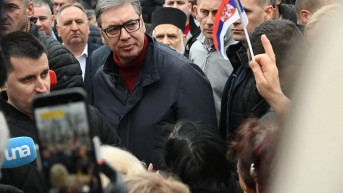
Serbian President Aleksandar Vucic stated today that he is deeply concerned about the situation in the Republic of Srpska, pointing to the historical actions of Western powers aimed at undermining all agreements reached with Serbia, including the Dayton Agreement and the 2013 Brussels Agreement, which provided for the establishment of the Community of Serb Municipalities (CSM). He noted that the CSM is no longer even mentioned and emphasized that, given the growing divide between the U.S. and Europe, Serbia must assess how to position itself in the new global order.
"I am very worried about the situation in the Republic of Srpska. Every RS president, from its founding to today, has been punished by the international community, and it is impossible that every single one of them was so bad and aimed to undermine Bosnia and Herzegovina and the Dayton Agreement," Vucic told reporters in Knjazevac.
He reiterated that historical parallels clearly show how Western countries have worked against Serbian interests, violating agreements that were reached.
He recalled that the document from the Berlin Congress of 1878 was nullified by Austrians and Germans through the annexation of Bosnia and Herzegovina, after bribing the Turks with 2.5 million pounds to keep silent about it.
"Of course, this was against Serbian interests, and only thanks to Stojan Novakovic were we able to avoid conflict with the Austrians and Germans for six years. This allowed us to be on the winning side in 1918, but they violated all agreements," Vucic pointed out.
A similar situation, he said, occurred with UN Security Council Resolution 1244 in 1999, which "seems like it never even existed."
"They destroyed the Federal Republic of Yugoslavia through Serbian paid politicians so that Kosovo could declare independence, while they pretended as if nothing had happened," Vucic added.
He also stressed that everything signed on April 19, 2013, in Brussels has not been implemented.
"None of the signed points have been put into practice. Not by the Albanians, but by the West and the EU, as they are the guarantors of the Brussels Agreement. They don’t care about regional police, judiciary, or prosecution. They don’t care about the CSM—they haven’t mentioned it for six months. They couldn’t care less about what’s written in the agreement because it is not in their vital interest," Vucic stated.
The same, he emphasized, applies to the Dayton Agreement:
"It was good to end the war in 1995, but afterward, the West started dismantling it, and for 30 years, they have been undermining the Republic of Srpska and stripping it of its powers," Vucic said, adding that the other side in Bosnia and Herzegovina refuses Milorad Dodik’s invitation for dialogue because they are not interested in Dayton and know they have support for further weakening of the Republic of Srpska.
He also noted that one of the causes of the war in Ukraine—though he clarified that he does not agree with Russia’s initial actions—was precisely the way Moscow was "strung along" with the Minsk Agreement.
"They were promised this and that, but they got nothing, just like us," the Serbian president added.
Now, he said, the situation is entirely different, sending a message to the EU to "wash its face with cold water" and realize how important the U.S. is.
"Your principles are frightening, we know your values, territorial integrity... We've experienced them firsthand. Look at the numbers: the U.S. holds 50% of global military capabilities, there are 30,000 American troops in Germany. Not to mention the presence in Pristina and Bosnia and Herzegovina, or how crucial the U.S. is for Greek-Turkish relations," Vucic pointed out.
He added that Serbia did not fully understand what was happening when the Berlin Wall fell, but that now it has a much clearer perspective and has been making accurate predictions.
Serbia must assess its position in the new world
A day after the meeting between U.S. President Donald Trump and Ukrainian President Volodymyr Zelensky, Vucic pointed out that the rift between the U.S. and Europe is growing and that Serbia must assess how to position itself in the new global landscape.
He said that events in the days leading up to the meeting hinted at the possible outcome.
He recalled that Trump sent his Treasury Secretary to Ukraine, and due to a delay in aid, President Zelensky initially refused to meet him immediately, making him wait for five hours.
"Trump saw this as a great insult. Then, on Monday, there was a vote in the UN, where we sided with Europe instead of remaining neutral, which is why I, as president, apologized and said that Serbia’s policy should have been neutrality. I said this because that vote further strained relations between Europe and the U.S., leading to more insults. The next day, Kaja Kallas went to Washington for planned meetings with Rubio and Kellogg, as well as an appearance on Fox News. All meetings and the TV appearance were canceled. That was a sign of what was to come," he emphasized.
Vucic said that what happened last night was not just a serious disagreement between the U.S. and Ukraine, but even more importantly, a rush by Europeans to oppose the U.S. more strongly.
"They didn’t even wait until morning. Just minutes after the meeting, European leaders from south to northeast scrambled to outdo each other in offering greater support to Zelensky and Ukraine. This tells us that the divide between the U.S. and the EU will only grow. Right now, some in our country are celebrating this, believing it is good that ‘the bear has come to dance at their doorstep’ and that there will no longer be a unified pressure on us regarding Kosovo and Metohija. But that is only partially true," he explained.
Vucic said that more intense conflicts would follow and that there would be a different division in the world.
According to him, Europe will try to present itself as the new beacon of freedom, which it cannot do with Trump. It will attempt, through liberal media in the U.S. and the Democratic Party, to organize all kinds of attacks on the U.S. president.
"I am very concerned for him and what he will go through. That assassination attempt against him was not carried out by some lunatic by chance. Such coincidences do not exist, and there aren't that many lunatics in the world," he warned.
Vucic also commented on the tariffs that Trump announced for Europe.
"If 25 percent tariffs are imposed, we will certainly be affected. Firstly, due to our current and future trade with the U.S. A significant portion of ammunition from Prvi Partizan has been exported to the U.S. for decades. I am sure they will try to exempt that business in the future, but in the first few months, we will be impacted. Let's not even think about how hard the tariffs will hit us if the German and French automotive industries are affected—because they will be. Some towns and places in Serbia survive solely thanks to the auto industry," he explained.
Vucic stated that it is now crucial to see where these political relations are heading and whether it is possible to reestablish a strategic partnership with the West.
"I am certain that this will not happen in the next year. Too many harsh words have been exchanged in recent days, and the U.S. is too great a power to back down before Europe," he emphasized.
Vucic pointed out that Trump is not burdened by the political history of the war in Ukraine because it began after his term. He can say whatever he wants, while Europe cannot.
"That is why Europe is in a difficult position—it cannot say anything different or seize the opportunity for peace because any peace that is not a victory for the West will be seen as a defeat. And then, someone will have to be held accountable for that defeat. And that is not Trump. Someone has to be blamed for hundreds of thousands of deaths. Right now, there is an attempt to avoid responsibility for those in Europe who wanted war. That is why some will continue pushing this forward. It is very important to see what will happen in the coming period. We will closely monitor the situation," he stressed.
Vucic said he would propose a broad debate in Parliament on future foreign policy to carefully assess how Serbia should position itself in a completely new world.
"Some changes will be temporary, and some will be permanent. We are a small country, we have always been consistent, but we will have to adjust as the wind blows in the right direction. We will have to consider many things—our national and state interests, national interests in the region, and also economic interests, which are a prerequisite for achieving all other goals," Vucic stated.

comments