
Bishop Teodosije at the Solemn Academy in Gracanica: The essence of reconciliation is to feel the suffering of others
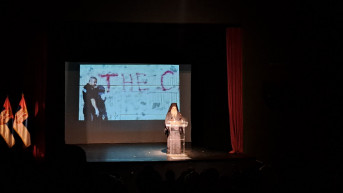
The goal of March 17, 2004, was to erase centuries of our existence and to drive out the population, Bishop Teodosije of Raska and Prizren said at the Solemn Academy in the Cultural Center of Gracanica on the occasion of the 20th anniversary of the March Pogrom.
Bishop Teodosije of Raska and Prizren stated that the March Pogrom had been the greatest violence by Kosovo Albanian extremists since the end of the armed conflict in 1999, where in most cases, the elderly and helpless people suffered, brutally driven out of their homes, and where Serbian sanctities and households had also been affected.
"The March Pogrom is deeply etched in the Serbian collective memory as one of the saddest moments of our recent history. On those two days, March 17th and 18th, our churches and monasteries, which had survived various wars and hardships for centuries, were burning, and news of atrocities against our innocent people, monks, and clergy were coming from all sides. That is why we regularly commemorate this anniversary, serving memorial services for the fallen, and offering prayers to the Lord to preserve our people and sanctities from ethnic hatred, which manifested itself in its worst form despite the overall international presence," the bishop said.
The bishop stated that "the aim was to erase centuries of our existence and permanently expel the population from their hearths."
"Those who perished in this Pogrom, as innocent victims, will always be in our memory because they perished simply because they were Orthodox Serbs, our own people. Painful images of our demolished churches, burnt homes, and desecrated graveyards, from Prizren, Djakovica, Pec, South Mitrovica, Pristina, and Podujevo, are deeply etched in our memory. The goal of the perpetrators was to erase centuries of our existence and permanently expel our remaining population from their hearths. It is distressing to see that on the eve of marking this anniversary, those who hold power in Pristina today characterize such a crime, which the entire world clearly and unequivocally condemned, as violence by the Serbs against peaceful Albanian demonstrators, thereby abusing the tragic deaths of three Albanian children in the river as justification for subsequent atrocities. Such irresponsible statements from those at the highest levels of the Pristina authorities not only demonstrate a fundamental absence of human consciousness and conscience but also represent a new drawing of targets on the Serbs and a new call for ethnic hatred and violence," the bishop said.
He emphasized that in recent days, irresponsible statements from Pristina had been coming, which are targeting the Serbs and calling for violence.
"Our Church has always condemned and will openly condemn any ethnic violence, as taught by the Holy Gospel. We held such a stance in 1999 when we aided civilian victims of all communities and condemned crimes from any side. Unfortunately, with such a one-sided approach, the current Kosovo authorities further deepen ethnic mistrust and harm their own population. The essence of reconciliation is to feel the suffering of others and to lend a helping hand to each other in times of need. Unfortunately, the continuation of violence and increasing pressure on our people over all these years clearly reveal the intentions and goals of those who publicly or tacitly supported the March Pogrom 20 years ago and now seek to force our people into exile and create an ethnically pure territory," the bishop said.
Bishop Teodosije also emphasized that we should never respond to evil and hatred in the same manner and measure.
"Despite all this and all the difficulties facing the Serbs in Kosovo and Metohija today, we must remain dignified and courageous, following the example of our ancestors who endured for centuries under difficult conditions and various authorities, preserving their faith, tradition, culture, and above all, human honor and integrity. Only in this way can we defend Kosovo and Metohija as our home and space, where our ancestors built sanctuaries as an expression of their love for God and their kin. For us, Kosovo and Metohija should not only represent the geographical space of one nation but also a place where we should enable the lives of other people with whom we wish to live in peace and mutual respect. This is the essence of our Christian faith, to bear our cross calmly and dignified, knowing that only in this way can we experience spiritual transformation and resurrection. We should never respond to evil and hatred in the same manner and measure, for then we would degrade our Christian and human dignity. Therefore, we will respond wisely and patiently to all provocations and pressures, lies and repression, knowing that in history, evil has never prevailed, and only those who endure to the end will be saved," Bishop Teodosije emphasized.
Bishop Teodosije also emphasized that "the memory of these terrible days from 20 years ago must not be an expression of bitterness but a warning to all, that such evil, as well as all other evils that have occurred here in Kosovo and Metohija, never happen again, knowing that God will judge all those who seek their happiness at the expense of their neighbors, regardless of their origin or faith."
"Therefore, for us, commemorating the twentieth anniversary of the March Pogrom is, above all, an opportunity to recall everything we have experienced in the last 25 post-war years, the path of the cross, and to decisively and courageously demonstrate that, as spiritual children of St. Sava, St. Prince Lazar, and St. King Stefan of Decani, we can remain and endure as our own, only if we adhere to Christ's Gospel, not wishing upon others what we do not wish upon ourselves, and extending the hand of reconciliation to every person of goodwill. This year, the commemoration of the Pogrom coincides with the beginning of the Great Lent, during which, with God's help, we will spiritually and physically endeavor, hastening towards Christ's Resurrection. Therefore, in the joy of our greatest holiday, let us offer prayers to the Lord to preserve us and all other people in peace and every good," Bishop Teodosije said.
Milena Parlic, Assistant Director of the Office for Kosovo and Metohija of the Government of the Republic of Serbia, stated that today the heroic wounds of Kosovo hurt the most.
"When we are more aware than ever that they are forever painful and will bleed eternally no matter how much time has passed, and too much time has passed without justice. We have rounded off 20 years since nine innocent Serbs were killed, and over 4,000 were expelled. Nearly 1,000 Serbian graves were destroyed, and more than 35 churches were burned down. It was not just a savage act towards the population; this ethnically motivated violence was a continuation of the Pogrom that our people experienced in 1999. It was a blow to our tradition, spiritual heritage, to magnificent monuments, to medieval Serbia," Parlic said.
She emphasized that "they could only destroy the material, unaware that the spiritual is indestructible by vandalism."
Parlic said that the culture of remembrance was "something that should be rooted in all of us."
"In the recent history of suffering, time for us Serbs is divided into before and after the war, and the war started thanks to lies. Lies about a humanitarian catastrophe, about alleged excessive use of force, about Racak. Lies created the so-called state of Kosovo, lies suppressed the truth about the suffering of the Serbs, the church, and the state. For 20 years now, lies have covered up the Pogrom that also started with lies about drowned children in the village of Cabra, and a lie was enough for entire hordes to set out on March 17 to burn, kill, and persecute," she said.
"In the name of the victims who were taken from us prematurely, of the homes that never witnessed the laughter of new generations, of the burned churches and monasteries, of the love capable of overcoming any hatred, and of the pride firmly standing behind thoughts that will never leave us," she said.
The head of the Kosovo District, Srdjan Popovic, emphasized that 20 years had passed since the day that had left the deepest scars on the Serbs.
"Remembering March 17th is our obligation. To remember all the Serbs who perished and were expelled, the burned sanctuaries and homes. All the horrors our families went through during those days. Not just today, but every day, for the past 20 years, each of us lives with the conviction that justice must prevail," Popovic said.
He emphasized that there were still those today who wanted March 17th to be forgotten and for the perpetrators of those terrible crimes to remain unpunished.
"Just as they try to push into oblivion many other crimes that happened before and after March 17th in the Kosovo and Metohija region. We are here to remind them every year of everything they did to us, which went unpunished, seeking justice," he said.
He emphasized that March 17th continued even after 20 years.
The President of the Serb List, Zlatan Elek, reminded that no one had yet been held accountable for the Pogrom on March 17th, 2004.
"Back in 2004, Albanian extremists attempted to eradicate everything Serbian and finish the job they failed to accomplish in 1999. Unfortunately, just like then, everything happened before the eyes of the international community and the missions of KFOR, UNMIK, EULEX, OSCE, and other international representatives who silently observed the killing of Serbian civilians, burning of Serbian homes, and the expulsion of over 4,000 Serbian inhabitants," Elek said.
He emphasized the importance of remembering March 17th and marking it every year in Kosovo and Metohija.
"What I would like to convey to the international community, the Quint countries, and the United States is to remember well that March 17th and never allow such a Pogrom to happen again in a democratic world in the heart of the Balkans as it did on March 17th, 2004," Elek said, adding that "today it is most difficult to be a Serb in Kosovo and Metohija."
"Our unity, solidarity, patience, and intelligence alone build the bulwark of our survival and existence in these areas, which is almost impossible without the state of Serbia," Elek said.
A surgeon at the Clinical Hospital Center of Kosovo, based in Gracanica, Dr. Dragan Peric, recalled his work during the Pogrom on March 17th, 2004.
"We worked day and night, we accepted all patients, and everyone was provided with appropriate assistance," he recalls.
He emphasized that after a few days, the security situation had improved.
"I intended to evacuate patients who required blood transfusions first. Perhaps, by my mistake, I called for KFOR's assistance without speaking to the wounded. I don't remember the exact number, but I think two helicopters from the German KFOR landed within the vicinity of the King Milutin Elementary School. During the conversation with the patients, a verbal conflict arose between KFOR and the wounded. Several of them said, 'Dr. Peric, you can do whatever you want with us, but we're not going to the German hospital,'" Peric recalls.
Novica Stolic, former Director of a high school in Obilic, says he happened to be in Gracanica with his wife on March 17th, and upon returning home, he saw a crowd heading towards Calavica along Veternik, with the attack on Obilic starting the next day.
"Since we were united, we prepared for something we didn't know would happen. They tried to enter our street twice, but they failed. All the while, we sought help from KFOR to evacuate our women and children, but their condition was all or none. We decided none. We stayed, and before that, our houses were marked by KFOR and the Kosovo Police Service. When the mob headed towards our street, we came out and begged the Kosovo Police. Since the Serbian part of the police had separated from them and joined the Serbian side, protecting Serbian villages, they said they couldn't help us because we were a democratic police force, and elegantly rejected all our pleas," Stolic recalls.


comments