
Diocese: Illegal construction works damaged the hermitage of St. Peter of Koris, we expect an urgent response
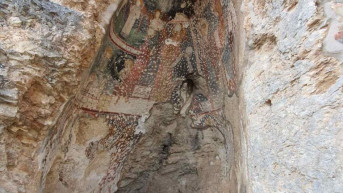
The Diocese of Raska and Prizren of the Serbian Orthodox Church announced today that illegal construction works at a site near Prizren have caused severe damage to the space of the hermitage of St. Peter of Koris, a Serbian Orthodox shrine from the 13th century. As a result, the Diocese has issued a strong protest and stated that it expects an urgent response from international institutions.
The Diocese's statement mentions that recent illegal construction works at the site, which included the creation of a wide access path and its paving up to the cave of the saint, around which the shrine is located, have severely damaged and endangered the archaeological and historical integrity of the site.
They also note that the very foundations of this medieval complex have been undermined, so that in the case of heavy rains or even the slightest earthquake, there could be landslides and collapse of the entire hermitage.
They remind that the hermitage of St. Peter of Koris is officially protected as one of the 50 special protected zones, in accordance with the Kosovo Law on Special Protected Zones.
Furthermore, they point out that after the armed conflict of 1999, the hermitage has been desecrated several times, including the exhumation of the saint's grave, the damaging of medieval frescoes with graffiti, and the placement of the Albanian flag above the hermitage, which is still visible, and regarding which the Diocese has called for protection.
"Scenes of desecrated frescoes are the most obvious evidence of extremely vandalistic behavior towards this holy site, which deeply offends the faithful of the Serbian Orthodox Church and shows the world what the attitude towards the medieval Serbian Orthodox heritage is like in Kosovo and Metohija. It also highlights the visible lack of care and competence of local Kosovo institutions, which, by law, in cooperation with the Serbian Orthodox Church and international representatives, are supposed to show at least a minimum of civilized respect for Christian culture and monuments, instead of working incompetently on their own and irreversibly destroying heritage that is of importance to all people of good will," the statement from the Diocese of Raska and Prizren concludes.
They also emphasize that the appropriation of Serbian holy sites, which have been exposed to brutal devastation and attacks for years, and the malicious rewriting of history, sound so ironically and hypocritically when one sees the attitude of Kosovo institutions and extremist groups towards the holy sites of the Serbian Orthodox Church on the ground.
They add that this particularly applies to those areas of Kosovo where, unfortunately, there are currently no Serbs and monks, who, in other places where they live, diligently strive to preserve their centuries-old heritage.
The statement recalls the provisions of the Law on Special Protected Zones, which aims to preserve the historical, cultural, and religious heritage of the Serbian people in Kosovo, prevent its damage and destruction, and ensure that any activities in protected zones can only be carried out with prior consent from the Serbian Orthodox Church (SOC) and within the framework of the Council for the Implementation of Protected Zones.
Any other approach represents a direct violation of the law and seriously endangers not only religious heritage but also peace and interethnic relations in these areas, the Diocese emphasizes.
In this regard, they point out that the Municipality of Prizren, despite the explicit legal ban on any intervention in this area — including road construction, clearing vegetation, or other works that could harm the archaeological and historical integrity of the site — carried out illegal activities independently, without the knowledge or approval of the SOC, thus grossly violating the existing valid law and seriously endangering the valuable historical site.
They further mention that the illegal works were carried out by the local Kosovo Albanian company "Eurovia," and given the unprofessional nature of the works, the use of heavy machinery to clear the path and the scattered debris left on a wider area of the site, it is evident that no experts in cultural heritage were involved, which is also a consequence of the complete lack of coordination with the SOC and the Commission for Special Protected Zones.
In addition to the legal aspect of the problem, the Diocese highlights the moral and historical significance of the hermitage for the Serbian people, as the hermitage of St. Peter of Koris represents an invaluable spiritual and cultural treasure of the Serbian Orthodox people and the entire Christian world.
The Diocese therefore calls for an urgent response from the international institutions present in Kosovo, primarily the EU mission, Eulex, OSCE, and KFOR, as well as the competent Kosovo institutions, to take urgent steps within their powers to stop the lawlessness, sanction those responsible, ensure the protection of the holy site, and repair the damage in full coordination with the SOC.
They also add that UNESCO and other relevant international organizations for the protection of cultural heritage in Europe, the U.S., and worldwide will be informed of this case, in order to draw attention to the actions of local Kosovo institutions towards Serbian Christian spiritual and cultural heritage in Kosovo.
The Diocese notes that this is just one in a series of incidents showing the systematic violation of the rights of the SOC — local Kosovo municipal authorities continuously engage in illegal activities within protected zones without prior consultation with the SOC or competent international bodies.
All of this, they add, once again highlights the need for special institutional mechanisms to protect the rights of the SOC and its holy sites in Kosovo, with firm international guarantees, which the SOC has been insisting on for years.
"This practice of ruining medieval Christian shrines is absolutely unacceptable, and the Diocese of Raska and Prizren demands that all illegal activities be immediately halted and that the Law on Special Protected Zones be strictly enforced to prevent further destruction of valuable religious and cultural heritage and preserve the centuries-old spiritual and cultural heritage of the Serbian Orthodox people in Kosovo and Metohija," the statement concludes.
0 comments