
Families of the missing in Gracanica: We will not give up the search for truth; EULEX and UNMIK archives should be opened
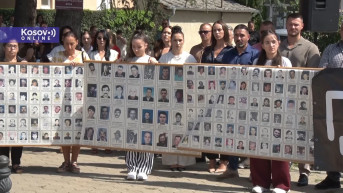
The International Day of the Disappeared was marked in Gracanica today, with families saying that, even after almost three decades, the fate of their loved ones remained unknown, while accountability was still lacking. Representatives of family associations stressed that they would not give up their search for the truth, noting that resolving the issue depended on political will and better regional cooperation.
President of the Association of Families of Kidnapped, Missing and Murdered Persons from the Municipality of Orahovac Negovan Mavric said on the occasion of the International Day of the Disappeared that more than 1,500 people were still being sought, including Serbs, Albanians, Roma, Egyptians, and members of other communities, stressing that resolving the issue of missing persons had become a matter of political will.
“As you know, more than 1,500 people are still being sought—Serbs, Albanians, Roma, Egyptians, and everyone else. That number will always remain in our hearts because we make no distinction based on religion or ethnicity; there is only the number. Our aim on this International Day of the Disappeared is precisely to show and demonstrate that we are searching for all missing persons,” Mavric said.
He pointed to the problems faced by the families of the missing and expressed frustration over what he described as insufficient efforts to resolve the issue.
“You have had an opportunity to hear what the families of missing persons are facing and all the problems they encounter, while very little is being done on this issue. I must tell you that we, as family members, are deeply frustrated because this situation is no longer humanitarian; it has become more a matter of political will than humanitarian will. As you can see, we depend on political will. If there were political will, we would not have been waiting this long and this number would not be so high,” he said.
Mavric said that it was approximately known where the events had taken place and where the bodies of missing persons might be located, but that someone was withholding and concealing that information.
“We know the general area where all of this happened; it is roughly known where the locations are and where the bodies are, but someone is withholding and concealing that information,” Mavric said.
Speaking about reports that a grave was currently being opened in Kaludra, Mavric said this was not new information and that the location had been discussed since 2010.
“We have heard in recent days that a grave is being opened in Kaludra. There is nothing new about that; it has been known for a long time, and Kaludra has been discussed since 2010,” he said.
He added that he himself had visited the location several times and that it had already been examined, but the precise location of the grave had not been known. He stressed that he supported examining every location where there was reason to suspect that the remains of missing persons might be found.
“I am not in favor of having only one side examine that location. That is why working groups exist, why forensic medicine exists, and why cooperation exists—so that at every location, wherever excavations are carried out, both sides are present, along with the EULEX department dealing with the search for missing persons,” Mavric said.
He said it was not known whose remains were in the graves, but that there was information indicating that graves had been relocated and bodies transferred elsewhere.
“Unfortunately, we do not know who is in those graves. We know very well that graves were relocated; we know that potential sites were excavated and the bodies moved, but no one knows where,” he said.
Mavric said that one of the key messages was the need to open archives in Belgrade, Pristina, and The Hague.
“Our message is that the archives must be opened. Everyone must open their archives; it cannot be only one side. The archives exist—we are all witnesses to that—and they should be opened in Belgrade, Pristina, and The Hague, particularly given that we know that the Hague Tribunal combed through and excavated the entire territory of Kosovo and Metohija,” Mavric said.
He added that the EULEX and UNMIK archives should also be opened.
According to him, EULEX had transferred a large portion of its archives to Pristina.
“Let us open all those archives together and find the bodies of our loved ones,” Mavric said.
Coordinator of the Association of Families of Kidnapped and Missing Persons in Gracanica Silvana Marinkovic said that families continued to live between hope and uncertainty and would not allow their victims to become mere statistics.
“This is not merely a day of remembrance; it is a day of responsibility, solidarity, and hope. Every missing person has a name, a story, and a family—a family that is waiting and that lives every day between hope and uncertainty. Behind every photograph hanging on the walls of our homes or shared on social media stands a mother who never stops believing, a father who never gives up searching, a brother, a sister, children, and spouses who continue to preserve the memory of their loved ones,” Marinkovic said.
According to her, the families gather every year in the hope that their messages will produce results, but they are still at the starting point.
“According to official data from the International Committee of the Red Cross, 9,920 people are still being sought as missing from the wars of the 1990s in the former Yugoslavia, including 1,620 in connection with the conflict in Kosovo. We are aware that resolving the fate of missing and kidnapped persons is a complex and lengthy process, but we are also convinced that better regional cooperation can improve that process. We are aware of the fact that we have been left to fend for ourselves, but that does not mean that we will stop. We will always fight and demand to learn the fate of our loved ones. Our path is by no means easy, but our desire for the truth gives us the strength to persevere every step of the way,” Marinkovic said.
She stressed that the families would not allow the victims to become mere statistics.
“Everyone has the right to know what happened to their loved ones. Living with uncertainty for 27 years is extremely difficult. How much longer can this go on? Sadly, many members of our families are no longer with us. They passed away wishing to learn the fate of their son, father, or brother. The grief for a child hurts the most. One mother, Dragana Majstorovic, whose son disappeared when he was only 17, managed to put her grief on paper and wrote poems dedicated to all those who were kidnapped,” she said.
Vice President of the Association of Families of Kidnapped and Missing Persons in Kosovo and Metohija Sasa Perenic said that 28 years was a long time, given that nothing new was happening regarding the issue of missing persons.
“We are in a situation where we have nothing new, and there is no one from whom we can even seek anything. The situation is what it is—you can see it yourselves. The international community is the only party to blame because it gathered all the information at the time when the work should have been done. Now it issues statements containing only scant information and says that it is working, but there are no results for the families,” he said.
Perenic said that he remained optimistic regarding the survival of the Serbian people.
“As for the situation itself, perhaps it will be resolved when we are no longer here. When everything is over and it has been accepted that there are no Serbs here, perhaps someone will do something. But even then, I seriously doubt it because this is an extremely difficult issue for all of them, while for us it is a source of enormous grief and pain. Many parents are no longer alive. They took that wish with them, just as my parents did. They died hoping until their final moments that they would learn something, but nothing new happened and they learned nothing new,” he said.
He stressed that 28 years had passed since the disappearance of his brother, Ranko Perenic.
“My parents have been gone for almost ten years now, which means that for 28 years we have been here on this same plateau, always together with you. There has been nothing new for us, and I can freely say that there will be nothing new for a long time. We will all remain here until the very end, fighting and searching for some truth, but as far as their side is concerned, it will be very difficult for that truth to emerge or for anything to happen,” he said.
Responding to the observation that there was no political will to resolve the issue, Perenic said that this was probably the case.
“The latest development is that they have excavated graves in Zubin Potok and Kaludra. They say they are certain there are already 23 bodies, although they do not reveal which group they belong to, but apparently they already know. Yet all of this happens at a moment that suits them. A few days ago, we had another meeting here at the municipality, attended by their representatives from the Commission on Missing Persons, but again we learned nothing new. They are only fighting to learn everything about their own victims, to uncover the truth, to find them... So, after 28 years, we can freely say that nothing new has been done. As for my brother’s case, there is nothing. The memorial plaque has now been erected for the tenth time, and every time it has been desecrated. If even a plaque marking the place where people disappeared is a problem, then we have nothing to hope for when it comes to truth or justice,” Perenic said.
Asked whether he expected the outcome of the trial in The Hague in September to bring anything for the families of the missing, Perenic said that this was a delicate issue.
“While Thaci was president—because our issue has existed since 1998, or rather since 2005—we were very active and participated in all those meetings. The issue was largely under the jurisdiction of foreigners at the time; EULEX was there. They dealt with the cases, but we received no results, so this will not change anything either. There will be nothing new—perhaps for them, but for us families it will remain the same. We are in a kind of labyrinth where, whatever happens, the issue of the missing resurfaces, but there are no results and no answers. I do not expect anything concrete,” he concluded.

comments