
Dangerous escalation in Albania: Is a political solution possible?
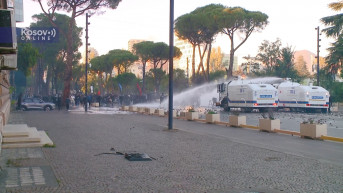
What happened in Albania during the summer now looks like an evening stroll in comparison. For 138 consecutive days, people protested mostly peacefully along Tirana's main boulevard and the capital's most important streets. This Tuesday, however, open conflict broke out.
By Bledar Kuka
On October 13, students held a protest announced days in advance and immediately began attacking the Ministry of Education, before moving on to Tirana City Hall. The police response was violent. The toll was dozens injured, mostly demonstrators, many of whom were arrested and prosecuted.
The unrest continued on Wednesday, with even greater intensity, although the attackers that day were mostly demonstrators, while the police had withdrawn.
The ministries of education, finance and economy, as well as the headquarters of the Albanian Parliament, were set on fire. Trees near the prime minister's office were also burned.
Thousands of Tirana residents joined the students, followed on the third day by secondary school pupils.
Since yesterday, classes have been suspended in secondary schools and other educational institutions in the capital, while students have been destroying signs and traffic lights, setting rubbish bins on fire and blocking roads.
Protests have also begun in other cities, starting in Kamza near Tirana, followed by Shkoder, Vlore, Lushnje, Korce, Elbasan and Durres.
What triggered the extreme escalation of the protests?
Dr Zylyftar Bregu, a professor at the Faculty of Journalism at the University of Tirana and the University of Tetovo, told Kosovo Online that people's loss of patience after four months of peaceful protests had contributed to the escalation.
“After more than four months of peaceful protests, attended by ever fewer participants, the beginning of the new academic year and the arrival of students in Tirana marked a turning point in people's patience. We can see that people no longer had the patience to accept the situation in the country. This also contributed to the larger turnout, with more people joining the protests, including students who came from other regions as well as those living in Tirana. We have now entered a new phase in which the country needs a political solution,” Bregu believes.
Political analyst and journalist Frrok Cupi sees the situation differently, although he opposes these protests, which he regards as violence against the state, without normal political, economic or social demands.
“Tirana has been attacked, and fiercely so. Two ministries, the government headquarters and the parliament building have been burned and damaged. It is very interesting and significant that the Vatican embassy was attacked, as was the office of ‘Europe for Youth’. Damage has been caused across Tirana, and traffic and public transport have been blocked. Banking services have been suspended because banks were attacked, and the damage is colossal. What is this? I call it vandalism because it is a protest, but one without demands. There are no political, economic or social demands. It is simply a gathering of vandals, without a leader, without direction, without thought,” Cupi said.
He is convinced that anti-Albanian Islamist circles operating from Kosovo or North Macedonia are behind the protests.
“Many KLA flags are being waved at the protests, and analysts have pointed the finger at former president and opposition leader Sali Berisha, who is persona non grata in the United States. Meanwhile, they have also pointed the finger at politicians from Self-Determination and Albin Kurti in Pristina, as well as those in Tetovo, where there is intense activity directed against Albania for religious and Islamic reasons. What is most striking is that this began on the very day Albania closed Chapter 20 in the EU accession process. The violence broke out here on precisely that day. These are anti-European Islamist forces. Of course, they have close ties to Islamist terrorism, and this is an analysis that can be made of these groups,” Cupi explained.
Bregu believes that the “peaceful phase” of the protests has already ended and that the situation will escalate further.
“The peaceful protest has exhausted its role, and the period of peace is over. Because the country's political leadership has failed to respond, the protest is now trying a new tactic in its uprising,” Bregu said.
He specifically called on the “clear-headed, intelligent people within the Socialist Party” to compel Prime Minister Edi Rama to find a political solution to the situation.
“I think the protest has entered a phase that makes the situation in Tirana and throughout Albania extremely delicate, because the protests are no longer confined to Tirana but are taking place in all the major cities of Albania. I think it is now essential for the clear-headed, wise people of this country to speak up. This applies particularly to those within the Socialist Party, who must compel the prime minister to deliver a political solution,” Bregu said.
It is impossible to predict how many days the clashes will continue, or whether Prime Minister Rama will respond with what is being called a “political solution”. In a statement to Reuters, Rama said that he would not resign because of the violent protests and that governments change through elections.
Former Prime Minister Sali Berisha, on the other hand, says Rama must choose whether to act like former Albanian communist leader Ramiz Alia, who accepted political change, or like former Romanian leader Nicolae Ceausescu, who did the opposite and lost everything, including his life.
0 comments