
Instructions on obligations during stay distributed to travelers upon entry to and exit from Kosovo
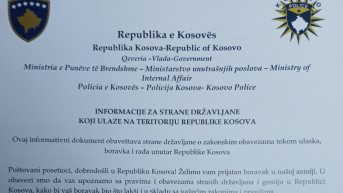
At administrative crossings, as part of an information campaign conducted by Kosovo’s Ministry of Internal Affairs and in connection with the implementation of the Law on Foreigners and the Law on Vehicles, travelers are being handed an instruction informing them of their obligations when entering, staying in, and working in Kosovo.
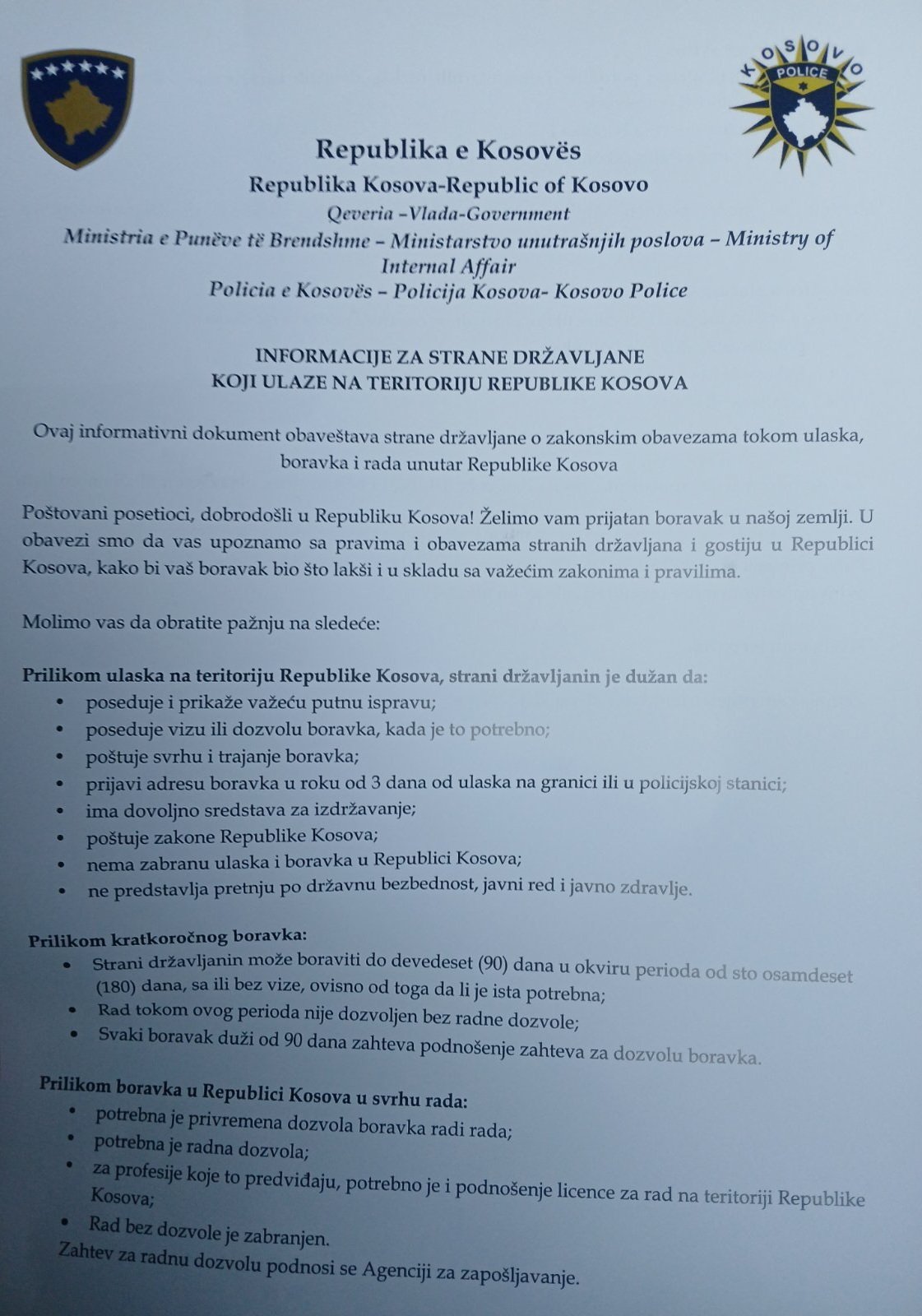
The instruction states that, upon entry into the territory of Kosovo, a foreign national is required to possess and present a valid travel document, hold a visa or residence permit where required, comply with the purpose and duration of stay, and register the address of residence within three days of entry “at the border or at a police station.”
In addition, as noted, a foreign national must have sufficient means of subsistence, comply with Kosovo laws, not be subject to an entry or stay ban in Kosovo, and must not pose a threat to security, public order, or public health.
As further stated in the instruction—which is distributed both upon entry to and exit from Kosovo—during a short-term stay, a foreign national may remain for up to 90 days within a 180-day period, with or without a visa depending on whether one is required, and employment during that period is not permitted without a work permit.
“Any stay longer than 90 days requires the submission of an application for a residence permit,” the instruction of Kosovo’s Ministry of Internal Affairs states.
For stays in Kosovo for the purpose of employment, as indicated, a temporary residence permit for work purposes is required, and a work permit is necessary for professions for which it is prescribed.
“It is also necessary to submit a license to work on the territory of the Republic of Kosovo. Work without a permit is prohibited. An application for a work permit is submitted to the Employment Agency,” the instruction specifies.
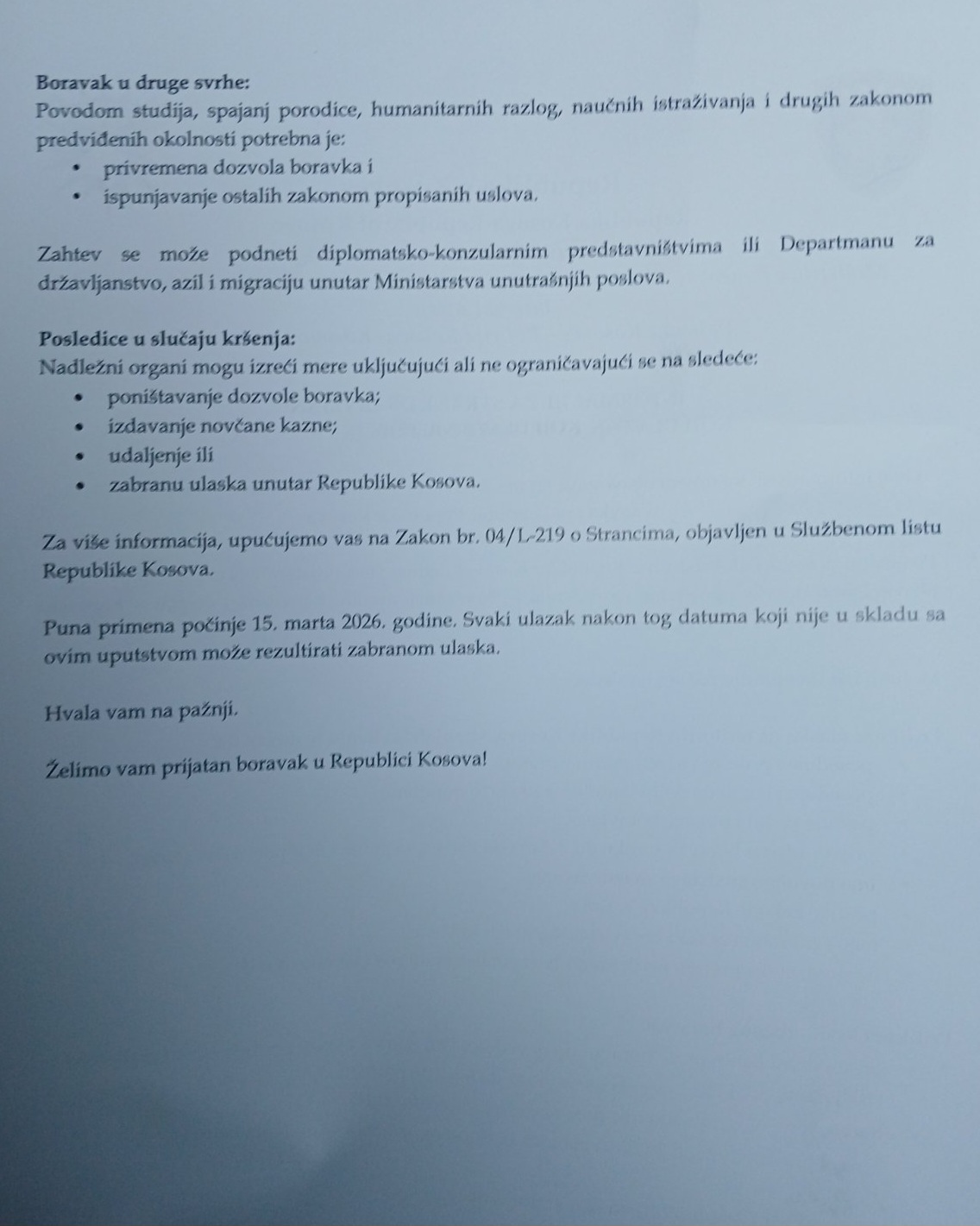


For stays for other purposes—such as studies, family reunification, humanitarian reasons, scientific research, and other circumstances provided for by law—a temporary residence permit is required, along with fulfillment of other legally prescribed conditions.
“The application may be submitted to diplomatic-consular missions or to the Department for Citizenship, Asylum, and Migration within the Ministry of Internal Affairs,” it adds.
The instruction also outlines the consequences in the event of violations.
“Competent authorities may impose measures including, but not limited to, the following: revocation of the residence permit, issuance of a monetary fine, removal, or an entry ban within the Republic of Kosovo,” the instruction states.
It is further noted that full implementation of the laws begins on 15 March, adding that any entry after that date that is not in accordance with the instruction may result in an entry ban.
A few days ago, Kosovo’s Ministry of Internal Affairs announced that, as part of the implementation of the Law on Foreigners and the Law on Vehicles, an information campaign for citizens has begun at all crossings and at Pristina Airport, in line with a decision announced by Deputy Prime Minister Besnik Bislimi that the implementation of the two acts will be accompanied by a transitional period until 15 March, during which visitors will be informed about the new procedures and rules.
Reacting to the two-month postponement of the implementation of the two laws, the Director of the Office for Kosovo and Metohija, Petar Petković, stated that this must not remain the final outcome of international engagement, as otherwise the survival of Serbs, as well as the dialogue on the normalization of relations itself, would be seriously called into question. He pointed out that these regulations represent a continuation of Pristina’s institutional violence against Serbs living and working in Kosovo and a new escalatory move by Albin Kurti, absolutely contrary to the agreements reached in the dialogue.
Srpska Lista also stated that the decision to postpone the implementation of these acts is the only rational solution, welcoming the strong and sincere engagement of international representatives in seeking a solution. However, the party warned that postponement alone will not resolve the problem of citizens being unable to use or obtain their documents or to use their vehicles, noting that the transitional period should be used to find a model that would resolve this issue and enable citizens, as well as all those coming to Kosovo to work or study, to lead a normal life—above all in terms of freedom of movement.
Experts familiar with the situation assessed, in an analysis by Kosovo Online, that the implementation of the Law on Foreigners and the Law on Vehicles will target exclusively the Serbian community and that the new rules have nothing to do with establishing order, but rather represent a mechanism for exerting pressure on Serbs.


0 comments