
Four and a half decades since the burning of the Patriarchate of Pec – Serbian churches and cultural heritage still under attack
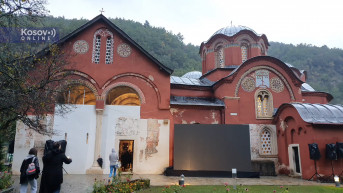
The arson attack in which the old residence (konak) of the Patriarchate of Pec burned down on this day in 1981, during the days of major demonstrations by Kosovo Albanians, was the first in a series of events over the following four and a half decades in which Serbian cultural heritage in Kosovo would become the target of extremists, interlocutors of Kosovo Online point out. The process of destruction of Serbian heritage, which continues even today, they warn, is not limited to its physical dimension; it is also occurring simultaneously on another level, where the past is falsified and Serbian cultural heritage is “Kosovized.”
Written by: Dusica Radeka Djordjevic
The blaze that broke out in the residence of the Patriarchate of Pec 45 years ago, between three and four o’clock in the morning, was at the time scarcely discussed in public, and there were attempts to conceal both the cause and the nature of the event in which part of the manuscript heritage was destroyed.
Today, reports that an Orthodox church in Kosovo has been broken into and robbed, or that crosses have been smashed and tombstones destroyed in an Orthodox cemetery, follow one another in rapid succession. Last autumn the Patriarchate of Pec, the spiritual seat of the Serbian Orthodox Church, was marked on Google Maps in Albanian as an Albanian Orthodox monastery, while diplomats accredited in Pristina often refer to Serbian churches as “Kosovar.”
According to data presented last week by Serbia’s Minister of Culture Nikola Selakovic, since 1999 a total of 156 Serbian churches and monasteries and 255 Serbian cemeteries have been destroyed in Kosovo, while more than 10,000 icons and various church artifacts have been stolen or destroyed.
Testimonies of Identity
The reason why sacred buildings in Kosovo have been targeted by extremists for decades, according to Jasmina S. Ciric, an art historian, lies in the preserved inscriptions and records found on them—whether on portals or frescoes—that directly testify to the Serbian identity in the territory of Kosovo and Metohija.
“If we speak about frescoes, there are also donor portraits (ktitor portraits) that directly testify to the Serbian presence in that area. Of course, it is not accidental why those structures are targeted—not only in terms of material damage, which we have witnessed in the past, but also in the contemporary sense, namely the alteration of historical narratives,” Ciric told Kosovo Online.
As a particular problem, she highlights the “Kosovization” of Serbian cultural heritage, which she says stems from the fact that UN Security Council Resolution 1244 is violated on a daily basis, as well as from what she describes as the unfortunate circumstance that the endowments in Kosovo are listed on the UNESCO website as medieval monuments in Kosovo, rather than in Kosovo and Metohija, as originally stated in the nomination dossier.
Ciric considers the burning of the Patriarchate of Pec in 1981 to be one of the darkest episodes in the destruction of Serbian cultural heritage and the first in a series of incidents involving damage to cultural property in Kosovo.
Although the church complex of the Patriarchate itself was not damaged, she explains that in addition to the monastery’s residential quarters, certain manuscripts were also destroyed, a fact that was rarely mentioned in the public discourse of the time.
Suppression of Serbian Heritage
Art historian and head of the Gallery of Frescoes of the National Museum of Serbia, Bojan Popovic, says that since the end of the Second World War there have been both open and subtle efforts to suppress everything Serbian in Kosovo.
“It is enough to say that when the residence of the Patriarchate of Pec burned, it was not permitted to speak about it publicly, so jokes circulated claiming that the burning of the residence was the work of a ‘little fire-starter’. This was an allusion that Albanian terrorists were responsible, since it could not be stated openly,” Popovic told Kosovo Online.
Journalist and writer from Gracanica, Zivojin Rakocevic, recalls a sentence describing the social context in which the fire occurred: “State firefighters arrived without water.” According to him, the phrase remained in the poetry of Darinka Jevric, as well as in the memories of nuns and people from that area.
“It is our perpetual fate that the systems in which we lived—and in which the Patriarchate of Pec lived and still lives today—are not there to care, protect, or at least leave us in peace. Even today the situation is almost the same. Systems come without water to extinguish fires in which they themselves participated and for which they bear responsibility,” Rakocevic said.
According to him, the flames at the Patriarchate of Pec deeply shook every member of the Serbian nation. Whether atheist or believer, everyone, he believes, felt that the mother of Serbian churches was burning.
“The burning of the Patriarchate of Pec was a point at which thousands of hectares of confiscated land and God knows how much property came together. In that fire were the expelled monks, imprisoned priests, and revoked rights. In it were gathered all the misfortunes from 1941 to 1981. It represents a whole complex of injustices, discrimination, exclusion from public life, and attempts to eliminate the Serbian Orthodox Church, its spirituality and values, and our cultural heritage. The burning of the Patriarchate of Pec was the moment when we understood that the mother of Serbian churches was saying: ‘I exist, even if in these flames.’ After that period came new upheavals and what can be described as fatal blows to a living civilization,” Rakocevic says.
Nevertheless, he adds that those who believed that the flames of the Patriarchate of Pec meant the end—or the beginning of the end—of Serbian culture, spirituality, and civilization in Kosovo and Metohija were mistaken.
Someone Is Trying to Make Ours Theirs
Forty-five years have passed since the event, and according to Rakocevic there are today two parallel processes aimed at destroying Serbian cultural heritage in Kosovo.
The first is physical and brutal, destroying what is visible on the ground. The second takes place on a theoretical and spiritual level, carefully designed and aimed at falsifying what cannot be destroyed physically.
“These two parallel processes run throughout our century and are in conflict with what is called civilization. Our civilization in Kosovo and Metohija is composed of a million pieces in a mosaic that we see and define as Kosovo and Metohija. Each of those pieces is important; some are of global importance. That is why this conflict is so complex and why these two levels exist. While we are talking here, somewhere a monument is being destroyed, and someone is devising an idea to turn what is ours into theirs,” Rakocevic says.
He adds that the angles of attack will expand, but that in the digital age—when everything is visible and can be restored—they cannot destroy an entire civilization.
“It is too late for that. But that we will face problems, that we will have to struggle, and that it will last for a very long time—that is beyond doubt,” Rakocevic concluded.
Damnatio Memoriae
Speaking about the motives behind the desecration of Serbian sacred sites in Kosovo over decades, Popovic says that they represent damnatio memoriae, or the erasure of the past.
“If you want to have the future told the way you prefer, and you have no respect but want to misuse the past, that is how you will act,” he emphasizes.
He points out that today there is a complete distortion of the past regarding Serbian churches in Kosovo, through claims that they were built on imaginary Albanian–Illyrian–Thracian structures that never existed. At the same time, he stresses that scientific evidence clearly testifies who built them and which culture the space belongs to.
“Truth is our first and last word. If that were not so, we would have lost them during the voting at UNESCO on whose monuments they are. I must commend my profession for making the effort to explain that these were not merely structures once erected by decree of our rulers, but a network in which our entire country and our people were involved. Moreover, this was not only a phenomenon of the 14th century—it has existed from ancient times to the present day,” Popovic says.
Monitoring Disinformation
Considering that in the age of social media misinformation about the origin of Serbian monuments in Kosovo spreads uncontrollably, Ciric believes that the digital response should focus on disseminating accurate information supported by appropriate arguments, relevant historical sources, and scholarly historiography.
“The information that appears day after day requires faster responses and quicker reactions, and science cannot always respond adequately at that pace. It could be very helpful if, at the state level, expert teams were organized to monitor disinformation regarding Serbian medieval culture in Kosovo and Metohija and issue rebuttals citing relevant sources. Such an effort should include historians, art historians, and archaeologists, and I sincerely hope that this will be implemented in the future,” Ciric emphasized.
Regarding ways to prevent the rewriting and erasure of the past, Popovic says this can be achieved through clear and well-argued texts that accurately reflect reality.
“If you can fully explain what exists there, it will ultimately have to be acknowledged. For a long time there has been a tendency in the West to wrap everything there in a Byzantine veneer and simply call it Byzantine art, which amounts to a substitution of theses. Of course, it may be art in the Byzantine style, just as it may be art of the Raska or Raska-Gothic style, such as Decani, but the essence is that it is Serbian art of the medieval and early modern periods,” Popovic concludes.

0 comments