
Rakocevic: You cannot talk about rights when all your rights have been taken away
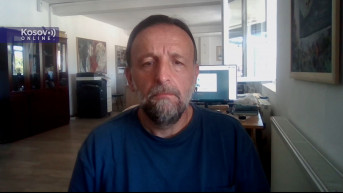
Journalist and writer from Gracanica, Zivojin Rakocevic, stated that there are not even “signals” of alleged negotiations between the Serbian Orthodox Church (SOC) and Pristina on a Fundamental Agreement or any other type of such arrangement, and that such claims are a “matter of logic,” because “you cannot talk about rights when all your rights have been taken away.”
“As far as we here on the ground know, there is not the slightest indication that such negotiations or ‘signals’—diplomatic activities—are taking place in that area, so that we could talk about agreements, documents, or papers of that kind. On the other hand, the key issue is a matter of logic. What would that mean, and why would the SOC need it? That is the first question that both the SOC and the Serbian people in Kosovo and Metohija logically face,” Rakocevic told Kosovo Online.
He said that Kosovo is the central point for the SOC, which makes it “absolutely impossible” for it to consider a Fundamental Agreement with Pristina.
“When we say SOC, we mean a thousand years of continuity and life, of uninterrupted presence, where Kosovo and Metohija are the central point. These are not dead numbers, but a living experience from which the SOC has never emerged as a loser. That is why it is absolutely impossible to even think about some kind of Fundamental Agreement,” Rakocevic emphasized.
He recalled that under the Ahtisaari Plan, later incorporated into the Constitution of Kosovo, the Serbian Orthodox Church was granted certain “extended rights,” but the key problem is that they are largely not implemented—the same model applies to the rights of Serbs in Kosovo.
“You cannot talk about rights when all your rights have been taken away or when they are threatened in various ways. What kind of discussion could that be if a liturgy is served among the ruins of the Church of the Holy Virgin of Hvosno, or if the hermitage of Saint Peter of Korisa near Prizren is being demolished, or if your very existence is being questioned? From that perspective, it is rather meaningless to talk even about drafts and ideas, and in any case, the information we have shows that such a thing does not, in fact, exist,” Rakocevic stressed.
He explained that the SOC and Serbs in Kosovo face “three levels of ongoing problems.”
“The first is the disappearance of the state of Serbia in every possible form, as the goal of Pristina. The second level is the breadth of attacks on the SOC, ranging from the hermitage of Saint Peter of Korisa somewhere in the Sar Mountains, to violations of the property rights of the largest monasteries and the prevention of the Patriarch from coming to Kosovo and Metohija,” Rakocevic said.
As the “third level” of endangerment of the Serbian community in Kosovo, he pointed to “innocent people in prisons.”
“This third level is particularly dangerous because it essentially undermines life itself in Kosovo and Metohija. And that life starts asking itself: ‘Am I next?’ If we know that someone from our immediate surroundings is innocent yet has been in prison for three years, then we say: ‘God, am I next? What will happen to me?’ You come to a situation where, when you have these three levels, all these rumors, pseudo-rumors, and pieces of information coming from all sides actually hit the weakest the hardest and affect their sense of security,” Rakocevic noted.
He said that Serbs in Kosovo have therefore developed “a specific form of resistance.”
“In the ghetto-like environments in which Serbs in Kosovo and Metohija live, a type of resistance has emerged that simply says: ‘It is their time, and I do not have to listen to everything coming from all sides. I will somehow manage to filter out the information that endangers me and makes me wonder at some point whether our survival is possible,’” Rakocevic explained.
0 comments