
Residents of Serbian communities in central Kosovo concerned about children’s safety amid increasingly frequent incidents
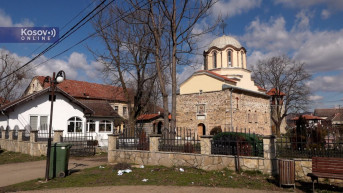
Dobrotin and Gornja Gusterica, villages with a majority Serbian population in the municipality of Lipljan, have in recent months repeatedly been targeted by vandals. Break-ins and thefts at churches, graffiti on utility poles, a kindergarten, and even a health clinic are incidents that have deeply disturbed residents of these settlements. As they say, they no longer feel safe even in their birthplace, and they are most concerned about the safety of their children on the way from school to home.
After the break in at the Church of St. Demetrius and the writing of ethnically motivated graffiti on the kindergarten and the clinic, the Kosovo Online portal’s team visited Dobrotin and spoke with residents, the village representative, school staff, and a prominent historian from the village, Aleksandar Gudzic.
Speaking about the rich history of the village, Gudzic stated that Dobrotin was first mentioned in written records as a settlement in a charter of Despot Djuradj Brankovic in the 1430s, and what is known with certainty is that Dobrotin existed as a settlement as early as the 4th century, during the Roman Empire and the rule of Constantine the Great and Empress Helena.
“This is confirmed by examples of Roman coins found in Dobrotin in the 1960s. The coins were found by Miodrag Gudzic, and today we know that they were minted in the period from 308 to 341. In 308, the first coin of Constantine I and Empress Helena was minted, and the last coin was minted in 341,” he said.
Today, he says, it is an ethnically purely Serbian village, with the population engaged exclusively in agriculture, but also dependent on funding from the state of Serbia.
“There were moments after the Berlin Congress when five Albanian households lived in Dobrotin, and these were mostly refugees who, after the Great Eastern Crisis and the Serbian Ottoman wars, moved from the area of Prokuplje and its surroundings to Dobrotin. The village is predominantly agrarian, people are engaged exclusively in agriculture, there are no industrial facilities in the village itself. In terms of social structure, the population in Dobrotin mainly depends on financial support from the state of Serbia, or they are employed in Kosovo institutions,” Gudzic states.
In the post-war period, Dobrotin experienced, as the historian recalls, the highest number of ethnically motivated attacks in central Kosovo.
“From the shelling of Dobrotin sometime in August to September 1999, to the throwing of hand grenades, explosive devices, daily attacks on Serbs. In those first post war years, Dobrotin perhaps experienced the most ethnically motivated attacks of all places in central Kosovo,” he said.
The trend of ethnically motivated attacks decreased after 2004 and the March pogrom, only to intensify again in recent months, which, Gudzic emphasizes, is causing concern among residents.
“We have witnessed occasional individual ethnically motivated provocations and incidents, and in the past month we have had the church burglary and the writing of ethnically motivated insulting graffiti, which is something that gives cause for concern,” he said.
That residents are indeed worried became clear through our conversations with them. While waiting for their children to finish school, they stress that they are most concerned about their safety.
As they state, traffic frequency is high and provocations are daily.
“We have to move cautiously, because there are incidents every day. It is normal for fear to be felt among residents, it is unsafe,” Cedomir Trajkovic said.
Dusan Cirkovic expects a reaction from the Kosovo Police and a safer life for residents.
“The situation is tense, residents are frightened, but we are brave and we will remain in our homes. We expect some reaction from the police, to establish patrols here, because people drive fast here and traffic frequency is high. We expect the police to station officers here to, among other things, control speed,” Cirkovic says.
He adds that life in Dobrotin had been good until now and that they had good relations with Albanian neighbors, but that tensions are increasing. Nevertheless, he expresses hope for a better tomorrow.
His neighbor Slavisa Zivic, however, doubts that life for residents will become better and easier.
“It is not safe at all when we have to take children to school and worry about how people drive and how they behave. What can we expect? I hope for a better life and that something will change, but I honestly doubt it. For now, there is no improvement. In earlier years it was calmer here in Dobrotin, but now, given all the incidents, people live in fear,” Zivic emphasizes.
Concern among parents has also been noticed by Ivana Zivic Dabic, a teacher at the Prince Lazar Elementary School in Dobrotin, which has 43 pupils. However, as she states, it is up to them to give their maximum so that children do not feel fear at every step and can have as carefree a childhood as possible.
“To be honest, I do not notice fear or any change among the children. I think the children do not know what happened, I am sure they did not learn it from the teachers, but I notice that many more parents now come to wait for their children than before. Previously, third and fourth grade students were independent and went home alone, and now I notice that parents come to pick them up,” Zivic Dabic said.
For village representative Dragan Curcic, the fact that three key institutions were attacked in a short period is worrying. He appealed to the competent authorities to strengthen security measures in Dobrotin.
“It is worrying that in a very short period three incidents occurred in which our three key institutions were attacked – the clinic, the kindergarten was damaged, and the Church of St. Demetrius. Of course the people are disturbed and humiliated by the attack on a religious building. Allegedly, the perpetrator who caused damage at the clinic was found, while for the church we have no information. We are in contact with the Local Public Safety Committee. I would ask representatives of law and order, in accordance with their authority, to strengthen security measures in the village of Dobrotin, both regarding facilities and citizens,” Curcic said.
In addition to Dobrotin, the neighboring villages of Gornja and Donja Gusterica have also recently been targeted by vandals. The Church of St. Nedelja was broken into and robbed only two days after the same happened to the church in Dobrotin.
Priest Vladan Vukomanovic emphasized at the time that, in addition to religious buildings, the houses of Orthodox residents are often targeted by vandals.
A resident of Donja Gusterica, Dejan Ristic, stressed that due to frequent attacks, residents of these villages are concerned about the safety of their children.
“The very thought that someone has the audacity to break into a church leads us to think about what could be happening in homes. It is noticeable that the number of Kosovo Police patrols has increased, so we hope that such events will not happen again. There were earlier break ins at shops and robberies. There is great concern, because this is a Serbian community and residents are worried about the safety of their children. We hope we will continue to live in peace, that is the priority of residents,” Ristic emphasized.
In addition to the mentioned incidents, the Orthodox cemetery in Skulanevo was also targeted by vandals when unknown perpetrators broke part of the fence in order to remove a Serbian flag from the grave of Ivica Talic, on two occasions.
The increasingly frequent incidents in Serbian communities in central Kosovo have also prompted a reaction from the Office for Kosovo and Metohija, which stated that a wave of intimidation of Serbs is continuing and that the attacks are neither accidental nor random.


0 comments