
Architectural or electoral “project” on the Ibar: Who needs bridges that divide?
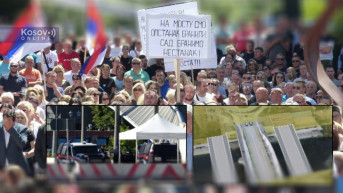
The proposal to build two new bridges between South and North Mitrovica has sparked fear and frustration among Serbs in northern Kosovo—much like last summer’s announcement to open the main bridge over the Ibar to vehicle traffic. When bridges divide rather than unite, the problem is no longer logistical but deeply political. Most interlocutors of Kosovo Online are convinced that the plan to build two new bridges is a pre-election move—difficult to implement and highly controversial.
Written by: Djordje Barovic
“We will continue building two more bridges, and probably many more along the Ibar,” stated Hysen Durmishi, Deputy Minister of Infrastructure in the caretaker government of Kosovo.
The project is based on a memorandum of cooperation between the Ministry of Infrastructure and the municipalities of North and South Mitrovica.
To show that the idea is not just symbolic, the Self-Determination Movement released a nearly comical photo of a conceptual design placing two new bridges directly next to the existing main bridge over the Ibar.
Whether architectural or electoral in nature, the proposed bridges seem to be a mystery even to those who should know about them—namely, the international community.
“This matter does not fall under KFOR’s mandate. For any comments, we refer you to the competent institutions,” KFOR’s spokesperson replied when asked if they were aware of the caretaker government’s plans.
The EU also expressed unfamiliarity with the initiative, warning that any such decision must be made “carefully and inclusively.”
“The EU is not informed about this project and is not involved. Any decision on building infrastructure across the Ibar must be made with full inclusion of all affected communities,” said the EU spokesperson for Kosovo Online.
Contrasting Views on Impact
Deputy Mayor of South Mitrovica Arian Tahiri is convinced the new bridges will not cause tensions and that Serbs actually welcome them.
“Every bridge, not just in Mitrovica but across Kosovo, is beneficial. It contributes to the development and well-being of the city and its residents. They do not cause tensions—they are welcomed even by Serb citizens,” said Tahiri.
However, Petar Ristanovic, Research Associate at the Institute for Serbian Culture in Leposavic, said that due to past experiences, Serbs view the proposal with deep suspicion.
“Normally, infrastructure projects like this should be met with joy. But here, Serbs react with caution. We can only speculate on the motive behind building two new bridges, but it's likely aimed at integrating North with South Mitrovica—possibly even facilitating, in part forcibly, the movement of Albanians into the north to shift the ethnic balance,” Ristanovic warned.
He believes the plan is part of Kosovo’s pre-election campaign and says implementation depends on whether the bridges are deemed of national interest by the Albanian political leadership.
“From a financial standpoint, this is an expensive idea—Kosovo lacks funds. But if the leadership views it as a national interest, the money will be found. If that’s the case, it will be clear to Serbs that the motive is not connectivity, but something else entirely,” he added.
Logistical Questions and Political Messaging
Milica Andric Rakic, Program Manager at New Social Initiative, also believes the project is a politically convenient narrative, yet lacking practical justification.
“There are many open questions. First, it’s not logistically warranted. In the area proposed, two bridges already exist and are functional for pedestrians and vehicles,” she said.
She pointed to the need for investment in road infrastructure and the renovation of existing bridges—such as those in Minarce and Cabra, which barely withstood floods in January 2022.
“There are far more compelling reasons to improve the infrastructure that already exists,” she emphasized.
She remains skeptical the project will ever happen and views it as “a pre-election message that resonates with the public in Kosovo.”
“This is primarily a political campaign—more for central than for local elections. It’s a topic that appeals broadly to the public in Kosovo, though the local Albanian population in North Mitrovica would likely prioritize other areas for investment. This is a form of compensation for the unfulfilled promise to open the main bridge,” she concluded.
Symbolism or Urban Planning?
Political analyst Nexhmedin Spahiu sees the announcement as good news and believes the Serbian community should not fear the new bridges.
“Whatever Kurti’s motive may be, the fact remains: the city needs them due to poor urban planning over the past 25 years. New bridges would improve connectivity and quality of life for residents on both sides,” said Spahiu.
He dismissed fears of increased institutional presence in the north, arguing that Kosovo’s authorities already have access through the existing bridge in the Bosniak Mahala.
“That bridge alone is sufficient for the government to assert control. The new bridges would only improve mobility and benefit all citizens,” he insisted.
Spahiu believes the construction is entirely feasible. “One of the bridges would be located near the North Mitrovica municipal building, easing traffic on both sides,” he specified.
Election Season Politics
However, political scientist Ognjen Gogic argues the plan must be viewed through the lens of pre-election rhetoric, questioning the legitimacy of those who initiated it.
“This is a proposal made by a caretaker ministry and municipal authorities nearing the end of their mandates. They lack the legitimacy to launch new initiatives, making this more of a campaign topic than a real project,” Gogic told Kosovo Online.
He recalled that opening the main bridge was a major electoral issue last summer and is likely to feature again in upcoming local and possibly national elections.
“Last year, the government pushed to open the main bridge to traffic—despite opposition from the Serb community. It was only KFOR’s stance that prevented it. That position has remained unchanged for over a year,” he said.
This summer, Gogic believes, Pristina has simply shifted tactics.
“Knowing KFOR’s position, they came up with a workaround—to build two new bridges instead of opening the existing one.”
He added that the plan also targets the Albanian diaspora, which returns in large numbers during the summer.
“Diaspora members have a strong desire to drive across the bridge. Since Kurti can’t offer them that, he’s offering two new ones as a symbolic gesture. It’s meant to stir emotions and mobilize voters,” Gogic concluded.



0 comments