
Defender Europe 25: Why is the Western Balkans one of the military training grounds for the U.S. and NATO?
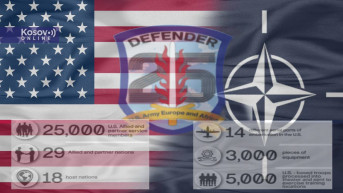
The second phase of the largest military exercise organized by the U.S. in Europe — Defender Europe 25 — begins tomorrow in the Western Balkans. The exercise, titled Immediate Response, will run from May 26 to June 9 at several locations, one of which will be Kosovo. According to Kosovo Online's interlocutors, there is no doubt that the region was not chosen by chance and that the U.S. and NATO intend to demonstrate their capacity to respond to any security challenge on the European continent.
Written by: Djordje Barovic
"This is about global deterrence. Everything we show we can do with our allies and partners, we can also do elsewhere. Defender gives us logistical and combat examples on a scale currently unmatched elsewhere," said General Christopher Donahue, U.S. Army Commander for Europe and Africa, while presenting the plans for Defender Europe 25.
This exercise, taking place across 18 countries, includes 25,000 troops from the U.S. and armed forces from 29 additional nations.
The first phase, Rapid Response, is ongoing from May 11 to 31 in Finland, Norway, Latvia, Lithuania, and Sweden, involving synchronized airborne operations at five locations.
According to the statement, the goal is to test power projection focused on expanding critical capabilities on the battlefield in the far north and the Baltic.
Immediate Response 25 is the second phase, during which approximately 12,000 troops from U.S. allies and partners will gather between May 26 and June 9 to strengthen cyber defense and demonstrate security capabilities.
The exercise will take place at eight locations: Slovakia, Albania, Bulgaria, Croatia, Greece, Montenegro, North Macedonia, and Kosovo.
The final phase, Saber Guardian 25, is scheduled for June 9 to 24 in the Czech Republic, Hungary, and Romania.
Kosovo’s acting Minister of Defense, Ejup Maqedonci, stated that Kosovo will play a key role this year, as the city of Gjakova will serve as the center of U.S. military command for the Western Balkans, making it a "strategic hub."
"We’ll be even more involved than in Defender Europe 23. Kosovo will not only host the exercise and participate with military units, but will also host the U.S. high military command that will oversee all training in the Western Balkans," said Maqedonci.
However, the 2023 exercise did not leave the best impression on Pristina. “For Kosovo, these exercises are over,” said then-U.S. Ambassador in Pristina Jeffrey Hovenier, after announcing Kosovo’s exclusion from Defender Europe 23 — the first punitive measure for ignoring U.S. calls for de-escalation in the north.
Soon after, EU sanctions followed and remain in effect.
Collective Security
Geopolitical and security consultant Nikola Lunic explains that the main objective of Defender 25 is the rapid deployment of U.S. forces in Europe and that the Western Balkans was chosen to rehearse operations for NATO’s eastern flank, which is being rapidly strengthened.
"The key point and goal is to practice rapid deployment of U.S. forces in Europe. For European allies and partners, the goal is increased interoperability with U.S. forces and within NATO," Lunic told Kosovo Online.
The scope of the exercise, according to Lunic, sends a clear message even to countries not yet in NATO that their future lies in the collective security system.
"The message supports integration into NATO, and there’s no doubt that all partners involved in this exercise will eventually be on the path to full integration," he adds.
He emphasizes that the region was chosen not because of local conditions, but as a training ground for NATO’s eastern flank, in response to the Ukraine crisis.
"The eastern flank of NATO is rapidly being strengthened, and all capabilities are being improved. It’s unfortunate we in the Western Balkans are not participating," Lunic said.
He notes this particularly applies to Serbia, which remains militarily neutral and refrains from participating in international military exercises.
"In today’s rapidly evolving technological landscape and changing warfare concepts, neutrality is unsustainable. We’ve imposed a moratorium on military exercises since 2022, which isolates us and diminishes our capabilities," Lunic concluded.
Intersection of Interests
Security expert from Pristina, Hisen Gecaj, told Kosovo Online that Defender Europe 25 is part of regular cooperation between the Kosovo Security Forces (KSF) and allied countries, aimed at testing readiness and the ability to counter potential aggression.
He emphasized that the interests of major powers intersect in the Balkans, often dragging small nations like Albanians and Serbs into conflicts not of their own making.
“These are regular exercises with the goal of assessing the capabilities of units and commanders to participate and respond to aggression. But in light of ongoing global crises — in Ukraine, the Middle East — these exercises take on greater significance,” said Gecaj.
He added that multinational military exercises have become more intense and complex due to rising global tensions, which have not spared the Western Balkans.
“Especially here, where problems persist in Bosnia and Herzegovina with Republika Srpska and Dodik’s political demands, and the unresolved Kosovo-Serbia dispute,” he said.
In such uncertain geopolitical conditions, he argued, every country must prepare for defense.
“Even if it stirs tensions among divided peoples, it’s necessary for nations to defend themselves,” Gecaj concluded.
Despite the global context, he warned that the Western Balkans is where great power interests converge, placing local nations in conflicts beyond their control.
“Political Locations”
Tirana-based political analyst and editor of Tema, Ilir Pata, believes Kosovo is a practical, not political, location for the largest U.S. military drill in Europe.
"Kosovo is more practical due to the significant U.S. base in Urosevac — Camp Bondsteel — which can serve as a logistical and operational center for participating forces," Pata told Kosovo Online.
Commenting on Maqedonci's claim that Kosovo is a “strategic hub,” Pata said the statement is political and aimed at gaining favor.
"Defender Europe has become routine over the last five or six years under NATO’s southern command, which includes North Africa, Italy, and the Western Balkans," he explained.
He noted that Albania hosted the drill two years ago and that both Tirana and Pristina tend to overhype it.
“Defender Europe is overestimated — both by Tirana during election season, and now by Kosovo. Kosovo already hosts NATO and KFOR. Politically, Kosovo is a different story, and I believe the U.S. will show less interest in the Western Balkans in coming months,” said Pata.
Asked how to interpret the exercise, Pata called it routine cooperation between NATO allies.
However, he pointed out that the recent military cooperation agreement signed by Albania, Croatia, and Kosovo goes beyond routine.
According to his sources, it was initiated not by Zagreb, but by Tirana.
“The agreement between Croatia, Kosovo, and Albania is geopolitical — aimed at countering Serbia’s military power. It was initiated by Tirana, specifically by Edi Rama, who has longstanding ties with former Croatian President Stjepan Mesic,” Pata revealed.
He concluded that such exercises carry no hidden messages.
"The Americans, including Vice President Pence and Trump, have stated they don’t intend to fight wars in Europe. If attacked, the U.S. will respond through its structures,” said Pata.
He added that in June, Europeans will face a “provocation” from Trump — a demand to increase defense spending.
"This is why governments in Germany, the UK, and elsewhere — despite decent ties with Trump — are preparing to raise military budgets. The U.S. no longer wants to carry Europe’s military burdens,” Pata concluded.
Messages and Military Grounds
Political analyst Blagojce Atanasovski from Skopje says the Defender Europe 25 exercise sends a political message of unity from the U.S. and NATO, and that the Western Balkans is no accident.
“This military exercise is a diplomatic message that the alliance remains strong in the face of Russian aggression in Ukraine,” Atanasovski told Kosovo Online.
He explained that regardless of future U.S. political leadership, these drills show continued transatlantic partnership.
"It signals enduring NATO cooperation between European and U.S. allies, including Kosovo, which, while not a NATO member, is part of the Western security architecture,” Atanasovski said.
He emphasized that the Western Balkans was not chosen at random.
“Just 30 years ago, the region experienced the bloody breakup of Yugoslavia. Conflicts and unresolved territorial disputes remain — in Kosovo, Bosnia — and NATO wants to ensure peace and prosperity here,” he said.
At the same time, NATO is sending a clear message against destabilization and promoting the integration of the Balkans into its alliance.
“It’s a warning to those engaged in unconventional or hybrid threats. NATO wants to ensure that the future of the Western Balkans lies within the alliance,” concluded Atanasovski.



0 comments