
During her three-year presidential term, what was Osmani's attitude towards the Serbian community?
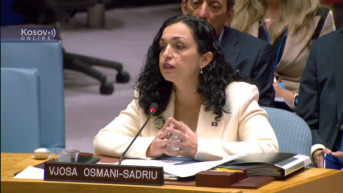
Although after being elected as President of Kosovo in the Assembly, Vjosa Osmani stated that she would be the president of all citizens and despite initial expectations that she could contribute to improving relations between Serbs and Albanians, her three years in this position, according to Kosovo Online sources, have not shown that her policy on this issue differs from that of the Self-Determination Movement.
In fact, what is criticized about this lawyer, who completed her doctoral studies at the University of Pittsburgh, is that she herself has contributed to the radicalization of Albanian society in Kosovo. It is also assessed that she builds her political image on nationalism, anti-Serb attitudes, and open hostility towards Belgrade.
As a candidate of the Self-Determination Movement, Osmani was elected president in the Kosovo Assembly on April 4, 2021, with 71 votes, with ten members of the Serbian List not present in the parliament. After becoming president, she stepped down from the helm of the Guxo list, which she founded, and which has since been registered as a political party.
When she announced in September 2022 that she would soon visit citizens in northern Kosovo, the then four Serbian mayors of northern municipalities stated that they perceived this announcement as a provocation of the Serbian people and another form of pressure on Serbs "in light of Osmani's anti-Serb actions and statements she had made."
Political analyst Srdan Graovac from the Center for Social Stability told Kosovo Online that both Osmani and Albin Kurti belong to the younger generation of the political elite in Kosovo and that many expected that, since more than 20 years had passed since the war in Kosovo, they would have a different and milder narrative, but the situation is completely different. Osmani and Kurti, he says, compete to be more extreme in their anti-Serb statements.
"She belongs to the group of younger political leaders in Kosovo who inherited older communist leaders from the time of Yugoslavia, but also those they called 'forest leaders,' mostly terrorist leaders from the time of the KLA. However, we see that this younger generation has a more pronounced nationalist and chauvinistic narrative towards Serbs and that they have contributed to the radicalization of Albanian society in Kosovo," Graovac emphasizes.
Furthermore, they are literally blamed for all the troubles in Kosovo, "for the lack of investments, excess unemployment, poor economic conditions, or for the inability to complete the process of forming an independent state of Kosovo, they blame Serbia and Serbs".
"In this way, they created an atmosphere of lynching directed towards Serbs, which led to an increase in attacks on Serbs. Taking this into account, it is not surprising that Osmani has an extremely negative narrative towards Serbs and Serbia because she participated in creating such an atmosphere in Kosovo society, and a different narrative is impossible. If you were to advocate a different stance, that radicalized public would not accept you. She is trying to reap the fruits of that radical narrative, and it is essentially anti-Serb," says Graovac.
According to Marko Milenkovic from the NGO "New Social Initiative," Osmani's attitude towards the Serbian community and the functions she performs aligns with the policy of the executive branch in Pristina, i.e., the policy of the Self-Determination Movement and their attitude. Although there were indications that she could contribute to improving relations between communities in Kosovo, it did not happen, and apart from some milder attitudes from her, nothing different was achieved compared to the Self-Determination Movement in power.
"In the previous period, we witnessed the deterioration of relations between the Serbian community and institutions in Kosovo. Everything that was built from the Brussels Agreement to the arrival of the Self-Determination Movement in power in recent years has been undermined, primarily the trust between citizens and institutions, but also between communities in Kosovo. This can be attributed to the entire Self-Determination Movement government, but also to Mrs. Vjosa Osmani, who fits into the whole picture," says Milenkovic for Kosovo Online.
He notes that there is a perception that Osmani has better relations with the international community compared to Albin Kurti, but he emphasizes that her mandate involves greater cooperation with the international community.
"There is also the perception of the international community about Osmani as a more constructive partner who has had less influence on making harmful decisions, primarily those related to the normalization of relations and relations with the Serbian community. In that sense, there is a better partnership between her and the international community, but not to a greater and significant extent because Osmani did not have great power to influence specific problems of the Serbian community and issues related to the normalization of relations and progress in dialogue," says Milenkovic.
According to some surveys, our interlocutor points out, Osmani as a political leader does not rate as high as some other political representatives from Pristina, especially those coming from the Self-Determination Movement, which somewhat indicates that she did not have enough freedom, nor mechanisms and strength to position herself in the political game as a significant political figure.
As for Osmani's views on the Association of Serbian Municipalities, she, like Kurti, is of the opinion that the ASM cannot have executive power, and regarding the European draft proposal for the statute of the ASM, she expressed concern that some of its provisions may be "challenging" to implement in practice. She also believes that there are ambiguous formulations in this draft that need to be clarified before this document is sent to the Constitutional Court of Kosovo for a constitutional review.
However, political analyst Shkelzen Maliqi says that Osmani's position is that Kosovo should fulfill all obligations from the dialogue with Belgrade and that she is trying to be constructive in that regard.
"Kurti counted on winning that game with Vucic, that the ASM wouldn't be formed because he had built his entire career opposing it. However, now is the last moment to clarify that, and it seems that the pressure is now directed towards Vjosa Osmani," says Maliqi for our portal.
He recalls that Osmani contributed significantly to Kurti's victory in the 2021 elections with a convincing majority of over 50% of the votes because she split her party, the Democratic Party of Kosovo, into two parts. As he says, nearly half of those who were with her were votes against Hashim Thaçi as an old guard politician.
"Vjosa is a president who didn't cause much trouble for anyone, but in the last year, she has started to 'wake up'. There is also the influence of Western factors that have had a lot of problems with Kurti because of his constant tensions towards Serbs in the north. Osmani has become a better interlocutor for Western ambassadors and envoys who come. This is now a new game because it is obvious that there will be elections. There will definitely be elections in 11 months and there may even be early ones," says Maliqi.


0 comments