
First Visit by Kaja Kallas to the Western Balkans: Old promises and expected scoldings
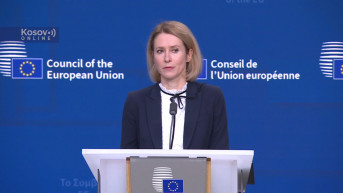
Six addresses and only three destinations. As an "accompaniment," a series of praises followed by scoldings. And an old promise: The Western Balkans are welcome in the European family. This briefly describes the first visit to the region by the EU High Representative for Foreign Affairs and Security, Kaja Kallas. For the interlocutors of Kosovo Online, from Tirana to Belgrade, there is an additional observation: the normalization of relations between Belgrade and Pristina remains high on the EU's agenda, but not the "stick and carrot" approach that would implement this in practice.
Written by: Djordje Barovic
EU High Representative for Foreign Affairs and Security Kaja Kallas concluded her Balkan "mini tour" in Sarajevo on Wednesday, after visits to Podgorica and Tirana.
"We truly care about this country and its European future. Political leaders must work together to solve problems, but inflammatory rhetoric and actions towards divisions are dangerous and pose a direct threat to Bosnia and Herzegovina," Kallas stated at the Eufor-Altea Mission base "Butmir."
While in Bosnia and Herzegovina she focused solely on current political tensions, in Montenegro and Albania, Kallas praised the dedication of these countries to European integration, but also emphasized the importance of continuing the dialogue between Belgrade and Pristina.
"What is important for Kosovo and Serbia is that they cannot progress without full normalization of relations between the two states," Kallas announced in Tirana.
Just a few days before arriving in the Balkans, she stated that if this was not possible through EU dialogue, they would try another way.
"What interests us is the normalization of relations between Kosovo and Serbia. Whether through this dialogue or some other instrument, we will gather ideas and make a proposal," Kallas mentioned.
According to EU spokesperson Anita Hyper, Kallas could not personally convey this message to Belgrade and Pristina due to the "limited time frame of the visit" of her "Balkan tour."
"The High Representative remains fully committed to the entire region, and future visits to other countries are already being planned. EU support for stability and European integration in the Western Balkans remains a priority," Hyper clarified.
(Un)forgotten
For political analyst Leonard Karaj from Tirana, Kaja Kallas sent a very important message to Belgrade and Pristina during her "Balkan tour."
"Kallas said something very important in Tirana, but I believe she also said it in Podgorica. She mentioned that Pristina and Belgrade are not forgotten, but the EU expects political stability there, negotiations to take place, and goodwill from both sides, from Serbia and Kosovo," Karaj told Kosovo Online.
Internal instability is the key reason why during her first visit to the Western Balkans, Kaja Kallas did not visit Kosovo and Serbia.
"We must take into account the fact that today we do not have a government in Pristina, as we had elections a few weeks ago. The situation in Belgrade, after the outbreak of numerous protests, has led to foreign policy being relegated to the background," he is convinced.
This is one of two reasons why he believes that at this moment, it is not possible to talk about progress in the negotiations between Belgrade and Pristina.
The second reason is the election of a new European mediator in the negotiations, Peter Sorensen.
"It is expected that the new negotiator will indicate what his stance will be, whether with the government in Pristina, which could again be Mr. Kurti's government, but with the presence of the opposition, or with the authorities in Belgrade, with a new prime minister proposed by Mr. Vucic," Karaj highlights in a conversation for Kosovo Online.
He is confident that the EU has mechanisms to persuade the parties to continue the dialogue.
"Diplomacy often works, but there are many cases where a policy of power is needed, especially when it comes to a region like the Western Balkans, which has always had problems. Therefore, a firm stance is needed, as happened in Rambouillet, when Ms. Madeleine Albright put a 'veto', if we can say so, and imposed the KLA on the negotiations, leading to what happened with the NATO bombing of Serbia and the end of the local war," claims Karaj.
Analyzing the first visit to the Balkans by the new European Commissioner for Foreign Affairs and Security, Karaj says that this shows that Europe has not turned its attention away from this region.
"Kallas' visit to the Western Balkans: Montenegro, Albania, and Bosnia, once again shows that Europe has not diverted its attention from these countries and that it wants these countries to become part of the European Union as soon as possible, without forgetting North Macedonia, Kosovo, and Serbia," believes Karaj.
He adds that the countries of the Western Balkans should not expect European integration to "happen tomorrow," but that this process will take several more years.
"Montenegro is clearly ahead of Albania and other countries in the region in this process and will probably be the next country to join the Union. Albania strongly asserts that it will open the last groups of negotiating chapters by the end of this year. I do not know how feasible this will be," this analyst believes.
The tense political situation is the key reason why Kallas decided to visit Bosnia and Herzegovina in addition to Montenegro and Albania.
"The political situation in this country is quite tense, given the approach of the Republic of Srpska and its president Milorad Dodik. It seems that the European Union is making efforts to direct Bosnia and Herzegovina towards a path to Europeanization, and not towards another path that could destabilize the region, a path that could be towards Moscow," says Karaj.
Brussels' Desires
Milan Sekulovic, editor at RTV Podgorica, believes that Kallas' visit to the Western Balkans is another proof that the EU "wants to bring the region to Brussels," but it is questionable how ready they are to cooperate on that plan.
"The messages we receive from the EU are more than encouraging. Literally, the EU not only wants to receive us and welcome us into the EU, but sometimes it seems that it wants to 'bring us' into Brussels, it's just a matter of how ready we are to cooperate on that plan. In the sense of whether we will fulfill all the tasks that we must fulfill, as demanded by the Brussels administration," says Sekulovic for Kosovo Online.
He emphasizes that Kallas sent a very encouraging message that Montenegro is a leader in the region in terms of European integrations.
"Although there has been a lot of talk about criticisms from Brussels against part of the current administration, mainly referring to some pro-Serbian parties, we see that despite this, the EU cooperates very well with these parties, and they show themselves to be very cooperative in terms of European integrations. If there is one cohesive factor in Montenegro between all parliamentary parties, even those outside parliament, it is that they all support Montenegro's entry into the European Union," emphasizes Sekulovic.
He believes that by choosing Albania, Montenegro, and Bosnia and Herzegovina as the first destinations of the new EU Commissioner, Brussels sent a "geostrategic message" to the countries of the Western Balkans.
"Essentially, the EU is very interested in the Western Balkans, and the Western Balkans are interested in the EU. In that sense, it is an encouraging message to us as countries in the region that are trying to meet all the strict criteria set by Brussels before us," emphasized Sekulovic.
This desire of the EU to give the region full membership is evident in the "tours" with which European officials begin their mandate.
"The very fact that they always start their mandate with these tours, whenever they choose the Western Balkans, is an indicator to the Western Balkans that it is welcome in the EU, and it's just up to this region to try a little harder to take advantage of the chance and opportunity that has been given to it," concluded Sekulovic.
"Stick and Carrot"
Unlike him, researcher Djordje Dimitrov at the Belgrade Center for European Policies points out that Kaja Kallas during her first visit to the Western Balkans actually did not bring any new message, and that conditioning to Belgrade and Pristina is difficult to implement because the EU does not have a strong enough "stick and carrot."
"The EU does not have a strong 'stick and carrot' at this moment except maybe some money. By the example of the Growth Plan, we have seen that this dialogue and progress towards normalization will not be such a strong factor when deciding whether Serbia and Kosovo have met the conditions for funding or not," says Dimitrov for Kosovo Online.
Kallas stated before her visit to the region that the EU has "other instruments" that could initiate dialogue between Belgrade and Pristina, but Dimitrov says such mechanisms do not exist because "the dialogue is not dead, but it is on pause".
"The European Union really doesn't have 'other instruments' it can rely on at the moment. The dialogue is on pause because we currently do not have a government in Kosovo that could negotiate. We do not even know if that government will be formed. On the other hand, we have internal events in Serbia. Vucic certainly does not want to stir up the domestic situation by continuing to make new concessions to Kosovo," Dimitrov specified.
He believes that although it was not on the agenda, Kallas will undoubtedly visit Serbia, but one should not have high expectations.
"We cannot expect anything that we haven't already seen in, say, Borell's visits. The EU will continue to insist that Serbia must impose sanctions on Russia and align its foreign policy. It will continue to push for reforms and will keep sending the message that the normalization process between Belgrade and Pristina is necessary. And of course, it will continue with those messages that the EU is here to help, to assist, and that the countries of the region are part of the European family and will join at some point," Dimitrov explains.
He considers the choice of Balkan countries that Kallas first decided to visit as "definitely interesting."
"Now, why she did not choose Serbia can be justified by the fact that it only has a technical government and she could not meet with everyone she would usually meet: the president, the prime minister, the foreign minister, and possibly the president of the National Assembly. Also, it can be justified by the fact that there is currently a major political crisis in Serbia. Probably, Kaja Kallas would like to avoid these sensitive issues," Dimitrov notes.
He specifies that Kallas visited two, at this moment, the most stable countries in the Western Balkans in terms of internal politics but also progress in European integrations.
"Montenegro is convincingly leading and excelling in this process and it can be expected, if it continues at this pace, that it will finish the negotiations in the next two years, while Albania's negotiations heated up last year and are expected to continue at this pace with the opening of clusters. As for Bosnia and Herzegovina, it is in a period of a very big crisis caused by events around Milorad Dodik. And probably the personal presence of the high commissioner is one way for the EU to calm tensions and respond to this crisis," evaluates Dimitrov.
"Other Instruments"
In Pristina, they think similarly.
Belgzim Kamberi from the Musine Kokalari Institute says that neither Brussels nor Washington currently know how the dialogue on normalization between Belgrade and Pristina should continue.
"There are two reasons why Kallas first visited Albania, Montenegro, and Bosnia and Herzegovina. The first is that Montenegro and Albania have progressed a bit more in Euro integrations, and the second is the crisis that exists in Bosnia and Herzegovina. But, the most important and most interesting thing is that she did not visit either Serbia or Kosovo considering that there is an EU-led dialogue on normalization of relations between Pristina and Belgrade," Kamberi stated for Kosovo Online. According to his words, this is a consequence of the crisis in which the dialogue is currently.
"We are now in a situation where neither the EU nor the USA knows how the Kosovo-Serbia dialogue will continue in the future. They themselves have said that they are looking for some 'other instrument' concerning relations between Pristina and Belgrade. And one of the reasons why she may not have visited Pristina and Belgrade is that in the EU they still do not know how to continue with the current dialogue between Kosovo and Serbia," Kamberi specified.
Kamberi says that the EU has various instruments that could initiate dialogue between Belgrade and Pristina and emphasizes that this could be a change in the format of the dialogue, but also a possible international conference at which a final agreement could be reached.
"The dialogue is currently moving in a way that Brussels talks first with Belgrade and then with Pristina, and it is not a direct dialogue. Maybe one of the instruments, and it would be harder, could be some kind of international conference that could be organized and where a big agreement could be reached, not the process that has been so far," said Kamberi. He emphasizes that the final decision will primarily depend on future relations between Washington and Brussels, which are not the best at this moment.
"The biggest question is therefore who will lead that dialogue between Pristina and Belgrade. Whether we will continue with the current process where the EU has been the one leading the dialogue, and Washington has been a side supporting that process, or we will come to a situation where the current American administration takes the main role in that relationship between Kosovo and Serbia. At this moment, it is difficult to say not only because we do not know what the future relationship of the Trump administration towards the EU will be, but also because of the situation in Pristina and Belgrade. In Pristina because we still do not have a new government, and in Belgrade because of the political situation and the executive power vacuum," assessed Kamberi.
"Next Phase" of the EU
Andreja Stojkovski, the executive director of the Prespa Institute from Skopje, agrees on the reasons why Kallas chose Montenegro, Albania, and Bosnia and Herzegovina on her first Balkan tour, but also adds that the region should adjust to the "next phase" of the EU because, as he points out, the Europe as we know it no longer exists.
"The European Union as we knew it probably no longer exists and we could say that phase is over. A new logic of functioning of states and relations among states, the Russian invasion of Ukraine, the election of a new president and new administration in the United States, as well as relations between the great powers and the Union, already make them much more focused on their own defense, on functioning of 27 states as a single entity. Therefore, I do not see that it will continue to function as we knew and I assume that we will also have to adjust to the next phase of the European Union and the next enlargement," says Stojkovski in a conversation for Kosovo Online. He expects that the first moves of the EU will probably come very soon, and that the choice of countries from the region that Kallas first put in her agenda to visit the Western Balkans should not be linked to "hidden messages."
"We could probably look for messages hidden in the choice of countries, but given that it is a three-day trip, three countries are quite enough for those three days," said Stojkovski.
He reminded that the European Commission previously stated that Montenegro has advanced the most in the accession process, and that Albania, by opening the first cluster last October, formally began negotiations with the EU.
Asked what messages the remaining countries of the Western Balkans should expect, Stojkovski says that Kallas was very clear at the beginning of her mandate that she does not recognize the EU until it includes the countries of the region.
"However, I do not see any specific message during this period or during this visit. In the foreseeable future, we might hear something more direct. Macedonia is either blocked or has been vetoed. Serbia and Kosovo, I think at least when Serbia is concerned, there is no interest nor appetite for overcoming problems, at least not with this composition of political elites," believes Stojkovski.
Commenting on Kallas' statement that the EU has "other instruments" to initiate dialogue between Belgrade and Pristina, he points out that there are several possibilities.
"There is always the position to block and stop negotiations until progress is made or a Kosovo-Serbia dialogue starts functioning. However, you also have other instruments that the Union can use. If you remember, some time ago they said we were the first country that managed to move things on the reform agenda and to get the first tranche of funds from the growth plan. Those are probably some of the instruments that the Union could use, at least when it comes to Serbia and Kosovo, although there will probably be a bit more or a bit more serious political pressure," specified Stojkovski.



0 comments