
Has the main bridge on the Ibar divided the Quint?
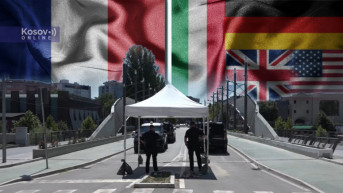
Everyone is clear and unanimous. And everyone condemns unilateral actions. The Quint members have so far issued dozens of identical statements declaring that they "do not support" these actions. Meanwhile, Pristina continued to act on its own, with only the key word changing in these statements: "dinar," "post offices," "mayors," and "special forces." And now, it has come to the "bridge." However, last week, France sharply stated for the first time that unilateral actions affect the daily lives of the Serbian community. Has the issue of (not) opening the main bridge between South and North Mitrovica become "the straw that broke the camel's back" and divided or united the Quint?
Written by: Arsenije Vuckovic
"France strongly condemns the increase in unilateral actions by the Kosovo authorities in the north of the country, which affect the daily lives of the Serbian community. These actions jeopardize efforts to normalize relations with Serbia, which are a prerequisite for achieving a European perspective for both countries," the French Ministry of Foreign Affairs stated.
The German ambassador in Pristina, Jorn Rohde, was also very clear – there is no talk of opening the main bridge on the Ibar.
"The assessment of the current security situation clearly shows that this is not the moment to open the bridge. As long as we believe that it is not the right time to open the bridge, we must remain in the current situation," Rohde said.
While the authorities in Pristina have "ignored" these warnings, analyst Muhamed Kelmendi concludes that France is directly opposed to opening the main bridge on the Ibar.
"France insists that the bridge remains as it is. I believe and hope that the US, Germany, and England will not let the bridge remain a border in the middle of Kosovo. We can't say that Kurti didn't know how significant the Ibar Bridge is to the Americans," Kelmendi said.
Analyst Arben Mece went a step further, saying that the "disturbing level of discord" between Prime Minister Albin Kurti's stance and those of the US and EU has made Kosovo a "hot spot" where potential conflicts could "trigger explosions."
(Dis)trust scenario
Director of the Center for Foreign Policy and former Serbian ambassador to London, Aleksandra Joksimovic, says that the West, especially the Quint members, are most concerned about such a scenario and that their warnings should not be taken lightly.
"If these countries assess that there is a security risk, I think they likely have much more information than we can comment on. But a very important aspect is that in the event of any unrest, KFOR would be directly affected, and those involved with KFOR will certainly try to avoid this at all costs," Joksimovic emphasized for Kosovo Online.
She emphasizes that the intention to open the main bridge on the Ibar differs from previous actions by Pristina, as it could endanger the safety of KFOR members.
"KFOR has issued a statement saying it is prepared to remain on the bridge regardless of what happens, meaning that KFOR could potentially be endangered by any actions and security destabilization if Kurti insists on fully opening the bridge. In this context, it seems that several visits to Pristina have been made in an attempt to warn Kurti against any uncoordinated actions. We see that even the CIA director was there, along with the third-ranking NATO official," Joksimovic noted.
Priština's unilateral moves, she adds, have also resulted in decreasing trust among Quint members in the current prime minister.
"For some time now, Kurti's activities have been building distrust with the members of the Quint, who have largely supported him. However, uncoordinated actions have led to a loss of trust, and future actions are being viewed with suspicion. One such action is the complete opening of the Ibar Bridge. It is important to note that all members of the Quint believe that this is not the right time for such a move, as it could be very risky," Joksimovic said.
The EU and Quint are concerned that a new crisis hot spot could emerge after Ukraine, and they assess that a unilateral action to open the main bridge on the Ibar could trigger such a scenario.
"Everyone is worried about the possibility of a new security problem, and there is potential for this activity to escalate into an uncontrollable security risk. In this context, it should be said that all Quint members are realistically opposed," she clarified.
Commenting on the recent strong statement from the French Ministry of Foreign Affairs, which called on Pristina to halt unilateral actions that disrupt the lives of the Serbian community in northern Kosovo, Joksimovic says that France, compared to other Quint members, has had a greater understanding of the position of Serbs and Belgrade from the start.
"France is always the one that, in certain nuances, has more understanding for the position of Serbs and Belgrade and perhaps always has slightly stronger and more decisive statements compared to others. But it seems that the Quint is currently united in the view that any discussion about opening the Ibar Bridge for traffic at this time represents a security risk," Joksimovic assessed.
She attributes this not only to the traditional historical ties between the two countries but also to the current bilateral relations between Paris and Belgrade.
Thus, she sees the statement from the French Ministry of Foreign Affairs as a sort of prelude to President Emmanuel Macron's visit to Serbia.
"There are historical ties with France. There is close and tight cooperation at this moment with significant economic aspects and frequent interactions. We see that President Macron is coming for his second visit. It is very significant to note that when the president of such a country comes for a second time, it carries great importance. It means that Serbia is a very important bilateral partner for him, and in this context, we can even say that this statement is a form of preparation for his visit, where they perhaps wanted to highlight that France understands certain concerns, fears, and positions of Serbia, specifically regarding the issue of the Ibar Bridge at this time," Joksimovic said.
(Pre-election) status quo
Security expert from Pristina, Nuredin Ibishi, says that the issue of opening the main bridge on the Ibar is unquestionable because it was agreed upon in 2017, but that this topic is currently in a status quo.
"We are now in a status quo, between not implementing and not opening the bridge and what the Government of Kosovo stated – to do so after the bridge is certified and other measures are taken. But this will likely be done in consultation or agreement with international factors, especially with our strategic partners," Ibishi told Kosovo Online.
Ibishi emphasizes that unilateral moves would be wrong and would lead to additional tensions and conflicts.
"We cannot do this alone, we are too small. Not just us, but also Serbia and Croatia in comparison to the great powers. It could only lead to discussions about war and peace in this region once again. That is why everything must be done in agreement and coordination with international factors," Ibishi said.
Although he doesn't question the reasons for the bridge to be opened, he does not rule out the possibility that the opening of the main bridge on the Ibar has become an election issue.
"I'm not making political judgments, that could be the case. But bridges serve to connect people, communities, for the flow of vehicles and goods... It is unimaginable that this bridge is not finally opened, considering that all the other bridges are in use. However, there is likely an assessment at this moment that this should perhaps be done in the foreseeable future. Therefore, I wouldn’t say whether any coalition in power or anyone else is using or criticizing this, but I think that realistically, the bridge should be opened. However, it must be done in agreement with the international presence in Kosovo and after assessing the situation to avoid worsening the situation. But, this cannot be delayed indefinitely," Ibishi concluded.
Wider context
French historian and professor of geopolitics at the University of Versailles, Alexis Troude, tells Kosovo Online that the situation around Kosovo must be viewed in the broader context of the weakening of the EU, which is why Quint's support for Pristina is not the same as in 2016, which, he emphasizes, is good news for both Serbia and Europe.
"The situation with the Quint is not the same as it was in 2016, when the agreement on Kosovo and Metohija was formed. Public opinion in France has changed. The same is true in Germany. Germany's support for the Albanian side is not as strong as it was eight or ten years ago. The Quint is, however, divided, and I think this is good news not only for Serbia but also for Europe because the situation in Kosovo must be considered in a broader context, including the weakening of the European community, European military strength, and the context of a new world order," Troude stated.
Commenting on the French Ministry of Foreign Affairs' reaction that Pristina's unilateral actions affect the everyday life of the Serbian community, Troude says that the Quint is still not divided on this issue, but that official Paris has had the ambition to protect all minorities in Kosovo since 1999.
"The only new thing, in my opinion, which can be seen every day in Brussels and New York, is that the Albanian side has less and less support from the major powers. This is very interesting because it should lead to peaceful decisions that favor minority communities," the historian said.
He adds that the policies of current Prime Minister Albin Kurti are receiving less and less support even among Albanians themselves.
"The Albanian people do not support Albin Kurti's policies. Many Albanians from Kosovo have gone abroad. They have gone to work throughout Europe," Troude emphasized.
He dismisses the possibility that a unilateral decision to open the main bridge on the Ibar could increase tensions or even, as some Albanian analysts suggest, an "explosion" of violence.
"As usual, I think there will be tensions and provocations, especially from the Albanian side, but it will not lead to a major conflict. We must consider that such a conflict would not be in the interest of America, and even less so of Russia. We also know China's position, which has always been strong on the issue of Kosovo and Metohija, and it would never support new tensions or another war," Professor Troude concluded.
Risks and expectations
Dimitrije Milic, Program Director of the "New Third Way" organization, believes that the Quint countries, especially the US and the EU, "have the tools" to deter unilateral actions, including the opening of the main bridge on the Ibar, while Pristina expects that Germany and the United Kingdom might oppose such deterrence.
In a conversation with Kosovo Online, he explained that the biggest risk for Pristina would be if the EU, directly in conjunction with the US, threatened concrete negative measures or some form of sanctions.
"That would be the biggest deterrent tool. It would involve all the countries that more or less disagree with the decision, regardless of whether they have publicly proclaimed it or not. If that becomes the official American and European position, the message is very clear," Milic told Kosovo Online.
He says that the Quint member countries have so far demonstrated unity in opposing the decision to unilaterally open the main bridge on the Ibar, while Pristina hopes that Germany and, to some extent, the United Kingdom might have "a somewhat more conciliatory tone" on this issue.
"Until now, we haven't heard a single official from the Quint, from any of the Quint states, who publicly supported this decision. On the contrary, we've seen several officials, and representatives of these countries, who condemned this decision and consider it an unnecessary escalation measure. We've heard this from France, the US... What I assume is that Pristina expects that Germany might have a slightly more conciliatory tone in relation to concrete actions. I also assume the United Kingdom, but more relying on previous patterns," Milic said.
He reminds that the previous UK government, led by the Conservatives, as well as the Foreign Affairs Committee of the Parliament, "definitely stood on Pristina's side."
"Given the change of government in the United Kingdom, we haven't yet seen such clear positions from the Labour Party on this issue because they haven't focused on this topic," he noted.
Regarding Germany's stance, Milic does not rule out the possibility of a change in "tone" compared to other Quint members.
"I assume that in this lineup of states, we might see some different tone from Germany, but we haven't seen it yet, at least not publicly," Milic concluded.

0 comments