
From international projects to promoting science: Aleksandra Petrovic on knowledge that shapes the future
From modernizing study programs and equipping state-of-the-art laboratories to international cooperation, scientific research and bringing science closer to the youngest generations, the work of Professor Aleksandra Petrovic, Assistant Professor at the Department of Road Traffic and Transport at the Faculty of Technical Sciences of the University of Pristina, temporarily seated in Kosovska Mitrovica, spans a range of fields in which knowledge is translated into tangible results.
Through international projects, science-promotion initiatives and cooperation with educational institutions, Petrovic told Kosovo Online that the goal was not only to improve conditions for studying and research, but also to encourage young people to develop their curiosity, explore and believe in their own ideas.
Among the results of international cooperation are modern laboratories and centers at the Faculty of Technical Sciences, opportunities for students to undertake professional training at partner universities, and projects designed to bring science closer to the wider public. These include the DiBS project under the Horizon Europe program, European Researchers’ Night, and the Traffic Light of Knowledge, a popular science program promoting safe and sustainable transport, which won first place in Category 2 of the public call issued by the Center for the Promotion of Science.
Speaking about the importance of international projects, Petrovic stressed that their results were visible not only in modernized study programs, but also in infrastructure, equipment, exchange of experience and new opportunities for students and teaching staff.
“The modernization of study programs is, we can all agree, absolutely essential in this era of rapidly advancing technology, so that we can keep pace with all these new challenges and the growing need for new knowledge, which we then pass on to our students through modernized study programs,” Petrovic said.
However, she emphasized that laboratories and centers established and equipped with modern technology in various fields were particularly important outcomes of these projects.
“For example, we have one of the most modern traffic and transport laboratories, an HDTV studio, a laboratory for renewable energy sources and electric mobility, a Center for Short Study Programs, and a Training and Innovation Center. These are all organizational units that were established and equipped through our international projects,” she explained.
In addition to improving infrastructure, another important result of international cooperation is the exchange of experience between teaching staff and colleagues from universities across Europe. Such cooperation creates opportunities for sharing knowledge and experience, while students are given the chance to acquire new knowledge and skills and familiarize themselves with how other higher education institutions operate.
“What is also important is that, in addition to studying here at our Faculty under improved conditions, our students have the opportunity to undertake professional internships at some of our partner universities and gain valuable experience, knowledge and skills there. But I would also say that they get to see that, in essence, their knowledge is in no way inferior to that of students there. The environment we come from does not determine how much we know, what we are capable of or what our potential is,” Petrovic said.
Unlike Erasmus+ programs, which focus on education, the Horizon Europe projects in which Petrovic is involved focus on science, research and bringing science closer to society.
One such project is DiBS—Digital Bridges: Science, Media, Society—coordinated by the University of Pristina. Through various activities, including European Researchers’ Night and the “Researchers at Schools” program, the aim is to bring science closer to the public, particularly children and young people, for whom opportunities to engage with scientific content are not equally accessible everywhere.
“One of the Horizon projects that we coordinate is DiBS, ‘Digital Bridges: Science, Media, Society,’ through which, in a very specific way and through specific activities such as European Researchers’ Night, which we organized on September 25, last month, as well as an activity called ‘Researchers at Schools,’ which is yet to be organized, we are trying to make science accessible to our youngest fellow citizens,” Petrovic said.
One of the project’s main objectives is to include schools from different communities throughout Kosovo so that pupils in rural areas also have an opportunity to encounter science and develop an interest in it.
“One of the main objectives of the project is precisely to give our youngest citizens the opportunity to discover science and become interested in it, including those for whom it may be far less accessible in some rural areas than it is here in Mitrovica,” she stressed.
European Researchers’ Night, held on September 25 at four locations, attracted more than 1,400 visitors, confirming the importance of activities that present science in a direct and accessible way. Rather than confining scientific knowledge to classrooms and laboratories, such events give visitors an opportunity to explore different scientific fields through experiments and practical demonstrations.
In addition to international projects, Petrovic is also developing initiatives aimed at popularizing science within the local community. One of these is “Traffic Light of Knowledge – a popular science program promoting safe and sustainable transport,” a project that emerged as a continuation of experience gained through earlier international projects devoted to road safety.
The idea was to use the existing infrastructure, equipment, expertise and results of scientific research to design activities that would bring science closer to children, young people, students and interested members of the public.
“The idea for the project ‘Traffic Light of Knowledge – a popular science program promoting safe and sustainable transport,’ which is its full title, emerged as a logical continuation of some of our previous international projects that dealt with road safety in various ways. The idea was to make use of all the infrastructure and equipment we have, as well as, of course, the knowledge, experience and results of our projects and scientific research in this field,” Petrovic explained.
She said the objective was to devise the best way of promoting science and making it accessible to different age groups, from preschool and elementary school children to high school students, university students and the general public.
“The aim was to use all of this to devise the best way to promote science and bring it closer to our young fellow citizens—elementary and high school students and preschool children, as well as our university students and, ultimately, the wider public interested in this subject,” she said.
One of the activities within the project was the exhibition “Traffic Light of Knowledge – Reaching Science through Creativity,” in which elementary school pupils from across Kosovo had the opportunity to participate.
“One of those ideas was to organize the exhibition ‘Traffic Light of Knowledge – Reaching Science through Creativity,’ and it is a great honor for me to say that elementary school pupils from across Kosovo and Metohija had an opportunity to participate in it,” Petrovic stressed.
The knowledge, experience and equipment acquired through international projects also provide the foundation for new initiatives, including a project designed for presentation at Expo. The idea is to create an interactive scientific exhibit through which visitors can conduct experiments themselves and gain firsthand insight into the importance of the human factor in road safety.
“We have now developed an idea for an Expo project in a unique way that we have not previously presented in this format. The Expo project will be an interactive scientific exhibit where visitors will have an opportunity to gain firsthand experience in a completely safe environment. We will measure the various parameters that these instruments allow us to assess, primarily reaction time—from the moment we perceive a critical situation to the moment we react,” Petrovic explained.
She illustrated the importance of reaction time in traffic by noting that a vehicle traveling at 100 kilometers per hour covers 27.8 meters in a single second.
“You know, when we are traveling at 100 kilometers per hour, one second means that we have covered 27.8 meters, and sometimes that is crucial to avoiding a traffic accident,” she stressed.
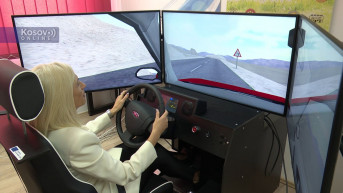
The exhibit will use a simulator, eye-tracking glasses, and goggles that simulate the effects of alcohol intoxication, fatigue and psychoactive substances. The equipment also includes a LiDAR system used for three-dimensional scanning of infrastructure and infrastructure facilities.
“The equipment we will use for this interactive scientific exhibit at Expo consists of a simulator, eye-tracking glasses, goggles that simulate intoxication, fatigue and the effects of psychoactive substances, as well as a special device called a LiDAR system, which is used for three-dimensional scanning of infrastructure and infrastructure facilities. All of these devices will be combined into a single special exhibit that we will present at Expo,” Petrovic said.
The equipment was procured through several international Erasmus+ projects and has a total acquisition value of approximately 100,000 euros. Bringing it together in a single interactive exhibit, she stressed, would provide an opportunity to present the results of their work in a new way while enabling visitors to better understand, through firsthand experience, the consequences of risky behavior in traffic.
“We have taken the opportunity to bring all this equipment together and present it in a very special way. It will also be an ideal opportunity to promote our University and our work, and I think it will be very interesting because visitors will be able to experience for themselves the consequences, for example, of driving under the influence of alcohol or any other distraction that we will be able to analyze there on the spot,” she said.
In addition to international projects and efforts to improve conditions for studying and research, an important part of Aleksandra Petrovic’s work is encouraging young people to develop their own ideas and interest in science.
“For young people, the most important thing is to have an idea, to be curious and inquisitive. We saw this at our European Researchers’ Night—the most important thing is that we will not simply give you the answer; instead, we will let you conduct the experiment and arrive at the answer yourselves,” Petrovic said.
As an example of success, she cited the students who are members of Sokolus and won first place in the “My Innovation” competition in Republika Srpska, competing against some of the strongest faculties in the field of technical sciences.
Her message to young people is to persevere in developing their ideas and not allow obstacles to discourage them.
“Never give up. Keep working on your ideas and do not let any obstacle discourage you, because success is made up of a series of setbacks. So be persistent, and of course, you will always have the support of our teaching staff and management in pursuing your ideas and achieving what you set out to do,” Professor Aleksandra Petrovic stressed.


comments