
Bruce: UNMIK mandate outdated; China calls for continued support for UN mission
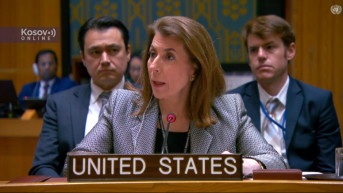
US Deputy Representative to the United Nations Tammy Bruce said that UNMIK’s mandate was outdated and that the Security Council should terminate the mission. On the other hand, China’s Deputy Permanent Representative to the UN Sun Lei stressed that dialogue was the only path toward resolving the Kosovo issue and that Serbia’s sovereignty and territorial integrity must be respected, while calling for continued support for UNMIK’s work.
“UNMIK no longer plays any role in Kosovo. KFOR, the EU mission and several other missions play a much greater role,” Tammy Bruce said.
According to her, continuing the mission served no one, while the Security Council’s inability to take a position on the issue demonstrated the problems facing the world organization.
Bruce stressed that the United States wanted a stable, peaceful and prosperous Western Balkans.
“Normalization of relations between Belgrade and Pristina is not only critical to the future, but the only way forward. President Donald Trump wants peace, stability and prosperity. We call on both sides to take steps to build trust, preserve stability and engage in constructive dialogue. Progress depends on Belgrade and Pristina, not on the Security Council,” Bruce stressed.
She underlined that the US position on UNMIK had not changed and that the mission should be brought to an end.
According to Bruce, the situation in Kosovo had changed since 1999, while the mission had continued under an outdated mandate.
“It is a peacekeeping mission without peacekeeping activities,” Bruce said.
China calls for continued support for UNMIK
China’s Deputy Permanent Representative to the UN Sun Lei stressed that dialogue was the only path toward resolving the Kosovo issue and that Serbia’s sovereignty and territorial integrity must be respected.
“China’s position is clear. We support the parties in reaching a solution through dialogue in accordance with Resolution 1244. In that process, Serbia’s territorial integrity and sovereignty must be respected,” the Chinese diplomat stressed.
He warned of the fragile security situation in northern Kosovo, noting that Serbian-owned homes and property had been demolished and that there had also been reports of police mistreatment.
He said that Serbia had remained calm and avoided escalation in response to these developments and called on the Kosovo authorities to prioritize peace and refrain from destabilizing actions.
Regarding the dialogue, he expressed regret that there had been no meetings or progress this year.
He stressed that the Brussels Agreement, particularly the establishment of the Community of Serb Municipalities (CSM), must be implemented.
“The Kosovo authorities must implement the Brussels Agreement and establish the CSM without delay, thereby removing obstacles to the dialogue,” Sun said.
Steps aimed at ensuring the inclusion of all ethnic communities were also necessary, Sun Lei stressed.
Speaking about UNMIK, he said that the mission had played an invaluable role in Kosovo and called on the Kosovo institutions and the international community to provide it with the support necessary to continue successfully carrying out its mandate.
“The Balkans have endured brutal wars, and we must not allow such a tragedy to be repeated. The international community must promote dialogue and peaceful coexistence. China stands ready to cooperate in this regard,” Sun Lei stressed.
Britain calls for review of UNMIK mandate
Political Counsellor at the UK Mission to the UN Jennifer MacNaughtan said that, given the changes that had taken place in Kosovo over the past 27 years, a strategic review of UNMIK’s mandate was necessary.
“We call for a strategic review of UNMIK’s role and funding. Many of the functions once performed by UNMIK are now carried out by Kosovo institutions and other international organizations, including KFOR, EULEX and the OSCE. This should be reflected in our structure and resources. While we welcome the significant staffing reductions that have already taken place, we reiterate our call for a strategic review of our responsibilities under the combined mandate, as well as funding, to ensure that UN resources are aligned with contemporary realities,” MacNaughtan said.
According to her, normalization of relations between Belgrade and Pristina was key to progress.
“We call on both sides to fully implement previously reached agreements, including the agreement on self-management for Kosovo Serbs,” the UK Mission’s Political Counsellor said.
Normalization of relations between Kosovo and Serbia, she added, remained essential to long-term stability and to the European future of both Belgrade and Pristina.
“We continue to call on both sides to implement existing agreements and engage constructively in the EU-facilitated dialogue. This includes full implementation of the Ohrid Agreement and fulfillment of the commitment under its Article 7 to ensure an appropriate level of self-management for the Serbian community in Kosovo. We note the concerns raised in the Secretary-General’s report regarding the impact of certain actions by Kosovo on non-majority communities, particularly in northern Kosovo. Kosovo’s Constitution provides comprehensive safeguards for their rights, which must be fully implemented in practice and in accordance with the rule of law,” MacNaughtan stressed.
Serbia, she added, should provide access to relevant archives and documents to support progress in resolving the issue of missing persons. She also noted that the fate of more than 1,500 people from all communities remained unknown.
She stressed that the United Kingdom welcomed the recent formation of the government in Kosovo and the election of President Justina Shiroka Pulja, and looked forward to continuing close cooperation with Kosovo to advance its Euro-Atlantic future and support its further development as an inclusive, democratic and multiethnic state.
“As the first country to recognize Kosovo’s independence, we call on those member states that have not yet done so to join the majority,” MacNaughtan said.
Nebenzya: Ultranationalist Kosovo leadership carrying out institutional terror against Serbs
Russian Ambassador to the UN Vassily Nebenzya said that the situation in Kosovo remained persistently tense and that the ultranationalist leadership in Pristina was carrying out institutional terror against Serbs with the aim of ethnic cleansing.
“The situation in Kosovo remains persistently tense and is literally teetering on the brink. Kosovo’s self-proclaimed leadership is deliberately creating intolerable living conditions and driving Kosovo Serbs out of the province. Institutions providing public services in healthcare and education are being dismantled. The use of Serbian identity documents has been prohibited. Electoral rights are being violated, while persecution of the Serbian Orthodox Church is intensifying. The so-called Kosovo Albanian judicial system is fabricating criminal cases on a massive scale and conducting campaigns of intimidation. The number of cases involving manifestly disproportionate use of force is growing—from aggressive arrests and searches to torture,” Nebenzya stressed.
According to him, more than 800 ethnically motivated attacks had been recorded over the past five years, while more than 250 Serbs and members of other non-Albanian communities had been arrested on fabricated charges.
“Homes and land are being unlawfully seized. Serbs are being forced to leave their homes outside established procedures. Serbian property is being demolished, as was the case with the mass demolition of structures in the area of the Gazivode reservoir in July this year. The preservation of Serbian cultural and religious heritage in the region is an urgent issue. The desecration of Orthodox monasteries, churches and cemeteries continues under the pretext of combating extremism. Serbian Orthodox and national symbols are being banned. All these actions by the ultranationalist Kosovo regime can be characterized as institutional terror aimed, in effect, at cleansing the province of its Serbian population,” Nebenzya stressed.
He said it was particularly scandalous that what he described as ethnically based oppression was taking place with the tacit approval of the international presence deployed in this part of Serbia.
“They ignore Belgrade’s numerous appeals and, through their inaction, facilitate the ethnic reshaping of Kosovo. To this day, the Kosovo Albanians responsible for the beating of UNMIK staff member Krasnoshchekov on May 28, 2019, have not been brought to justice. On December 31, 2021, Pristina, in violation of established norms of international law, declared UNMIK staff member Antonov persona non grata,” the Russian representative said.
He said Russia had taken note of the September convictions handed down by the Kosovo Specialist Chambers to former members of the so-called Kosovo Liberation Army for war crimes.
“As is well known, Pristina sharply criticized this judgment and resorted to legal manipulation in an attempt to alter the mandate of the Specialist Chambers. For some reason, the EU prefers to turn a blind eye to all of this. The formal recognition of the bloody nature of the activities of Kosovo Albanian militants, in our view, requires an appropriate response from the NATO countries that launched armed aggression against Yugoslavia in 1999. The EU also turns a blind eye to Pristina’s refusal to establish the Community of Serb Municipalities in Kosovo. Brussels’ inability and unwillingness to ensure that the Kosovo Albanians take constructive steps have completely discredited both the negotiation process and EU mediation itself,” Nebenzya said.
He stressed that the EU was preoccupied with pressuring Belgrade and attempting to force the Serbian leadership to recognize the state sovereignty of its own southern province.
“There is talk of implementing certain oral agreements from 2023, while the legally binding Brussels agreements are deliberately forgotten and Kosovo’s militarization is being systematically accelerated,” he added.
Nebenzya said that the so-called army, whose existence he said was prohibited by Security Council Resolution 1244, was being strengthened and supplied with weapons from abroad.
“In such a tense atmosphere, the West’s positive assessments of the security situation in the province are bewildering. They are clearly completely detached from reality. Nevertheless, based on these assessments, NATO forces in Kosovo have launched a process of ‘optimizing’ their presence, including at the most sensitive locations. At the same time, replacing KFOR troops with Pristina’s security forces at the bridge over the Ibar River in Kosovska Mitrovica, as well as at the Visoki Decani Monastery, represents an extremely risky move. This could lead to a serious escalation of interethnic tensions,” Nebenzya warned.
He said that the multinational contingent had been deployed pursuant to Security Council Resolution 1244 and must continue to fully perform the tasks entrusted to it, without involving Kosovo Albanian security forces, which he described as unreliable.
“Failure to do so risks the most serious consequences for stability—not only in Kosovo but throughout the Balkans. We also expect more active, decisive and visible work by the UN mission in Kosovo. The main element of its mandate is not monitoring the situation, but creating conditions for the peaceful coexistence of the peoples living in the province. It is important that the Security Council receive candid and objective assessments of the situation from the mission. We consider neutral interpretations, as well as attempts to reduce the analysis to an administrative context, counterproductive,” he added.
Nebenzya stressed that Russia supported maintaining UNMIK’s current level of budgetary and staffing resources, as well as preserving the agreed frequency and format of Security Council meetings on Kosovo.
Developments in Kosovo, according to him, were a direct consequence of attempts to artificially consign the fundamental Security Council resolution—Resolution 1244—to oblivion.
“This key document must be fully implemented. Moreover, a comprehensive analysis of this resolution is increasingly necessary. The Security Council must send a clear signal that the international community will not tolerate violations of Resolution 1244. Only on the basis of this resolution can a sustainable and mutually acceptable solution to the entire range of Kosovo-related issues be found in accordance with international law, and only in this way can the interests of the Serbian people be protected,” Nebenzya said.
France criticizes amendments to Law on Specialist Chambers
Deputy French Ambassador to the UN Jay Dharmadhikari stressed that the law adopted by the Kosovo Assembly amending the legislation governing the Specialist Chambers was not consistent with Kosovo’s international obligations.
“France calls on Kosovo to fully respect its international obligations in order to guarantee the independence, impartiality and judicial integrity of the Specialist Chambers,” he said.
At the same time, he told Belgrade that it was unacceptable that those responsible for the Banjska attack remained at large.
Dharmadhikari stressed that the ultimate objective for Belgrade and Pristina should be the full implementation of the Brussels and Ohrid agreements, including the establishment of the Community of Serb Municipalities.
“Despite all the challenges, Serbia and Kosovo share a European future that will benefit their peoples. This demanding path requires continued efforts toward normalization through the dialogue led by the European Union and its Special Representative. France calls on both countries to regain momentum in the dialogue, which began earlier this year with the March 14 agreement on the gradual implementation of the Law on Foreigners. The ultimate objective is the full implementation of the Brussels and Ohrid agreements, which requires firm commitment from both sides,” Dharmadhikari stressed.
Lambrinidis: EU fully committed to membership perspective of Western Balkan countries
Head of the EU Delegation to the United Nations Stavros Lambrinidis said that progress in normalizing relations between Belgrade and Pristina remained one of the essential conditions for the European path of both sides.
He reiterated that the EU remained fully committed to the membership perspective of the Western Balkan countries and stressed the crucial importance of the EU-facilitated Belgrade-Pristina dialogue. He also emphasized the need for full implementation of the 2023 Agreement on the Path to Normalization, as well as all previous agreements reached within the dialogue.
Lambrinidis said that the EU expected both sides to advance the normalization of their relations, act in good faith and create the conditions for such a meeting to take place.
According to him, the EU regretted Pristina’s decision to accept the resignations of Serbian judges after those resignations had previously been withdrawn and called on both sides to refrain from inflammatory rhetoric.
He called on Serbia to fulfill its obligations and bring those responsible for the events in Banjska to justice, while criticizing Pristina for attempting to alter the mandate of the Specialist Chambers through legislative amendments.
“This does not constitute compliance with international obligations,” the head of the EU Mission said.
Lambrinidis called on Belgrade and Pristina to continue de-escalation efforts and stressed that the EU expected political leaders to act responsibly, refrain from inflammatory rhetoric and contribute to regional stability.
He reiterated that Kosovo needed fully functioning institutions focused on reforms related to European integration and the EU-facilitated dialogue, and that it should continue close cooperation with the EU mission and other relevant international actors.
Balta: Dialogue the only framework for establishing a sustainable basis for peaceful coexistence
UN Security Council President and Greece’s Ambassador to the United Nations Aglaya Balta said that Serbia and Kosovo needed to redouble their efforts to advance the normalization of their bilateral relations.
“The EU-facilitated dialogue remains the only framework for resolving outstanding differences and establishing a sustainable basis for peaceful coexistence. Both sides should engage constructively and in good faith, with the aim of achieving tangible progress toward the full implementation of commitments undertaken under the Brussels Agreement, without preconditions or conditionality,” Balta stressed.
She said that Greece looked forward to the early convening of a high-level meeting within the EU-facilitated dialogue between the two sides, chaired by Kaja Kallas, which would provide an important opportunity to renew political commitment to the normalization of relations between Serbia and Kosovo.
“We remain concerned about the fragile situation in northern Kosovo, particularly unilateral measures affecting Kosovo Serbs and their access to essential public services. Actions involving demolitions, as well as disruptions or closures of healthcare, education and other vital services, risk undermining the rights of the population, deepening mistrust and further complicating the normalization process. Such measures should be addressed through dialogue and consultation, in close coordination with the Kosovo Serb community and in full compliance with the relevant agreements reached within the EU-facilitated dialogue, including the March 14 agreement,” Balta said.
She stressed that the establishment of the Association/Community of Serb-majority Municipalities remained a key outstanding obligation and was essential to advancing the normalization process.
Balta also expressed deep concern over amendments to the law governing the Kosovo Specialist Chambers, as well as the decision not to reintegrate Kosovo Serb judges and prosecutors into the judicial system.
“Such developments risk undermining confidence in judicial institutions and the rule of law. Strengthening judicial institutions and ensuring their effective and inclusive functioning, independence and impartiality are essential,” she stressed.
Greece, she said, strongly condemned inflammatory rhetoric, the glorification of war criminals and genocide denial, which were incompatible with the European values on which our societies were built.
“We call on all sides to refrain from such rhetoric, which leads only to division,” Balta said.
She stressed that Greece recognized the continued importance of the mission established under UN Security Council Resolution 1244 of 1999, which provided the legal framework for a final political settlement between Serbia and Kosovo.
“The mission continues to play an important role in promoting human rights, facilitating dialogue and building trust among communities, bridging ethnic and social divides. We remain open to discussing ways of enhancing the mission’s effectiveness based on actual needs and the situation on the ground. Greece firmly believes that the European perspective of Serbia and Kosovo represents the only credible and sustainable path toward stability, security and prosperity in the Western Balkans. The vision of the 2003 Thessaloniki Declaration, reaffirmed by the Delphi Declaration in April this year, must continue to guide our collective efforts toward a shared European future, lasting peace and sustainable economic development,” Balta stressed.
Denmark: Progress toward normalization an integral part of Serbia and Kosovo’s European path
Denmark’s representative to the UN stressed that the establishment of functioning institutions in Kosovo provided an opportunity to resume the implementation of necessary reforms, as well as substantive engagement in the dialogue.
“Denmark remains firmly committed to the prospect of EU membership for the Western Balkan countries, including Serbia and Kosovo. Progress toward comprehensive normalization of their relations is an integral part of their European path, as well as a prerequisite for lasting stability, peace and prosperity throughout the region. The EU-facilitated dialogue provides the framework for achieving this objective. Its success depends on the willingness of both sides to seriously engage with their commitments and seek solutions. The concrete progress achieved earlier this year demonstrates what constructive engagement can accomplish,” she stressed.
According to her, the agreement on the implementation of the Law on Foreigners demonstrates how pragmatic cooperation can contribute to resolving sensitive issues and improving people’s everyday lives.
She stressed that the priority remained the full implementation of the 2023 Agreement on the Path to Normalization, while honoring all previously undertaken commitments.
“Kosovo must continue the process of establishing the Association/Community of Serb-majority Municipalities. Serbia must fulfill its commitment not to oppose Kosovo’s membership in international organizations. Both sides have responsibilities. Implementation of the agreements cannot depend on either side choosing only those obligations that suit it at a particular moment,” she said, adding that lasting progress required both sides to act in good faith.
An inclusive approach within Kosovo was equally important for creating the conditions for normalization, she stressed, adding that Denmark encouraged further efforts to support the participation of Kosovo Serbs in public institutions and to address the concerns of non-majority communities.
“Decisions affecting these communities, including those concerning property issues, demolitions and evictions, should be taken following meaningful consultations. Allegations of police misconduct must be investigated impartially, while ensuring effective representation of non-majority communities in judicial institutions is particularly important for strengthening public confidence in the rule of law. Preserving peace is also essential,” she stressed.
She called on both sides to exercise restraint and refrain from unilateral actions that could heighten tensions or undermine the dialogue.
Denmark also called for restraint and full respect for judicial independence within the Kosovo Specialist Chambers.
“Any challenge to a judgment must be pursued through the established appeals process before the court. Any forward-looking initiatives concerning the relevant legislation must be consistent with Kosovo’s international obligations,” she recalled.
She noted that the Security Council needed to consider how UNMIK could best respond to current needs.
“Given that the mission’s mandate was established as far back as 1999, a strategic review could help ensure that it reflects the actual situation on the ground,” she stressed.
Liberia’s Ambassador to the UN said that the relative calm described in the report provided an opportunity for further political progress, adding that the task now was to translate existing commitments into greater security, stronger trust and tangible improvements in people’s lives.
He expressed regret that no high-level meeting had been held within the EU-facilitated dialogue during the reporting period, noting that “when dialogue stagnates, mistrust does not.”
“We therefore call on both sides to renew substantive engagement and refrain from unilateral actions or rhetoric that could lead to heightened tensions,” the Liberian diplomat said.
He noted that decisions affecting communities must respect established procedures and involve meaningful consultations.
“Institutions earn trust when every community can see that they are there to protect them,” he said, adding that Liberia called on Belgrade and Pristina to exercise restraint, fulfill their commitments and place the well-being and security of their people at the heart of their decisions.
“We stand ready to support constructive efforts toward these objectives,” he said.
Somalia’s representative to the United Nations said that his country supported the EU-facilitated dialogue on the normalization of relations between Belgrade and Pristina, describing it as the principal framework for resolving outstanding issues.
“We encourage Belgrade and Pristina to remain committed to the EU-facilitated dialogue and, through good-faith engagement, seek practical and mutually acceptable solutions. Our delegation believes that lasting stability requires restraint, respect for the rights of all communities and consistent implementation of commitments undertaken. We remain committed to supporting diplomatic efforts that advance reconciliation, strengthen regional cooperation and ensure a peaceful and inclusive future for all,” he said.
He added that Somalia reaffirmed its support for UNMIK and its mandate, which is aimed at promoting peace, stability and trust among all communities.

0 comments