
Is Kosovo closer to a “Unity Government” or new elections?
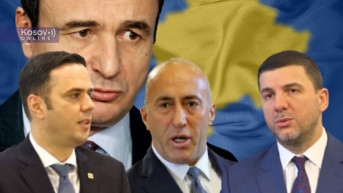
The game is played to 61, but the scoreboard has shown the same result for months. The leader of the Democratic League of Kosovo (LDK), Lumir Abdixhiku, has offered a solution through a “government of national unity.” “Secure 19 votes, I’ll provide the rest,” immediately replied the newly re-elected leader of the Democratic Party of Kosovo (PDK), Memli Krasniqi. Both the opposition and the Self-Determination Movement are chasing minority support to form a majority, but even if they secure it, analysts told Kosovo Online that the stability of such a coalition would be highly questionable.
Written by: Djordje Barovic
No Math, No Government
The math is clear—there is no math. This logic also brought down the 35th attempt to constitute Kosovo’s ninth parliamentary assembly.
“51 MPs voted in favor, one against, none abstained. There is no quorum. We’ll reconvene on Monday at 11 a.m.,” said presiding officer Avni Dehari.
There is not even a hint of how Kosovo might emerge from the institutional crisis. Abdixhiku has proposed one possible solution—his “15-point plan.”
The plan includes ambitious constitutional reforms, salary increases, resolution of the energy crisis, and the renewal of partnerships with the U.S. and EU—just to name a few.
“I proposed it because the state is paralyzed. Because there is no functioning parliament. Because there is no functioning government. Because there is no legitimate representation. Above all, because nothing honest is happening behind the scenes to bring us closer to any sort of solution—whatever that may be,” explained Abdixhiku.
The plan envisions a “government of national unity” which, as he described, would mark “the end of the blockade and the beginning of national stability,” and would remain in place until the election of a new President of Kosovo.
“The Math Is Simple”
“The math is very simple—just 19 votes from the LDK, I’ll secure the rest, and we reach 61. You, I, and everyone know the math—there are MPs in the Kosovo Assembly, excluding the Serbian List, with whom the former opposition parties can form a majority of 61 votes,” responded PDK leader Memli Krasniqi.
The “Magic Number”
Milos Pavkovic, an associate at the European Policy Centre in Belgrade, also uses numbers to explain the institutional crisis in Kosovo.
“The math is clear. Self-Determination has 48 seats, and the three largest opposition parties—PDK, LDK, and AAK-Nisma—together hold 54. So, they need that ‘magic’ number of 61. One option is to secure ten minority votes—not from the Serbian List, but from other minority groups, such as Bosniaks, Roma, Ashkali, and Egyptians. With those ten votes, the opposition could theoretically reach 64 seats in parliament, without the Serbian List,” Pavkovic explained.
However, he pointed out to Kosovo Online that “numbers and statistics” are one thing, but reality is something else entirely.
“We’ve seen that even Kurti has struggled to gain the support of minorities, and it will be even harder for the opposition—because that would be a coalition of three or even four parties, plus minority groups. It would definitely be a highly unstable government, just like a potential Kurti-led minority coalition. In political theory, it would be a ‘minimal government’ with 61, 62, or 63 votes—prone to easy collapse,” said Pavkovic.
The first major challenge for such a government—regardless of who forms it—will be the upcoming parliamentary election of the President of Kosovo.
“That election is due in early 2026 and will be a serious test for any government,” Pavkovic stated.
When asked how likely a deal between LDK and PDK is, the analyst said the key point of contention would be who gets the prime ministerial post.
“It all depends on the dynamics between the leaders of these three parties, and whether the question of who becomes prime minister would be raised. That issue alone could derail negotiations from the start—because both PDK and LDK are eyeing the prime minister’s seat, which complicates any potential coalition deal. Whether they will prioritize removing Kurti and Self-Determination over their own ambitions remains to be seen, but if personal ambitions take precedence, the opposition is unlikely to find the strength to form a government,” Pavkovic concluded.
The “Political Class” Capacity
Professor of European Law from Pristina, Avni Mazreku, is not interested in doing the math.
He is convinced that the course of the constitutive session of Kosovo’s parliament shows that the “political class”—both government and opposition parties—only has the capacity to deal with “minor political issues,” not with key questions like EU membership or NATO accession.
“I don’t think what’s happening in Kosovo has ever occurred in the history of parliamentary politics anywhere in the world. They are not considering the national interest, which is the establishment of institutions. The capacity of this political class is to deal only with very minor political problems. So, the question arises: how can this political class approach solving other major issues—Kosovo’s EU membership, recognition by five EU countries, NATO accession, and other global matters far more important to Kosovo than these parliamentary maneuvers,” Mazreku told Kosovo Online.
Commenting on the LDK’s Proposal to Form a “Unity Government”
Mazreku emphasizes that the most optimal solution to overcome the political crisis would be the creation of a broader coalition that includes the majority party, the Self-Determination Movement.
“But that idea has failed. In this case, the opposition is right. We should not be conditioning each other with blockades, because that harms Kosovo’s interests—and that interest is the formation of a stable government,” Mazreku stresses.
He therefore considers the current course of the parliamentary constitution harmful and holds both the winning and opposition parties responsible.
Self-Determination, for insisting on Albulena Haxhiu as the new Speaker of Parliament, and the others, for insisting that a vote on her should not be held.
“These parties have brought Kosovo to the point of trying to solve a problem which, in my opinion, does not exist. There are no political arguments for it, because the Speaker of Parliament has no executive powers, but should be a unifying figure who ensures the smooth functioning of parliamentary sessions. I might understand if this were about insisting on the formation of a governing coalition,” Mazreku clarifies.
He adds that although he does not understand why Self-Determination leader Albin Kurti insists on Haxhiu’s election, if he were a politician, he would unconditionally vote for the candidate proposed by the largest party.
“Meanwhile, the Kosovar political class is behaving as if Kosovo has no political problems,” Mazreku is convinced.
Asked why neither Self-Determination nor the opposition parties are considering a possible coalition with the Serb List, and given that acting Prime Minister Albin Kurti has stated that it should be banned, Mazreku emphasizes that the Serb List is a valid party in Kosovo that participated in the elections.
“If we refer to Radoicic or any other senior Serb List official, it’s not as if there haven’t been cases in other parties where leaders were involved in unlawful situations,” he notes.
He argues that, therefore, the responsibility of Radoicic for the crimes he is charged with should be separated from the functioning of the Serb List.
“Kosovo’s interest lies in steps that lead toward the integration of those who are still not constructive participants in its constitutional and legal system,” Mazreku believes.
Coalition “Potential”
Dragisa Mijacic, Coordinator of the Working Group of the National Convention on the EU for Chapter 35, brings the focus back to “math.”
“If the opposition parties have enough votes to form a government, I believe they’ll also find enough votes to constitute the parliament. Kosovo has entered an institutional crisis from which there is no simple way out. This is not just about electing the Speaker of Parliament, but about forming a new parliamentary majority. It seems more likely that new elections will be held than that the political parties will reach an agreement to form a government,” Mijacic says in a statement to Kosovo Online.
For him, the only question is whether those snap elections will be held alongside the local ones, or earlier or later.
“Every decision will come with its own challenges, but time will tell. I think that under these circumstances it is very difficult to form institutions—especially the assembly, and later the government,” he stresses.
Commenting on the potential cooperation between the PDK and LDK, Mijacic recalls that such a coalition already existed, but that its “replay” would not be successful due to the fact that Albin Kurti’s party would act as “a strong opposition.”
“That would lead Kosovo into further political instability. Albin Kurti did not win the election, but he did receive the most votes. He will represent a strong opposition, and I believe such a government would not last long. Simply put, everything is also hinging on the election of the President of Kosovo, scheduled for next March. That is a major part of this equation,” Mijacic says confidently.
He sees the key problem in the fact that no party currently has sufficient “coalition potential.”
“Kurti, who convinced himself he could govern alone, can no longer do so—or can only do so with the support of minority parties, which again brings him to the threshold of 61 votes, which is not the same level of stability he had previously. And he is very reluctant to give up that stability and unilateral style of governance. He ruled unilaterally for the past four years, doing things as he pleased. On the other hand, the opposition parties don’t have enough votes to ensure societal stability in Kosovo,” Mijacic emphasizes.
Thus, he reiterates, the solutions are either new elections—or U.S. intervention at some point in the process.
“They will help form a government in the way that suits them best,” he believes.
Asked how realistic it is to expect the formation of a “unity government,” Mijacic remains skeptical.
“I don’t think it is. A national unity government already existed during the UNMIK mandate, and it didn’t work. I don’t believe that can be a viable option,” Mijacic concludes.



0 comments