
Kurti and the Albanian flag in Parliament: What Is the Symbolism Behind This Gesture?
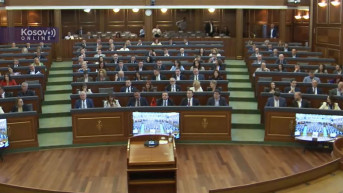
Campaign rallies featuring Albanian flags—with the occasional Kosovo flag—and posing with symbols of "Greater Albania" or a red flag in party offices have become trademarks of Albin Kurti. However, his presence in a parliamentary seat of the Kosovo Assembly adorned with the Albanian flag—while frantic attempts continue to elect the speaker of parliament—is viewed by analysts speaking to Kosovo Online as not only unlawful but also indicative of Kosovo’s still-unformed identity.
Written by: Dusica Radeka Djordjevic
The constitutive session of Kosovo’s ninth parliamentary convocation began on April 15. During that initial gathering, during a break, acting Minister of Justice Albulena Haxhiu, also Self-Determination's nominee for Speaker of the Assembly, placed the Albanian flag on Albin Kurti’s desk.
Since then, the session has resumed 29 times, and each time Kurti has sat beside the Albanian symbol.
“This is an illegal, shameful, and punishable act,” political analyst Nexhmedin Spahiu told Kosovo Online.
That no punishment has followed, he adds, is a matter of its own.
Spahiu emphasizes that no flag other than Kosovo’s may be displayed in the Assembly, except when a foreign guest is present.
“The Albanian flag may only be displayed if the President, Prime Minister, or Speaker of the Albanian Parliament is visiting Kosovo’s Assembly. The same applies to the flags of any other state—be it the U.S., Italy, or Croatia. In that context, the guest’s flag may appear,” he explained.
The symbolism of Kurti with the Albanian flag in parliament does not surprise historian Vukan Markovic, who says that Kosovo, like other Balkan entities or states, struggles with identity formation.
Since its inception, Kurti’s Self-Determination movement has, according to Markovic, exhibited a pan-Albanian ideological identity rooted in the unification of all Albanians, liberation from oppressors, and a redefinition of the Albanian nation across the Balkans.
The insistence on displaying the Albanian flag, he believes, is tied to the ongoing process of forming a Kosovar identity—an identity still far from mature or established.
Kosovo’s symbols, he explains, were modeled after Cyprus or Bosnia and Herzegovina, designed to downplay ethnic, religious, and historical identities.
“The Kosovo flag depicts the geographic contours of Kosovo and Metohija with stars representing national minorities. This is somewhat hypocritical, especially considering the active persecution of the Serbian minority under Kurti’s government. The idea of a multiethnic Kosovo—envisioned after the 2008 unilateral declaration of independence—is essentially cosmetic. The notion that Kosovo is a multicultural state for all its citizens simply doesn’t hold in practice. No observer would say interethnic relations in Kosovo are good or that minority rights are well protected. On the contrary, just look at what happened recently in Leposavic,” Markovic said.
Among a large portion of the population—not only Albanians but people across the former Yugoslavia—he adds, there is a persistent belief that existing borders are not final, and that ethnic problems will eventually be resolved “naturally.” Nationalists in Pristina, including Kurti, view that resolution through the lens of unification with Albania.
“In other words, Kosovo’s independence is seen as a means to something greater. The Kosovar identity—distinct from the Albanian identity—has not taken root, whether in the form of belief in or belonging to Kosovo as a state, or in the sense that Kosovar Albanians represent a different kind of Albanian from those in Albania. This is common across the Balkans,” he said.
While noting that he doesn’t wish to draw strict parallels between Kosovo and Bosnia and Herzegovina—since BiH is a recognized state under international law and Kosovo is not—Markovic points out that even after 30 years, Bosnia’s identity has not fully formed. Bosnian Croats remain more loyal to Croatia, and Serbs in The Republic of Srpska feel a greater affinity to Serbia than to BiH.
“Given that Kosovo remains an unfinished and dysfunctional state project—lacking not only legitimacy but also institutional functionality—the idea of unification with Albania still appeals to many as a hopeful future. Kurti’s display of the Albanian flag should not be surprising—it is entirely consistent with the fragile and hybrid national narratives that prioritize ethnic identity over civic belonging,” he emphasized.
The notion that civic identity should serve as the unifying foundation of any country or entity has never taken hold in the Balkans, or in Eastern Europe after the fall of the Berlin Wall, Markovic noted.
“People overwhelmingly prioritize ethnic, national, and religious identity over the civic identity of the state they reside in. What makes this situation farcical is that Kosovo continues to officially insist it is a multicultural, supra-national state. In practice, this is blatantly untrue—minority persecution in Kosovo is systematic and among the worst in the Balkans, if not beyond,” he concluded.
Historian Aleksandar Gudzic from Gracanica sees Kurti’s prominent display of the Albanian flag in the front row of parliament as choreography consistent with a long-standing pattern. Since the early 2000s, Kosovo’s Albanian political elites, lacking economic development, have relied on extreme nationalism. Since the 1990s—and especially after 1999—they have portrayed themselves as the “Piedmont of Greater Albania.”
Gudzic notes that Kurti has long presented himself as the leader of all Albanians in the Balkans.
“Recall his visit to Skopje a few years ago and the symbolism of Greater Albania displayed there. Kosovo emerged from the Yugoslav wars with a form of statehood recognized by part of the international community. Within the Albanian world, it holds political credibility and presents itself as the ‘Piedmont’ of a future Greater Albania. That’s no secret—we know that in the 2000s, former KLA members fought in the 2001 insurgency in North Macedonia against Macedonian security forces, and many of them also participated in armed actions in Serbia during those years,” Gudzic said.
If Kurti’s use of the Albanian flag is something part of Kosovo’s society is used to, what would happen if MPs from the Turkish or Serbian communities displayed the flags of Turkey or Serbia in front of their seats?
Gudzic suggests that Kosovo’s ruling majority might not view such a gesture from the Turkish community as politically harmful. But if the Serbian List were to display the Serbian flag, he believes there would likely be consequences.
“Institutions would probably react, and government representatives would find an explanation for why it’s harmful—just like when a student raised three fingers and the Interior Minister labeled it a ‘symbol of genocide against Albanians.’ They would likely come up with a similar rationale for the flag,” Gudzic concluded.



0 comments