
Momentum for resolving territorial disputes around the world – an opportunity for the Balkan "puzzle" as well?
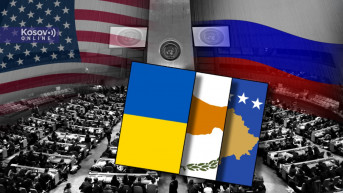
Momentum. That is the key word used to describe a wave of peace initiatives following the US taking on the role of mediator in ending the war in Ukraine. Riding this “wave,” many simmering conflicts and territorial puzzles around the world could be resolved, including those in the Western Balkans, but much will depend on the future geopolitical intentions of the United States, Kosovo Online’s interlocutors say.
Written by Djordje Barovic
Amid peace negotiations aimed at ending hostilities in Ukraine and the Middle East, representatives of Greece and Turkey recently met in Geneva to attempt to move the Cyprus issue off dead center – a territorial conflict more than half a century old.
This was the first such format of talks held after more than three years of “silence.”
“We must forget the past and look to the future,” Ersin Tatar, president of the self-declared Turkish Republic of Northern Cyprus, said ahead of the meeting.
The initiator of the informal talks was UN Secretary-General Antonio Guterres, and according to French historian and geopolitics professor at the University of Versailles, Alexis Troude, now is the right moment for the United Nations to host an international peace conference to “renegotiate international rules” for the future.
“The whole world, 26 years after the bombing of Yugoslavia, is becoming aware that international rules must be renegotiated, and that this has to happen within international institutions, not NATO, but the United Nations. That is why this is a good moment to once again organize an international conference, perhaps on Kosovo, and return negotiations to the UN framework, which remains the most important instrument of international politics,” Troude emphasized.
“A new dynamic”
Ambassador and Head of the Bosnia and Herzegovina Mission to the EU, Obrad Kesic, has no doubt that the arrival of Donald Trump at the helm of the US has created a “new dynamic” in efforts to resolve territorial disputes worldwide.
Still, he does not believe this can be done through international peace conferences, especially not in the case of Kosovo.
He offers three reasons.
“First, President Trump has little trust in multilateral and foreign policy mechanisms. He doesn’t have much faith that problems can be resolved by involving a large number of countries. His foreign policy is clearly based on bilateral relations. Even the ongoing negotiations over Ukraine are unfolding through direct talks between the US and Ukraine, and the US and Russia. In that context, there is absolutely no room right now to broaden participation. And that is one of the main priorities Trump has announced as a key foreign policy goal. It is unlikely this approach would change when it comes to other issues,” Kesic said for Kosovo Online.
He also explains that officials in Pristina would oppose the internationalization of the Kosovo issue.
“They don’t want to internationalize the issue because they see this as their last chance to achieve what they have been aiming for: the consolidation of so-called independence and of governance over the entire territory of Kosovo and Metohija. That is why I think they would be highly skeptical about entering a process without certainty that Washington would support them in the context of new international negotiations,” Kesic explained.
As a third decisive factor, he points to the lack of readiness among EU leaders and most EU member states.
“The European Union, its leaders, and even most of its member states are not prepared to reopen an issue where they believe their policy is already showing some concrete results,” Kesic explains.
He is convinced that the United States will be involved in many of the world’s unresolved disputes.
“With Trump’s arrival, we have an entirely new dynamic in which ‘America First’ means that every global issue is viewed primarily through the lens of American interests, and everything else comes second. In the past, there was no space to revisit the Cyprus issue as long as the status quo existed, which held that opening up the matter could lead to renewed conflict. With Trump, that has changed, because everyone feels that if the issue isn’t resolved now, it may be resolved to their disadvantage, due to a lack of confidence in continued American support,” Kesic said.
He specifies that this is a key factor not only for resolving the war in Ukraine, but also for the future relationship between Europe and the United States.
“Europe cannot be confident that America will remain a reliable partner, because many issues previously framed as shared interests through common positions are now being reopened. That no longer exists. This worldview shows a significant difference between the perspective from America, from Washington, and that from Brussels. In that context, we definitely need to start talking, and we need to begin resolving problems in the Western Balkans as well. The first, of course, is the issue of Kosovo and Metohija, and the second is Bosnia and Herzegovina,” Kesic stated.
He believes that the West’s previous approach, especially Washington’s, has led to major crises in the Western Balkans, resulting in the Serbian community “constantly feeling under pressure from Western policy.”
“With the arrival of President Trump and a new team loyal primarily to him and his worldview, a better perspective opens up for resolving the Serbian national question throughout the former Yugoslavia,” Kesic believes.
Washington’s influence
Attorney and former chief inspector of the Kosovo Intelligence Agency (KIA), Shkelzen Sopjani, expects “significant steps” from the new US administration in the Western Balkans, and believes that without more direct involvement from Washington, no agreement between Belgrade and Pristina should be expected, because Europe won’t be able to achieve it on its own.
“A political agreement between Serbia and Kosovo won’t happen without stronger, direct influence from Washington, because Europe won’t be able to bring the parties to a deal,” Sopjani told Kosovo Online.
Despite his belief that the Kosovo issue is resolved and that, aside from Serbia’s refusal to recognize it, there are no major outstanding disputes, he still expects increased involvement from the new US administration.
“Over the next four years of the Trump administration, I believe we’ll see some very significant steps, not only regarding Kosovo but the entire Balkan region. But I don’t think Kosovo is the problem. The real issue in the region is Bosnia. Kosovo is, more or less, settled, except for the northern part, which is also under control,” Sopjani said.
He is convinced that behind US President Donald Trump’s intention to end the war in Ukraine – as well as other global conflict zones – is a strategic desire to shift focus to China, which he views as the United States’ main rival.
“Trump’s return to the presidency represents a new momentum in international relations, particularly in Europe. Trump will focus more on China, and that is why he will try to resolve every possible conflict that might distract from that focus. The greatest threat to the US, both economically and in terms of security, is China. Trump wants to direct all his energy toward that and prevent China from overtaking America in projected power. That means we will likely soon see an agreement between Russia and Ukraine, because from what we can see now, that agreement would be more of a victory for America and Europe than for Russia itself,” Sopjani explained.
He rules out the possibility that the Kosovo issue could be resolved through an international peace conference, however, he does not rule out greater US involvement in the Western Balkans.
“I believe that when it comes to Kosovo, everything is resolved and there are no disputed issues, aside from Serbia, which does not recognize Kosovo, but I believe that will change,” Sopjani concluded.
A new “Iron Curtain”
A completely different view comes from Milan Igrutinovic, research fellow at the Institute for European Studies.
He is skeptical that the end of the war in Ukraine will trigger a “wave” of resolutions to other unresolved issues around the world, including Kosovo, because for the US and EU, the key priority is curbing Russia’s influence in European politics.
“From the perspective of the war in Ukraine, what will unfold in the coming years, and what is essentially a ‘locked-in policy,’ is the exclusion of Russia from European politics. That dividing line, the new so-called ‘Iron Curtain,’ is now somewhere along the Dnieper. We know who the new NATO members are, and both Europe and America are working to suppress all those Russian ‘pockets’ of influence in various ways,” Igrutinovic told Kosovo Online.
He warns that this approach will also shape future policy toward the Kosovo issue.
“If they perceive that Russia’s role in Serbia and in relation to the Kosovo issue is too large, intolerable, and disruptive, they may adopt the logic of ‘we have to resolve this problem’ in order to limit Russian influence. And that has been the American logic for 15 years now, regardless of the administration,” Igrutinovic believes.
He explains that official Washington has never been particularly bothered by Serbia’s refusal to recognize Kosovo, but rather by the potential for “malign Russian influence” on Serbia’s official stance.
“They weren’t so troubled by Serbia’s opposition, which they understood as something normatively grounded and entirely legitimate. What troubled them more was Russia’s role and Serbia’s reliance on Russia on this issue – that so-called ‘malign Russian influence.’ If anything pushes them to resolve outstanding issues in a broader sweep, it will stem from their perception of Russia’s role, not from the specific local characteristics of each individual dispute. That is a lesson for us, to be very cautious in how we position ourselves on this issue so that, because of great power conflicts, we don’t ruin our own national interests and position,” Igrutinovic emphasized.
Commenting on claims from geopolitical analysts that the issue of Ukraine, along with other unresolved conflicts, such as Cyprus, could be addressed through some form of international peace conference, Igrutinovic doubts this approach would apply to the Kosovo issue, as he notes it’s “a diplomatic game being played on a somewhat lower level.”
“Kosovo’s membership in the UN is not the key issue, nor is it essential for its eventual EU membership. Recognition by the five EU member states that have not recognized Kosovo isn’t the key either. Those countries will primarily weigh Serbia’s stance, while also factoring in their own internal issues. But the UN membership is a forum where Russia and China can wield significant influence. Clearly, this diplomatic game is being played at a lower, more Euro-regional level. That is what matters to them,” Igrutinovic concluded.

0 comments