
Old allies in a new front against Serbia: Tirana, Zagreb, and Podgorica call for sanctions against Belgrade
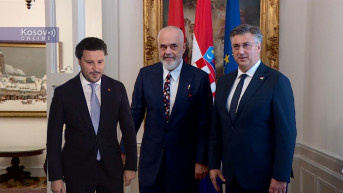
Kosovo's President Vjosa Osmani paid a two-day visit to Zagreb, where she met with Croatian President and Prime Minister Zoran Milanovic and Andrej Plenkovic. These meetings conveyed messages about strengthening Kosovo's relations with Croatia and demanded condemnation of Belgrade for the Banjska incident. Criticism of Belgrade also came from the Prime Ministers of Montenegro and Albania, Dritan Abazovic and Edi Rama, who had previously shown understanding of Serbia's policies, even regarding its ties with Russia.
This raises the question of whether a new regional alliance is in the making between Tirana, Zagreb, and Podgorica. Experts speaking to Kosovo Online have no doubt that these are partnerships that have been seen before but have been renewed with certain adjustments following the events in Banjska. They argue that these partnerships are aimed at weakening Serbia, the most populous country in the region and that in this context, messages of support for Kosovo are being sent from these three centers.
Writer and journalist Muharem Bazdulj sees this as a bloc struggle and sees two blocs forming in the Balkans with the renewal of some alliances from the past.
"I would say that these are new-old alliances because this strongly resembles the situation in the early 1990s, even in the late 1980s, with the exception of Podgorica, which was close to Belgrade at that time. These alliances had a common goal during Yugoslavia, which was to break away from Yugoslavia and Belgrade. Now, their goal is to somehow weaken Serbia as much as possible," Bazdulj says for Kosovo Online.
Bazdulj sees the alliance between Zagreb, Tirana, and Podgorica, along with the almost identical political messages coming from these centers, as unsurprising.
"One can see a consensus here, what metaphorically could be called an integrated editorial board as these statements are coming from the same mind. Interestingly, a left-leaning Croatian historian, Damir Markovina, recently noted that among all the nations in the Balkans, Albanians and Croats are the closest because they don't have any unresolved issues, they don't share borders, and they are not in competition, not even regarding the Janjevci. The issue of the small Croatian minority in Kosovo has been resolved because Tudjman resettled them in the regions where the Serbs used to be a majority. So, this seems to be a renewal of old alliances in new circumstances," Bazdulj believes.
Bazdulj believes that Serbia is not entirely alone and without allies, and that due to the size of the Serb population, there are those who will support it.
"Serbia has that potential because of the large Serb population in Montenegro and the existence of the Republika Srpska. It definitely has allies in the region. A relationship was also established with North Macedonia, which relaxed after the resolution of the issue of the Macedonian Orthodox Church. So, the creation of two blocs in the Western Balkans, in which Serbia, even if it were completely alone, is the largest and most populous," Bazdulj emphasizes.
He points out that there is nothing unusual or illogical about this bloc division and adds that these alliances cannot change much in the context of Serbia and its position.
"This can, of course, slightly change the balance on some regional scales. But it seems to me that these countries forming alliances, if there isn't external mentorship, such as German or British influence, are not particularly strong on their own. In the context of Serbian-European integration, for example, Croatia might have the right to veto or attempt some kind of pressure, but it seems that Croatia is too small to do something like that if, at some point, France or Germany were to set their priorities. I don't see how this could inflict significant damage on Serbia," Bazdulj concludes.
Historian Aleksandar Rakovic believes that economically and politically strengthened Serbia is bothering some in the region, which is why they are once again uniting, seeking punishment and sanctions against Serbia due to the events in Banjska. He reminds Kosovo Online that these alliances have been known since the time of the Kingdom of Serbs, Croats, and Slovenes, and Yugoslavia.
“Zagreb has been the organizational center of these alliances, and that's where it all originated. This arc extended from Zagreb through the Dinaric region all the way to Sofia. It's been somewhat redefined now, with multiple centers. These include Zagreb, political Sarajevo, separatist Cetinje, separatist Pristina, and Skopje when it comes to the Albanian factor in Macedonia. So these are old alliances being deepened and renewed when they think the opportunity arises. Banjska provided them with a chance to launch a joint attack against Serbia," Rakovic believes.
However, Rakovic adds that he is confident that Serbia will prevail even against the factors from the surrounding region.
"However, the far greater problem is the so-called Western international factors, the international community, and political Brussels, Washington, and London, which continually exert pressure on Serbia and the Serbs to resolve the Kosovo and Metohija issue as they envision, rather than in a just manner," Rakovic notes.
In his opinion, "what is being discussed and demanded in Zagreb" will have no effect on Serbia.
"They aim to align themselves as closely as possible and take the initiative for more radical solutions. I don't even believe they received orders from anyone to push for those radical solutions or demand sanctions against Serbia. However, they think that if they go a step further, they will satisfy their sponsors in Brussels, and then those in Washington. The solution depends solely on Western factors, not on those here. It doesn't depend on Zagreb, Sarajevo, Cetinje, Pristina, or Skopje. If the West wants it, they will do it. It doesn't seem likely to me, but that doesn't mean the situation won't change," Rakovic states.
He notes that only one more event, of much lower intensity than the one in Banjska, could have consequences. However, when it comes to sanctions, he believes they would affect prominent individuals rather than the state.
According to Rakovic, many have targeted Serbia because it has strengthened economically and politically.
"Serbia is a thorn in the side, especially now that it has grown economically and begun to regain confidence. Confidence has returned to all Serbs wherever they live, as we can see in the Republika Srpska and Montenegro. Confidence is on the rise, and it annoys all the others in the region. They have no answer to Serbia's superior policy and can't respond to the superior ideas that come from Serbia. So, they resort to these feeble arguments - impose sanctions on them, punish them, but it only reveals their weakness, which they may not fully realize," Rakovic emphasizes.
Rakovic concludes that all these countries forming alliances to weaken Serbia's position would have no chance when facing it in a different geopolitical environment and the battle of political ideas.
Director of the Center for Regionalism, Aleksandar Popov, tells Kosovo Online that it's not surprising at all that Zagreb supports Pristina. He reminds us that Croatia is an EU member and that it has aligned, and must align, its policy with the Union.
"So, it's expected that they support Kosovo. However, we have another problem here, of an internal nature, and that is that President Milanovic and Prime Minister Plenkovic are often in a duel with each other. Simply put, if you listen to Plenkovic and Milanovic, you don't know what Croatia's stance is on some domestic and foreign policy issues. This is the case here too. Milanovic often makes some excesses with his statements and so on. But in essence, this is in line with Croatia's foreign policy and its relationship with Kosovo as an EU member," Popov says.
Popov also adds that the event in Banjska on September 24 further emphasized this support, which resulted in Serbia finding itself in a defensive position.
"I think the turning point was actually made by Banjska, that is, that unfortunate incident, actually more than an incident, as there were human casualties. It created that turning point where we turned 'plus' into 'minus'. We had an advantage over Pristina because Pristina was the one obstructing what the EU demanded, which was to de-escalate the situation in the north. Instead of using that moment, we created that incident, completely unnecessarily. Even today, it is not known why it was done, because the only thing that was achieved was damage to Serbia in the negotiation process. Now it is in a 'minus' instead of being in a 'plus' compared to Kurti," Popov concludes.


0 comments