
Preliminary election results in Kosovo: Can Kurti form a new government without the "Monsters"?
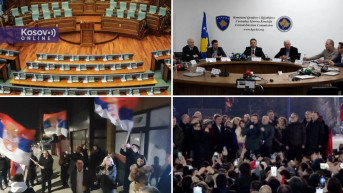
Kurti has declared victory and called the opposition "monsters". The opposition is satisfied because, in total, they have more votes. However, the Serb List is the most satisfied. Despite obstructions, they managed to secure the maximum number of mandates designated for the Serbian community. The results of the parliamentary elections in Kosovo are not a big surprise, but there will be "gymnastics" in forming the new government, regional analysts tell Kosovo Online.
Written by: Arsenije Vuckovic
Judging by the reaction, from North Mitrovica to Pristina, citizens are satisfied with the results.
"I am satisfied with the results, my expectations have been met, I hope it will be better, we hope for the best," one resident of North Mitrovica told Kosovo Online.
Residents of central Kosovo are also satisfied with the result and expect improvements. According to Kosovo Online, the goal is for Serbs to remain in Kosovo.
"We expect progress and that it will be better than it has been so far," said Caslav Trific.
The day after the parliamentary elections, residents of Strpce emphasize that they are satisfied with the results and the high voter turnout, and they expect their life to be easier in the coming period.
Slobodan Kostic from Brezovica told Kosovo Online that he is especially pleased that people turned out to vote and that he hopes things will improve.
"I am very satisfied that people came out to vote. How it will unfold we do not know, but it should get better. Institutions need to return, we pensioners have to go to Serbia to collect our pensions. We hope for improvement," said Kostic.
Similar reactions in Pristina.
"It could be better, but it's fantastic. The elections were normal, everyone who wanted to participate did, Albanians, Serbs, Turks, and all others, they voted for whoever they wanted, there were no obstructions, no incidents, I think these are the best elections so far. The result is excellent, one party, among 27 parties, to win. That is the most important thing," said Halil Sulejmani.
According to the Central Election Commission (CEC) data, based on 93 percent of the votes counted, the Self-Determination Movement won 41.01 percent of the votes, the Democratic Party of Kosovo 22.46 percent, the Democratic League 17.66, and the coalition Alliance for the Future of Kosovo - Nisma - 7.51 percent.
Forming a new government requires 61 out of a total of 120 votes from the deputies in the new session of the Kosovo Assembly.
Article 96 of the Constitution
Political analyst from Pristina, Artan Muhaxhiri, also warns of a very important detail - Article 96 of the Kosovo Constitution, according to which one of the ministers must come from the Serbian community.
Because of this, he believes, it will be very difficult for Kurti to "camouflage" post-election moves.
"A very important factor is the Serb List. There is already a high degree of political animosity with it, and without the Serb List, or rather Article 96 of the Kosovo Constitution, a government cannot be formed unless one of the ministers is from the Serbian community, and they will be chosen by the party that receives the most votes, which in this case is the Serb List. Therefore, it will be very difficult for Kurti to camouflage his views because without the Serb List he will not be able to form a government. Because of his previous conflicts with this party, no one knows how everything will 'be packaged'," Muhaxhiri says in a conversation with Kosovo Online.
There is no doubt that the victory of the Serb List has dealt the greatest blow to Kurti, resulting from his approach to unresolved issues with the Serbian community, particularly in northern Kosovo.
"There is an impression that the mobilization of people to vote for the Serb List in such large percentages is a result of Kurti's approach to the north and everything that has happened there. Not just the interventions, but also what followed. Kurti did not provide a political option to resolve the problems in the north, and I think this is a kind of contraindication for everything that has happened in the last two years," believes Muhaxhiri.
He adds that, paradoxically, the convincing victory of the Serb List could serve as a "political excuse" for Kurti to claim he needs more power.
"I think in a paradoxical way this situation can help Kurti use it as a political excuse to say, 'See, when I have power, the Serb List is mobilized, which is why I need even more power to more strongly resist them'," says the analyst.
However, he believes that Kurti should act politically rationally.
"In a rational political sense, he will have to change his views, or he will need the help of the international community to exert pressure on the Serb List because without them, it is not possible to form a Kosovo government," emphasizes Muhaxhiri.
Commenting on the election results in the majority Albanian community, this analyst says that it will be difficult for both Self-Determination and the opposition to form a new government.
"The election results are extremely complicated because now everyone is saying that it will be very difficult to form a government, both from the perspective of Self-Determination and the opposition because the distribution of votes is almost the same, so it will take a lot of negotiations, a lot of talks, a lot of compromises for each side to be able to form a government," says Muhaxhiri. Analyzing the number of votes received by political parties, he believes that Self-Determination, despite a smaller number, achieved a better election result.
"The election result is better for Self-Determination. In the past four years, they haven't done much in economic development, international relations for Kosovo, and it was expected that this would be punished by the voters. Also, the opposition did not do a good job during the election campaign, and therefore they could not 'break through' Kurti's populism and win more votes," emphasized Muhaxhiri.
Strongest Impression
For Marko Milenkovic, an associate of the NGO "New Social Initiative," the election results in Kosovo confirmed pre-election forecasts about the decline in support for Self-Determination, which now will not be able to form a government independently, while the Serb List won all ten mandates, which he sees as a response of the Serbian community to Albin Kurti's previous policies.
"The pre-election tendencies were confirmed, which is what we had in the polls, that Self-Determination would experience a decline in voter support. And that indeed happened. That is perhaps the strongest impression of these election results. Although we don't have the final results, it is evident that Self-Determination will not be able to form a new government alone but will have to enter a coalition government or go into opposition. At this moment, it is evident that this drop is serious," says Milenkovic for Kosovo Online.
Marko Milenkovic interprets the results indicating that votes shifted to opposition parties, which speaks to a form of distrust.
Discussing the Serbian representatives, he emphasizes that the result achieved by the Serb List, which secured all ten mandates, alongside the decline of Self-Determination, marked these elections.
"At this moment, these are the two things I would highlight. I am certain that the previous policies of Self-Determination led to their drastic drop, and that there has been a consolidation or unity within one political party in the Serbian community, given the conditions in which the Serbian community lives and which were imposed by the previous government of Self-Determination. The Serbian community obviously decided to vote for the option, that is, for the Serb List, and thereby to show Self-Determination and Kurti what they actually think about that policy, but also about the atmosphere of fear and the poor security situation. Serbs have consolidated within the Serb List and chosen - 10 out of 10 MPs," Milenkovic stated.
Two Scenarios, One Concern
Political scientist Ognjen Gogic tells Kosovo Online that the election results show that the "period of parliamentary stability in Kosovo is behind us."
"The period of parliamentary stability is behind us. As things stand, it will not be easy to form or maintain a parliamentary majority. Thus, it is very possible, as is already being discussed, that we will have repeat elections. Keep in mind that in the next elections, the President of Kosovo is to be elected, which requires a two-thirds majority. Any parliamentary majority that is formed now must take this into account. Otherwise, the parliament is dissolved," says Gogic.
He emphasizes that we are entering a period of political instability and calculation, with two possible scenarios.
"The first is that Self-Determination becomes the cornerstone of the new government, wherein they have sufficient support from the parties of minority communities other than the Serbian one, which they now have. The second is that Self-Determination enters into a coalition with one of the Albanian parties, which is unlikely, given the significant animosity towards them. A third option, which is unlikely, is that all other parties form a government, and Self-Determination remains in opposition. This scenario could be realized if supported by Western embassies, but it does not guarantee stability. Kosovo has had such periods before, with coalitions that fell apart. Thus, there is a risk that Kurti could return stronger in new elections," Gogic believes.
A coalition that would be unstable would quickly fall, he warns, and Kurti could return even stronger in new elections.
"I would rather expect that Kurti will be allowed to form a new government, because that might actually be better for everyone. Perhaps it is better for Kurti to receive a new mandate, to continue the trend of decline, and then for a new government to come along that will be more stable, rather than rushing now to create an anti-Kurti coalition that would be short-lived and return Kurti even stronger," emphasizes Gogic.
Commenting on the Serb List securing the maximum number of mandates, Gogic says this confirms the support of the people, but they should be "moderately satisfied with the results" considering the lower turnout of Serbs.
"The Serb List has declared victory and won ten mandates, however, we still do not have the final election results, so there is a possibility that one mandate could be taken by the opposition party of Nenad Rasic, until we count all votes we won't know. Assuming the Serb List took ten mandates, as it claims, this actually isn't a change, because it had the same result in the previous elections. This just means that it has maintained the support it had. But we must keep in mind that the turnout of Serbs is lower than before, maybe that is actually what we need to comment on. The question is, despite those Serbs who came from central Serbia, where are the Serbs who live in Kosovo, how engaged and interested they are in politics, that is what is concerning," Gogic highlights.
Arsovski points out a second uncertainty regarding how much the American administration will intervene in the post-election maneuvers.
"If it's left to just the local political scene, then the prospects for a new Kurti mandate are much better," Arsovski evaluates.
He also highlights a third uncertainty: how Belgrade will react to the results of the Kosovo elections and what will be on the agenda of the new government.
"Whether the agenda of the new government will include the Community of Serb Municipalities, whether a plan to resolve the Kosovo issue will be on the agenda of either Kurti or the current opposition, and whether this will be a condition for forming the government," emphasizes Arsovski.
He believes that the normalization of relations with Belgrade and the formation of the Community of Serb Municipalities will be a condition for forming any government in Pristina.
"I think these tensions will continue. Especially if Kurti maintains his firm stance that he will not discuss it, and he manages to assemble a government. But I believe that this agenda of normalization of relations will be a condition for any government, which I predict will lead to, conditionally speaking, not normalization, but rather a mild loss for Kosovo," Arsovski specified.
Asked about the expected relationship with North Macedonia and other countries in the region, Arsovski believes that Pristina will mostly be occupied with internal political dynamics in the coming years.
"I don't believe much will change, but certainly the unstable political situation, constant tensions with Belgrade, and internal unstable political situation do not benefit Macedonia, Albania, or Serbia either. And I think that such a period is indeed coming," Arsovski concludes.
Many Dilemmas, Everyone Satisfied
Political analyst and editor at RTV Albania 1 Gert Selenica tells Kosovo Online that there is an impression that both the government and the opposition are satisfied with the election results, and that the formation of a new government will depend on whether the opposition wants to unite and whether Albin Kurti, as he announced, will gain the necessary majority based on votes from the diaspora.
"Self-Determination celebrated victory, as did the opposition. The Democratic Party of Kosovo is pleased because it doubled its votes. Thus, this process has somehow satisfied all sides. The dilemmas are about what will happen after the elections. It remains to be seen what the new government will be like. There are many dilemmas, many questions, both for the government and for the new parliament," Selenica highlights.
Selenica explains that the election results indicate a decline in support for the Self-Determination Movement, which was anticipated and can be attributed to the "cost of governance."
However, he does not believe this means they will not have the opportunity to form a new government.
"This has happened in Kosovo, it has happened in the region. Is it logical for the opposition to unite and form a new government, even though the parties lost in these elections? It's difficult, but the numbers provide this opportunity. Therefore, the votes from the diaspora, which have yet to be counted, are awaited with great interest. There are claims from Self-Determination that thanks to the diaspora votes, they will deepen their advantage," emphasized Selenica.
On the other hand, he reminds us, the opposition did not want to enter into pre-election coalitions, but this possibility should not be ruled out now that the results have shown that it has doubled its votes.
"It is very difficult to predict whether we will have a Kurti 3 government, as each party must retreat from some of its pre-election positions. We know that Kurti said before the elections that he would have a 'third government,' without any other parties, except those in his pre-election coalition. On the other hand, we have the Democratic League of Kosovo and the Democratic Party of Kosovo, which also had aspirations to govern alone. They did not make a pre-election alliance because they wanted to test their strength. We also have the Alliance for the Future of Kosovo, which achieved results within expectations, but is most active when it comes to forming a coalition," explains Selenica.
He also points out that the post-election maneuvering will largely depend on relations with the USA, and in this light, one should also consider the controversy caused by Richard Grenell, the special envoy for special missions of the American president.
"U.S. Special Commissioner Grenell has repeatedly used sharp, undiplomatic language towards Prime Minister Kurti. Attention is also drawn to his latest statement on Friday, two days before the elections, that relations between Kosovo and the USA are at their lowest level, which raises many questions about the continuity of Kurti's government and the positions he will have to take. Let's not forget that Kosovo owes a kind of historical debt to the USA, perhaps like the entire Balkans, but Kosovo in a more pronounced way. These statements could also determine how Kosovo will be governed after the elections, regardless of who forms the government," warns Selenica.
On the other hand, this analyst does not expect that, if he wins a third term as Prime Minister, Kurti will change his rhetoric.
As for a change in rhetoric regarding the dialogue with Belgrade, he claims, one should not expect it from the opposition parties either if they form a new government.
"In my opinion, no change in relations with the neighbors is expected even if we have a coalition government of opposition parties. We must not forget that no political party during the election campaign ever mentioned the role they will have after the elections in the dialogue with Serbia. Thus, no political party included the issue of continuing relations with Serbia in the pre-election debates, not for a single day of the campaign. We are talking about a very sensitive issue that the USA is very interested in and is expected to have a strong influence. These are the reasons why I say that little change is expected," emphasizes Selenica.
Asked whether the idea of the unification of Kosovo and Albania will return with the new Kosovo government, this analyst says that this issue is outdated and that all Albanian politicians see such a "union" exclusively within the framework of the European Union.
"On the other hand, countries in the region have many trade agreements or trade relations despite political contradictions or nationalist stances," specifies Selenica.
He also doubts that there will be a change in relations with official Tirana, regardless of who forms the new government in Pristina.
"I believe that little will change there too. I believe that joint meetings of the two governments in Albania and Kosovo will continue, as well as joint meetings of the two parliaments. Regional politics, beyond individuals, will still be focused on European integrations. The best example is Montenegro, which will seemingly be the first country to open negotiations on EU membership by 2026, followed by Albania and other countries," concludes the analyst.
Pyrrhic Victory and Consequences
Associate at the Center for Social Stability, Srdjan Barac, believes that the preliminary results of the parliamentary elections in Kosovo show that Albin Kurti has achieved a Pyrrhic victory and faces post-election "gymnastics," while the success of the Serb List has shown that Serbs can be united and politically oppose all forms of repression.
"This is a Pyrrhic victory for Albin Kurti, and the definition of the election is that the results have united the Serbs. The epilogue of such an electoral result is that Albin Kurti must engage in electoral gymnastics, and it is questionable whether he will succeed," Barac emphasizes for Kosovo Online.
Barac believes that Kurti will try by any means to secure a majority in order to form a government.
"Will there be a post-election maneuver in the form of nullifying some polling places, or will he try with votes coming from abroad, or might Rasic snatch that one seat from the Serbs, although I think the chances of that are very slim. But we have a politician who looks to not only bend every legal regulation but to completely disregard them. Therefore, I wouldn't be surprised if he resorts to a form that would be an absolute destruction of all principles, rules, and regulations," Barac thinks.
He doubts that the opposition parties, regardless of the results, will be able to form a stable government, which is why he does not rule out the possibility of repeat elections.
"It's a very difficult legal construction when we talk about having three parties, plus minorities. It would be very complicated for them to form a majority that would be stable and that could create policies that are solid and resilient to the challenges that are certainly not small in the region of Kosovo and Metohija, particularly speaking about economic problems, issues of corruption, crime, and their mismanagement in the context of geopolitical upheavals. In such a 'melting pot', I think it will also be complicated for them. I also leave a great possibility that maybe we are heading to new elections, that we will not have a majority from this election result," Barac emphasizes.
He notes that the main message concerning the Serbian community is that the Serbs are united.
"Serbs who have managed to survive despite all the pressures send a strong message primarily to the international factor. Serbs united around a single political idea are Serbs who can resist," Barac assesses.
With such election results, Serbs in Kosovo have a political way to fight not only for their rights but also against legal, economic, and physical attacks and psychological violence.
"This is a great success and I think that the policy in which we are united around one political option is a policy in which we can somehow resist and that at the same time is a very clear message that the international community must understand and must consider how it will create political directions and concrete policies that are good for the Serbian population in Kosovo and Metohija," Barac emphasizes.
Therefore, he believes that both the celebration by Albin Kurti and the insults directed at the opposition are consequences of the fact that the Serb List won the most votes.
"He is irritated by this political situation because the main imperative of Albin Kurti's policy was to expel the Serbs from the territory of Kosovo and Metohija and to prevent the resistance of the Serbian population. And this happens when we are divided," concludes Barac.




0 comments