
Selenica: The opposition can form a new government, but Kurti is also counting on the diaspora's votes
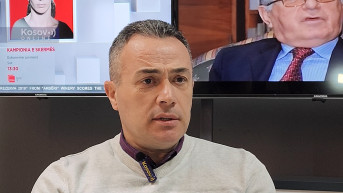
Gert Selenica, a political analyst and editor at RTV Albania 1, stated that both the government and the opposition are satisfied with the election results, and the formation of a new government will depend on whether the opposition wants to unite and whether Albin Kurti, as he announced, will be able to secure the necessary majority based on votes from the diaspora.
"Self-Determination has celebrated a victory, as has the opposition. The Democratic Party of Kosovo is pleased because it has doubled its votes. Thus, this process has somehow satisfied all sides. There are dilemmas about what will happen after the elections. It remains to be seen what the new government will be like. There are many dilemmas, many questions, both for the government and for the new parliament," Selenica told Kosovo Online.
He explains that the election results show that the Self-Determination Movement is in decline, but that this was expected and can be attributed to the "cost of governance."
However, he does not believe this means they won't have the opportunity to form a new government.
"This has happened in Kosovo, it has happened in the region. Is it logical for the opposition to unite and form a new government, even though the parties lost in these elections? It’s difficult, but the numbers give this opportunity. Therefore, the votes of the diaspora, which have not yet been counted, are awaited with great interest. There are claims from Self-Determination that thanks to the votes of the diaspora, they will deepen their advantage," emphasized Selenica.
On the other hand, he reminds us, the opposition did not want to enter into pre-election coalitions, but this possibility should not be excluded now that the results have shown that it has doubled its votes.
"It is very difficult to predict whether we will have a Kurti 3 government, as each party must retreat from some of its pre-election positions. We know that Kurti said before the elections that he would have a 'third government,' without any other parties, except those in his pre-election coalition. On the other hand, we have the Democratic League of Kosovo and the Democratic Party of Kosovo, which also had aspirations to govern alone. They did not make a pre-election alliance because they wanted to test their strength. We also have the Alliance for the Future of Kosovo, which achieved results within expectations, but is most active when it comes to forming coalitions," explains Selenica.
He also points out that post-election combinatorics will largely depend on relations with the USA, and in this light, one should also consider the controversy caused by Richard Grenell, the special envoy for special missions of the American president.
"U.S. Special Commissioner Grenell has repeatedly used sharp, undiplomatic language towards Prime Minister Kurti. Attention is also drawn to his latest statement on Friday, two days before the elections, that relations between Kosovo and the USA are at their lowest level, which raises many questions about the continuity of Kurti's government and the positions he will have to take. Let's not forget that Kosovo owes a kind of historical debt to the USA, perhaps like the entire Balkans, but Kosovo in a more pronounced way. These statements could also determine how Kosovo will be governed after the elections, regardless of who forms the government," warns Selenica.
On the other hand, this analyst does not expect Albin Kurti to change his rhetoric if he wins a third term as Prime Minister.
Regarding changes in rhetoric about the dialogue with Belgrade, he claims, should not be expected from the opposition parties either, even if they form a new government.
"In my opinion, no change in relations with the neighbors is expected even if we have a coalition government of opposition parties. We must not forget that no political party during the election campaign ever mentioned the role they will have after the elections in the dialogue with Serbia. Thus, no political party included the issue of continuing relations with Serbia in the pre-election debates, not for a single day of the campaign. We are talking about a very sensitive issue that the USA is very interested in and is expected to have a strong impact. These are the reasons why I say that little change is expected," emphasizes Selenica.
Asked whether the idea of the unification of Kosovo and Albania will return with the new Kosovo government, this analyst says that this issue is outdated and that all Albanian politicians see such a "union" exclusively within the framework of the European Union.
"On the other hand, countries in the region have many trade agreements or trade relations despite political contradictions or nationalist stances," specifies Selenica.
He also doubts that there will be a change in relations with official Tirana, regardless of who forms the new government in Pristina.
"I believe that little will change there too. I believe that joint meetings of the two governments in Albania and Kosovo will continue, as well as joint meetings of the two parliaments. Regional politics, beyond individuals, will still be focused on European integration. The best example is Montenegro, which will seemingly be the first country to open negotiations on EU membership by 2026, followed by Albania and other countries," concludes the analyst.




0 comments